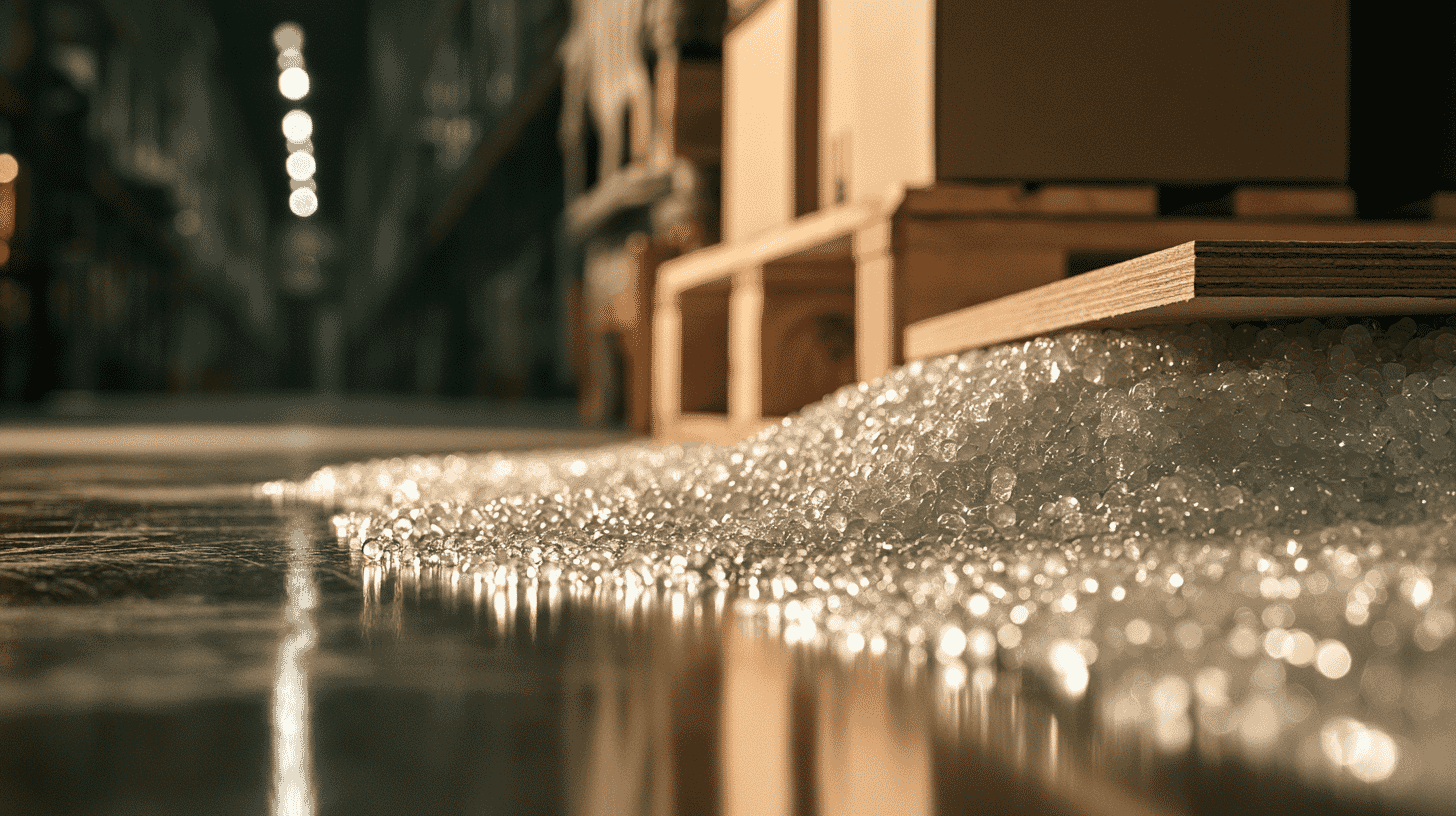
🏗️ Scatter sapphire grains across a warehouse floor, lay boards on top, stack your pallets as usual. That, a Japanese engineering team says, is enough to count as earthquake protection, with no base-isolation hardware involved. The grains cost a few hundred yen per square meter. The professor behind it says the boards are the expensive part.
The isolation layer broke in a four-year-old city hall
When the 2026 Kumamoto Earthquake struck on July 28, the city hall in Yatsushiro, Kumamoto Prefecture, which recorded shindo 6-upper on Japan's seven-point scale of local shaking intensity, was damaged. The building had been completed in 2022 and sits on base isolation.
Reporters from Nikkei xTECH visited on July 30 and found expansion joints in the isolation layer broken in several places, some of them fallen into the clearance gap. The building may be sitting on tens of centimeters of residual displacement, and the contractor is now investigating the devices below ground. Nothing collapsed. But the isolation layer, the part whose job is to absorb the movement, was itself broken.
Base isolation puts laminated rubber bearings or sliding supports between the ground and the building so that shaking never reaches the floors above. It works. The hardware is also expensive, and the maintenance is billed. And it is not a cure-all either, as Science Portal, run by the Japan Science and Technology Agency, noted in an article on August 17. The same article described a method that approaches the problem from the opposite direction.
Sapphire sand on the floor
The procedure is almost disappointingly plain. Scatter a spherical artificial aggregate across the warehouse floor. Lay base boards on top. Then load palletized goods the way you always have. No special device is involved.
The aggregate is sold under the name Espal. It comes from Yamakawa Sangyo, a maker of industrial specialty sands based in Amagasaki, Hyogo Prefecture. Its original job is as mold material for metal casting, a product with no connection to earthquakes whatsoever.
The material is sapphire. Because it lacks the purity to sell as a gemstone, Science Portal reports, it can be obtained relatively cheaply. The grains are close to perfect spheres, with smooth surfaces.

Source: Yamakawa Sangyo / Science Portal
Professor Kuniaki Yamagishi of Kanazawa Institute of Technology's Department of Architecture came across the sand in 2018. He had started the research in 2014 but could not find a material that slid the way he needed it to. He learned of the product through a casting-sand supplier, made an inquiry, and was given material free of charge. The project moved from there.
Stop resisting, start sliding
Ask anyone about earthquake protection and the instinct is to resist. Thicker columns, heavier walls. This method inverts that. It lets things slip at the right moment and bleeds the force away instead. In Japanese structural terms it counts as response control, not base isolation.
The boards shift a few centimeters across the floor. That reduces the force reaching the goods, and it also reduces the seismic force transmitted into the building frame. Because it protects cargo and structure at the same time, Yamagishi calls it the slide effect.
The difficulty is not sliding too easily. Move at the slightest tremor and the load topples; refuse to move and the energy has nowhere to go. Yamagishi ran repeated tests across combinations of base boards and floor finishes, and found that grains between 50 and 425 micrometers worked best. Changing the grain size changes when sliding begins, so the mix can be tuned floor by floor to suit a particular warehouse.

Source: Kanazawa Institute of Technology / Science Portal
In tests that simulated an earthquake, loads at around shindo 5 barely moved at all. At shindo 6-lower they travelled a few millimeters to a few centimeters, and nothing came down.
The boards cost more than the sand
The aggregate comes to a few hundred yen per square meter, which at the roughly 158 yen to the dollar of August 2026 is a matter of a few dollars. The boards laid on top cost more than the grains underneath them.
Less seismic force in the frame also means slimmer columns and beams. Kanazawa Institute of Technology calculates a reduction of roughly 5 to 10 percent in the weight of structural members, based on a five-story steel moment-frame building of about 44,000 square meters. Rising construction costs are themselves now a burden on putting up new warehouses in Japan.
Existing warehouses can be retrofitted too. The system sits on the floor that is already there, so no major renovation is required and the warehouse can keep operating during installation.
It does not work in a single-story shed
There are limits. The method only produces its effect in buildings of two stories or more. In a single-story warehouse the slide effect simply does not arise.
As of August 2026, performance evaluation and certification are still ahead, as are field trials with logistics operators. Yamagishi says the installation cost is low while the effect rivals that of base-isolation hardware. That comparison is, for now, the university's own view rather than a third-party certification.
The idea of letting a floor slide to shed shaking is not new either. THK and others already sell isolation hardware that can be fitted to warehouse racking or floors after the fact. What differs here is that the sliding surface is bulk industrial sand rather than a manufactured device, and that the method aims to lighten the load on the building frame at the same time as protecting the cargo.
This is not a sudden brainwave, though. Yamagishi has been publishing peer-reviewed work on reducing seismic response through sliding cargo since 2017, and presented warehouse floor-sliding papers at the World Conference on Earthquake Engineering in both 2021 and 2024.
From one earthquake country to another
Japanese earthquake protection has been built on the assumption that specialized hardware exists and that somebody can pay for it. Not every earthquake-prone country can assume both.
Yamagishi is already looking that way. From April 2020 to March 2023 he held a Japan Society for the Promotion of Science grant for basic research on vibration-reducing foundation methods aimed at business continuity in developing ASEAN countries.
Nobody lives in a warehouse, which is exactly why its earthquake performance gets postponed. Yet when a warehouse stops, deliveries stop, factories wait for parts, and shelves empty. The people who suffer are the ones who were never inside the building.
How well protected are the distribution centers in your country against earthquakes and other disasters? Or do you live somewhere that never has to think about it?
References
- https://www.kanazawa-it.ac.jp/kitnews/2026/0707_yamagishi.html
- https://scienceportal.jst.go.jp/newsflash/20260817_n01/
- https://researchmap.jp/read0144162
- https://xtech.nikkei.com/atcl/nxt/column/18/03703/073000023/
- https://www.kumesekkei.co.jp/project/0421.html
- https://www.thk.com/opm/logistics/menshin/






Global Discussion
3 comments