🐈 Cats have a reputation for keeping their feelings to themselves. A team from Kyoto University and Azabu University went looking for those feelings somewhere less obvious: in urine. In homes where the owner had more oxytocin, the cat tended to have more too. And owners whose cats had higher oxytocin reported less anger and anxiety. What the study can't say yet is which way any of this runs.
How do you measure a bond at home?
The researchers recruited 19 owners through social media and flyers, aged 18 to 60 (16 women and 3 men), along with their 29 cats, who ranged from 4 months to 13 years old. Each household took part for one month.
During that month, urine was collected from each owner and each cat 3 times. The lab measured two hormones in it. Oxytocin is often called the bonding hormone because it is linked to attachment between parents and children. Cortisol is a common marker of stress. No usable sample came from 5 of the cats, so 24 pairs made it into the hormone analysis.
The team also tracked how close owners and cats actually stayed on ordinary days. Each cat wore a small Bluetooth Low Energy (BLE) beacon on its collar, and the owner's smartphone logged the signal strength continuously for the whole month, a rough gauge of distance inside the home. Owners filled out a standard mood questionnaire (a short Japanese version of POMS2). The cats took a simple behavior test: the owner or a stranger sat inside a circle on the floor, and the researchers watched whether the cat came in.
Cat urine has turned up in other research too: an Iwate University-led team recently identified candidate compounds in it for a cat's "scent calling card," a story we covered here.
When owners ran higher, so did their cats
Cats living with high-oxytocin owners tended to have higher oxytocin themselves. Owners with higher cortisol, on the other hand, tended to have cats with lower oxytocin. The cortisol readings of the two did not line up.
To the team's knowledge, this is the first study to show a link between cat and owner oxytocin in a natural home setting. According to the universities, earlier cat research measured hormones in only the cat or only the owner, and none had measured oxytocin in both cat and owner over a period of weeks.
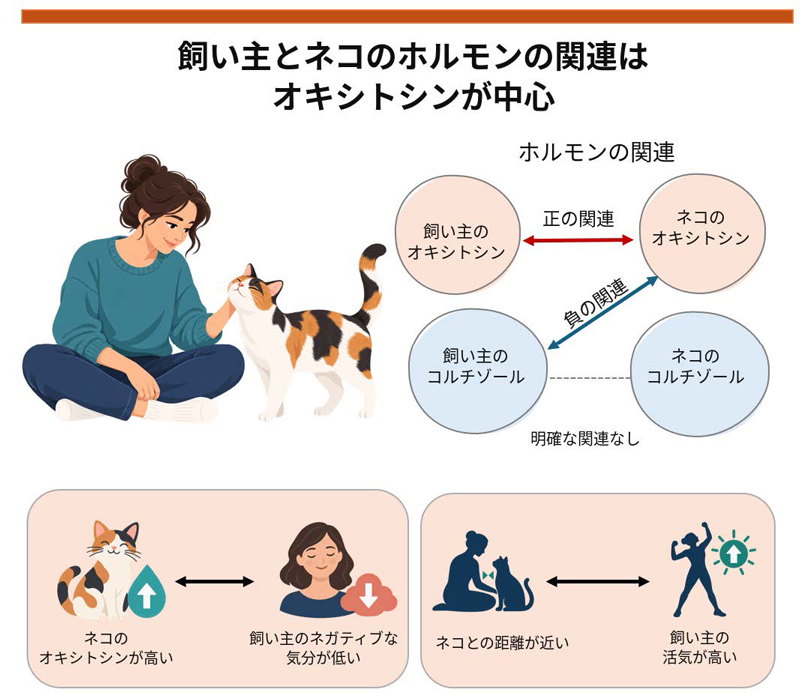
Source: Takagi et al., 2026, iScience (Japanese version published by Kyoto University, CC BY 4.0)
The cat's hormones and the owner's mood
Owners whose cats had higher oxytocin scored lower on four negative scales: anger-hostility, confusion-bewilderment, depression-dejection and tension-anxiety. The owners' own cortisol mattered too. The higher it was, the worse their negative mood.
Lead author Saho Takagi, a program-specific assistant professor at Kyoto University's Hakubi Center, said she found it interesting that the cat's oxytocin predicted the owner's negative mood better than the owner's own oxytocin did. Her guess: indoor cats are always at home, so their physiology may reflect the relationship more closely.
Owners who were physically nearer their cats for more of the day scored higher on vigor-activity, the questionnaire's measure of energy. How long they had lived with the cat showed no such link. The universities read this as a hint that daily closeness may matter more than simply owning a cat, which may be one reason studies of cats and human health have been less consistent than studies of dogs.
The cats' behavior fit as well. Cats with more oxytocin stepped into the circle and approached the seated person more readily, whether it was their owner or a stranger.
Dogs gaze. What do cats do?
In 2015, an Azabu University team that included Miho Nagasawa and Takefumi Kikusui, both co-authors of the new paper, reported in Science that gazing drives oxytocin in dogs and owners. Among 30 dog-owner pairs, in the group whose dogs looked at their owners a lot during a 30-minute session, urinary oxytocin rose in both dog and human. In the group that gazed little, nothing changed. In 11 pairs of hand-raised wolves and their handlers, the wolves barely looked at their handlers, and neither side showed a change.
Cats have been harder to pin down. A 2021 study in PeerJ asked 30 women in the United States to spend 15 minutes with their cats. Overall, oxytocin in their saliva did not change compared with reading a book. But it moved with certain moments: it was higher with petting and when the cat started the approach, and lower when the cat turned aggressive.
The Japanese study looked at a month of ordinary living instead of a short session in which the owner tries to engage. The universities suggest the cat-human bond may run mainly through oxytocin, while dog studies have also found shared patterns in stress hormones. That could reflect the cat's different path to domestication, and the fact that the dog's ancestors lived in packs while the cat's were largely solitary.
Japan keeps more pet cats than dogs: about 8.85 million cats against about 6.82 million dogs, according to Pet Food Association figures cited by Kyoto University.
What the study can't tell us yet
Takagi stressed that what they found is an association, and that which one drives the other is still unknown.
The arrow could point either way. Time near a cat might lift an owner's mood, or owners who already feel good might simply spend more time with their cats. And because cats and owners share a home, part of the hormone link could come from shared conditions, such as daily rhythms and the living environment, rather than from their interactions.
The study was exploratory and was not preregistered. It was small, and most owners were women. With 3 urine samples each, it captures associations at points in time, not a month of hormones rising and falling together. The universities' announcement also does not say how strong the links were. As of October 2026, the team plans studies that take repeated measurements from cats and owners at the same moments, plus experiments, with a more varied group of participants.
Dogs have their long stare. What plays that role for cats is still an open question. In your country, do cat owners say their cats notice their moods?








Global Discussion
4 comments