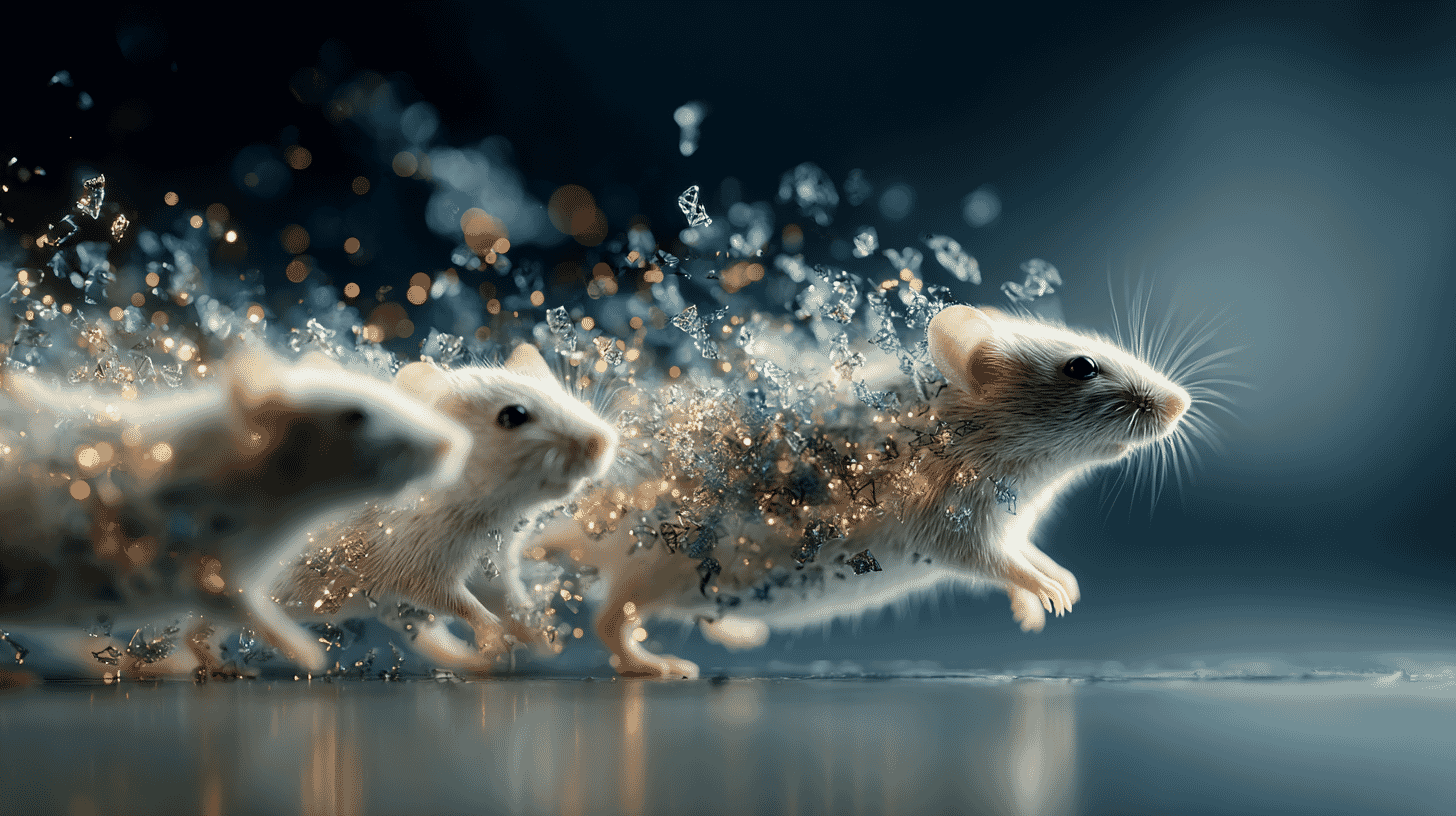
What happens when you clone a clone of a clone, 58 times over? A Japanese research team spent 20 years finding out. Starting with a single mouse, they produced over 1,200 clones across 58 generations. Every clone in the final generation died the day after birth. The result offers the first hard proof that mammals simply cannot sustain themselves through cloning alone.
A 20-Year Experiment Spanning 58 Generations
In 2005, a team led by Professor Teruhiko Wakayama at the University of Yamanashi in Japan began an ambitious experiment: take a single female mouse, create a clone from its body cells using nuclear transfer, then clone that clone, and repeat the cycle indefinitely. Working at a pace of three to four generations per year, the team continued this serial re-cloning experiment for roughly 20 years, producing 58 generations and a total of 1,206 cloned mice by 2025.
The fundamental question driving the experiment was simple yet profound: can mammals sustain their species through cloning (asexual reproduction) alone? Plants and some simpler organisms can reproduce asexually without issue, but no one had ever tested whether mammals could do the same over many generations.
The study, conducted in collaboration with the Radiation Effects Research Foundation (RERF) in Hiroshima, was published in Nature Communications in March 2026.
The First 25 Generations Looked Promising
Initially, the results were encouraging. The cloning success rate started at 7.4% for the first generation and actually improved over time, reaching 15.5% by the 26th generation. In 2013, when the team published results from their first 25 generations, they concluded that serial cloning might be possible indefinitely.
The cloned mice appeared perfectly healthy, with normal lifespans and no visible abnormalities. On the surface, making copies of copies of copies seemed to work just fine.
Generation 27: The Turning Point
But around the 27th generation, things started to go wrong. The cloning success rate began a steady decline. When the team sequenced the genomes of clones from various generations, they discovered why: "heavy mutations", large-scale chromosomal abnormalities and lethal genetic changes, were rapidly accumulating.
The data revealed that cloned mice carried roughly three times more mutations than mice born through natural mating. Each generation of cloning added approximately 70 point mutations and 1.5 structural variations (deletions, inversions, insertions, duplications, and chromosome translocations). One particularly alarming finding was that some clones had lost an entire copy of their X chromosome. Since female mammals carry two X chromosomes, losing one is a serious genetic blow.
Generation 58: The End of the Line
By the 57th generation, the cloning success rate had plummeted to just 0.6%, yet the mice that survived were still healthy and lived normal lifespans. The 58th generation, however, was a different story entirely. Every clone born in that final generation died the day after birth, despite showing no visible physical abnormalities.
"There were no visible abnormalities in the pups, and the cause of death is unknown," Wakayama said. The accumulated burden of mutations had apparently crossed a threshold incompatible with life.
Muller's Ratchet: Proven in Mammals for the First Time
The results provide the first experimental evidence in mammals for "Muller's ratchet," a theory in evolutionary biology proposed decades ago. The concept works like a ratchet, a gear that only turns in one direction. In asexually reproducing populations, harmful mutations can only accumulate over generations because there is no mechanism to eliminate them. Every defective gene gets passed directly to the next generation.
Sexual reproduction, by contrast, provides a reset mechanism. When two parents contribute genetic material, the process of meiosis (cell division that produces eggs and sperm) and fertilization can shuffle, repair, and eliminate harmful mutations.
Remarkably, even the late-generation clones still had functional reproductive organs. When 50th- and 55th-generation clone females were mated with normal males, fertilization succeeded, though litter sizes were dramatically smaller. But when the offspring of those matings were bred with normal mice again, litter sizes bounced back to normal. This strongly suggests that sexual reproduction acts as a genetic "reset button."
In comparison, mice maintained through natural breeding for over 60 generations showed no decline in fertility or survival whatsoever, a stark contrast to the cloned lineage.
From Dolly to Generation 58: Three Decades of Cloning
It has been nearly 30 years since Dolly the Sheep was born at Scotland's Roslin Institute in 1996, becoming the first mammal cloned from an adult cell. Since then, cloning technology has advanced significantly.
Wakayama's team used a compound called trichostatin A (TSA), an epigenetic modification reagent, to boost cloning success rates throughout the experiment. Even for 51st-generation clones, TSA tripled the success rate (5.4% with TSA vs. 1.6% without). However, the reagent could not prevent the underlying accumulation of mutations.
Today, cloning technology is used for breeding elite livestock, conserving endangered species, and even cloning beloved pets. This study makes clear, however, that current nuclear transfer technology has a fundamental flaw: it introduces DNA mutations at a rate far higher than natural reproduction.
Connections to iPS Cell Research
This research also has implications for induced pluripotent stem cell (iPS cell) technology, which won Japanese scientist Shinya Yamanaka the Nobel Prize in 2012. iPS cells are created by "reprogramming" ordinary body cells back to a stem-cell-like state, and concerns have long existed about mutations introduced during reprogramming.
The finding that repeatedly resetting cell nuclei accumulates mutations is directly relevant to regenerative medicine. When iPS cells derived from a patient's own body are used for treatment, the question of how many rounds of culture and passage remain safe becomes critically important.
What Comes Next
"We had believed that we could create an infinite number of clones. That is why these results are so disappointing," Wakayama said. "At this point, we have no ideas for overcoming this limitation. I believe we need to develop a new method that fundamentally improves nuclear transfer technology."
For conservation of endangered species and preservation of valuable genetic material, serial cloning remains essential. But achieving it safely will require developing nuclear transfer methods that do not introduce harmful mutations.
This study is a powerful reminder of why mammals evolved sexual reproduction over millions of years, to refresh and repair their genetic code. Just as photocopying a photocopy over and over degrades image quality, copying life has its limits. Nature, it turns out, had very good reasons for the way it designed things.
How does your country view cloning technology? What do people think about cloning pets, reviving extinct species, or using clones for conservation? We'd love to hear your perspective.







Global Discussion
15 comments