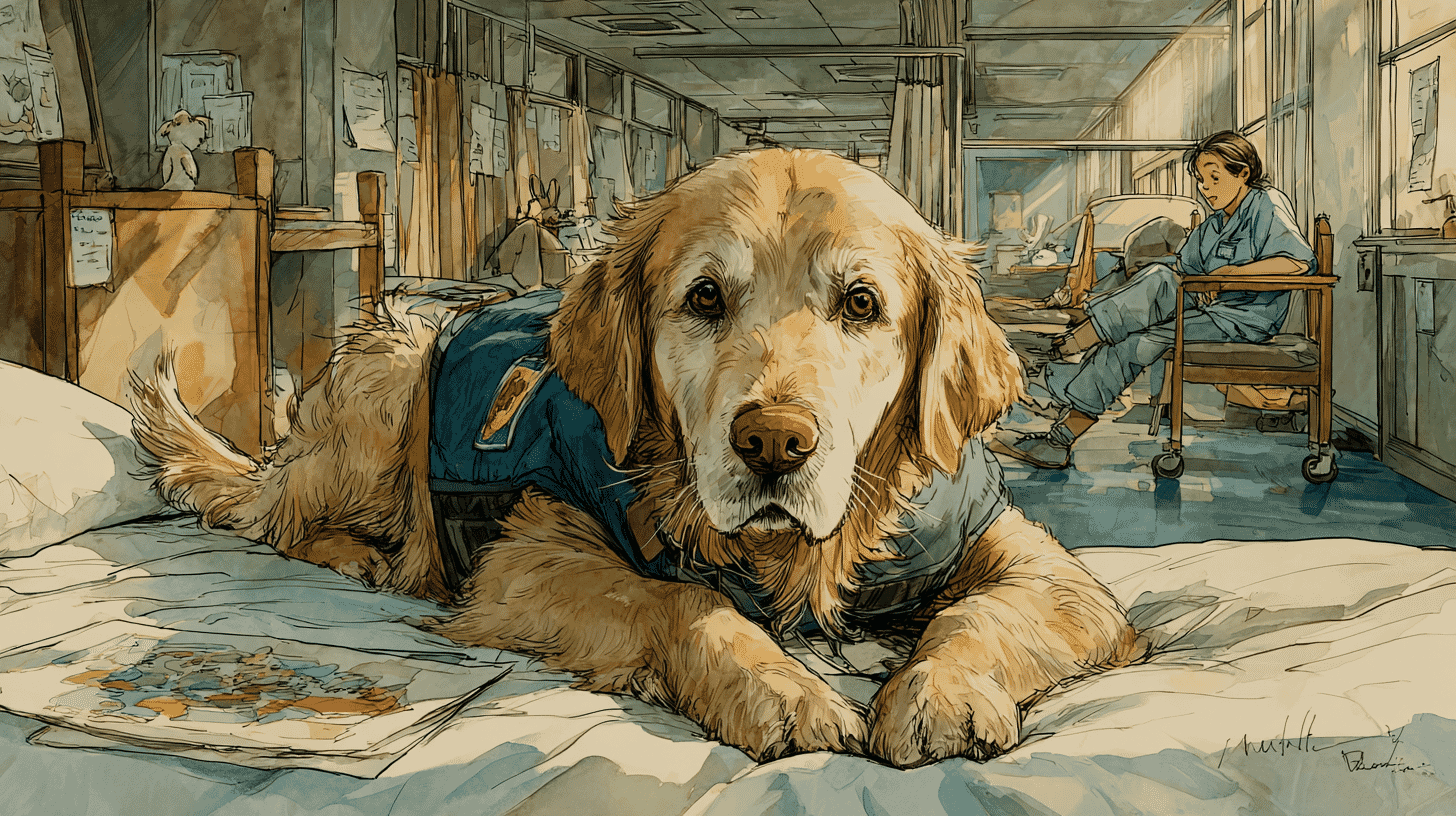
🐕 At a handful of Japanese children's hospitals, a dog reports to work every weekday, just like the doctors and nurses. "Hospital Facility Dogs" are specially trained canines who clock in five days a week at a single pediatric hospital, pairing up with a nurse-handler as part of the medical team. Japan launched the program in 2010 with just one dog at one hospital. By fiscal 2027, the country will reach seven teams nationwide, a slow but steady expansion now backed by crowdfunding and corporate partners willing to help cover the roughly $76,000-per-dog annual price tag.
What is a "facility dog," and how is it different from a therapy dog?
The term "facility dog" refers to a service dog trained to work in a specific institution. In Japan, the certified NPO Shine On! Kids has built its entire Hospital Facility Dog Program around children's hospitals specifically.
The key difference from a therapy dog is consistency. Therapy dogs typically visit hospitals occasionally and interact with patients in short sessions. A facility dog, by contrast, is always paired with a specifically trained handler, a medical professional, and shows up at the same hospital five days a week, every week.
That continuity is the entire point, says Yuko Morita of Shine On! Kids: "The fact that the same dog is always there, and that children can spend long stretches of time with that dog over and over, becomes a real emotional anchor for kids going through hospitalization."
The model itself isn't Japanese in origin. Facility dogs spread across the United States starting around 2000, expanding beyond hospitals into special education classrooms and even courtrooms (where they support child witnesses giving testimony). Japan's first hospital facility dog, a golden retriever named Bailey, started work at Shizuoka Children's Hospital in 2010, roughly a decade after the U.S. model took hold.
Creating "time when you don't have to be brave"
The job description is broader than it sounds. Facility dogs cheer on kids who hate taking medicine, sit with patients whose appetite has dropped, accompany children into examination rooms and operating theaters, and assist with rehabilitation. The nurse-handler designs the interaction around each child's medical condition and emotional state, with the dog working as a fellow team member rather than a visiting comfort animal.
The on-the-ground stories are striking. At Tokyo's National Center for Child Health and Development, a Labrador named Masa is reported to have prompted a bedridden child to stand up and walk, something the rehabilitation staff had been unable to coax out of the child.
A young girl currently battling a serious illness, interviewed by Japan's withnews (a digital outlet from Asahi Shimbun), described the dogs as "an emotional pillar." Years of IV treatments have left her veins fragile, so each new IV line takes a long time to insert and causes intense pain that can persist for 24 hours afterward. "When the facility dog comes," she said, "I can finally think to myself: for this little while, I don't have to be brave."
The dogs are trained to handle the full clinical environment, including the ICU, says Shinya Kawasaki, who oversees their training at Shine On! Kids. He notes that the dogs end up brightening the day not just for patients, but for families, doctors, nurses, and even the administrative staff working the hospital corridors.
From 4 dogs to 7: the 2027 expansion
Sixteen years after Bailey's debut in Shizuoka, four Japanese hospitals currently have a full-time facility dog. The next chapter is finally taking shape.
Starting in April 2026, two new teams entered a trial phase at Hyogo Prefectural Kobe Children's Hospital and another partner site. Tsukuba University Hospital is scheduled to bring on its own facility dog from fiscal 2027. If everything stays on track, Japan will reach seven facility dog teams (seven dogs across seven hospitals) by next fiscal year.
Shine On! Kids has set a longer-term goal of placing a facility dog at every one of Japan's 15 pediatric cancer hub hospitals. That's a slower pace than the United States, where the model has had a quarter-century to mature, but the careful expansion reflects the level of specialization required.
"Facility dogs need training on a par with guide dogs or service dogs," Kawasaki says. Shine On! Kids' dogs go through 18 to 24 months of training built around international assistance-dog standards before they ever set paw in a hospital ward.
The ¥12 million wall, and the support starting to fill it
The biggest obstacle to expansion is, predictably, money. Facility dog activities aren't covered under Japan's national health insurance system. Counting handler salaries, veterinary care, and operating costs, running one facility dog team comes to roughly ¥12 million (about $76,000) per year.
What's changing is the funding ecosystem.
When Tsukuba University Hospital launched a crowdfunding campaign to cover its initial setup plus operating costs, it set a first-target goal of ¥22 million (about $140,000). Donors cleared it almost immediately; the target was raised twice to ¥45 million, and the campaign still closed at over ¥57 million. The Japanese public's appetite for supporting animal-assisted medicine has finally translated into concrete money.
Corporate partners are stepping up too. Osaka-based outdoor brand Montbell co-developed a working vest with Shine On! Kids, specifically designed for facility dogs. Because the dogs spend their days being touched and hugged by kids, the vest had to balance fabric thickness, softness, and ease of putting on and taking off. Montbell donated 77 of the vests through its "Montbell Club Fund."
Shine On! Kids is also working on a longer-term play: gathering clinical-effectiveness data so that, eventually, facility dog programs might qualify for reimbursement under Japan's medical fee system. If that happens, the funding model could shift from charity-dependent to sustainable.
Why expansion is happening now
The pace from Bailey's 2010 debut to seven teams in 2027 looks slow on paper, but several forces are converging right now.
First, multi-generation experience matters. Japan has now lived through retirement cycles: Bailey's generation has aged out, successor dogs have been placed, and the operational know-how has accumulated. Second, Shine On! Kids launched a domestic training program in 2019, meaning Japan is no longer fully dependent on dogs imported from Assistance Dogs of Hawaii. The supply chain is becoming sustainable on home soil.
There's also a cultural shift worth noting. The pandemic forced Japan to reckon, on a national scale, with what isolation does to people, especially children stuck inside. In that context, the value of a creature whose entire job is to be reliably, predictably present has become easier for hospitals, donors, and the general public to articulate.
What's it like in your country?
In the United States, the same model has had 25 years to grow. Facility dogs work in pediatric hospitals, rehabilitation centers, special education programs, and courtrooms as a matter of routine. Japan, by comparison, has spent 16 years carefully building from one dog to seven, a layered ecosystem of hospitals, families, breeders, trainers, corporations, and individual donors all slotting into place.
Stationing a dog at a children's hospital, five days a week, for years on end, to make treatment a little less terrifying. Is this kind of program common where you live? Whether it's therapy animals at hospitals, assistance dogs in classrooms, or comfort animals in courtrooms, we'd love to hear how the role of animals in care looks in your country.
References
- https://news.yahoo.co.jp/articles/ba51bf9eca4fd39e29e3cd2f2ee5a9d72f98becf
- https://sokids.org/what-we-do/hospital-facility-dogs/
- https://en.nippon-foundation.or.jp/news/articles/2023/20230405-89193.html
- https://japantoday.com/category/national/feature-japan's-hospital-dogs-bring-moments-of-normalcy-to-seriously-ill-children









Global Discussion
14 comments