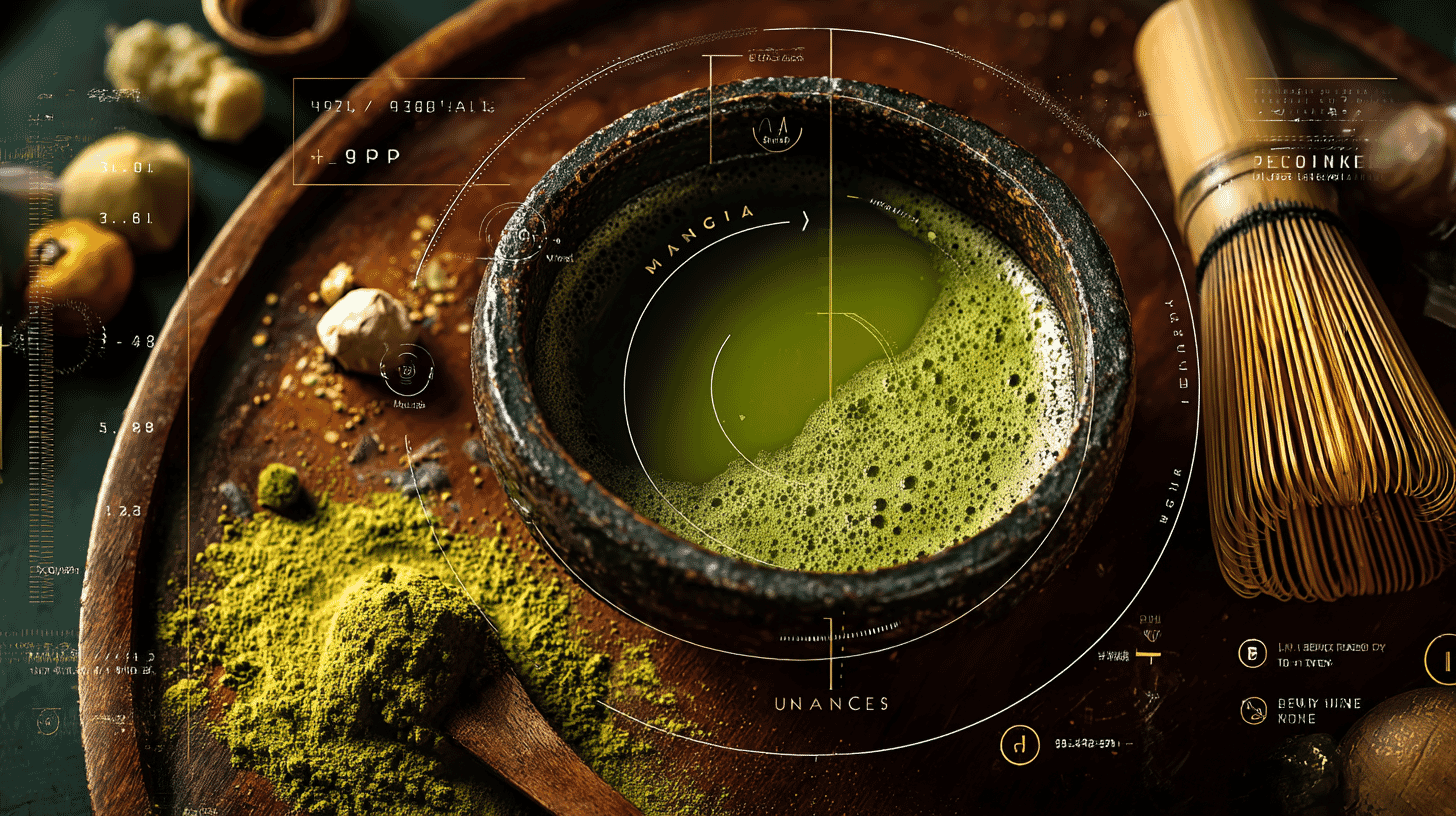
The global matcha market is worth roughly $4.4 billion in 2026, yet until now, no international body has ever formally defined what "matcha" actually is. On April 22, 2026, that changed. The world's first international matcha industry association, the International Matcha Association (IMA), launched in Tokyo. At its helm: a 28-year-old tea master who inherited the ceremonial name "Soryo" from Urasenke, Japan's oldest tea ceremony school. On its board: the CEO of the Specialty Coffee Association, a UC Davis tea scholar, and the founder of Italy's Future Food Institute. After years of runaway global growth, matcha is finally entering a new phase: governance.
No Universal Definition of "Matcha": Until Now
The hashtag #matcha has racked up billions of views on TikTok. Starbucks matcha lattes are a global staple. Yet no internationally recognized definition of "matcha" has ever existed.
Within Japan, the Japan Tea Federation defines matcha as a fine powder stone-ground from tencha, tea leaves grown under shade covers, steamed without rolling, and dried flat. China established its own national standard (GB/T 34778-2017) in 2017, applying the term to Chinese-produced shaded-tea powders. European and American markets have no official definition at all.
This regulatory vacuum has produced chaos. Green-colored powders dyed for vibrance, powdered teas skipping the shade-cultivation step, green tea powders produced outside Japan, all of these circulate worldwide labeled as "MATCHA," with consumers having virtually no way to tell them apart from the real thing.
The Founding Board Is Unusual: Deliberately So
The driving force behind IMA is Ryo Iwamoto, 28, CEO of Tokyo-based tea company TeaRoom. Born in 1997, he began studying tea ceremony at age 9 under the Urasenke school, founded TeaRoom at 21 while still a university student, and took over a tea plantation and processing facility in Shizuoka Prefecture's Hongyama region in 2020. Urasenke bestowed on him the rare ceremonial name "Iwamoto Soryo" at an unusually young age.
The board he has assembled deliberately steps outside the traditional Japanese tea industry.
Yannis Apostolopoulos serves as CEO of the Specialty Coffee Association (SCA), the world's largest specialty coffee trade body. He is the figure who helped globalize the "specialty" concept in coffee, now bringing that playbook to matcha.
Katharine P. Burnett founded the Global Tea Institute (GTI) at UC Davis, a world-leading academic platform for tea research. She also holds a professorship in Chinese art history, bringing a rare cross-cultural scholarly lens to tea.
Sara Roversi is the founder of Italy's Future Food Institute, a global ecosystem for food sustainability education. She is internationally recognized for her work on regenerative food systems and the cultural significance of food.
Toshimi Nishi is the representative director of Nishi Tea Factory, one of Japan's leading organic matcha producers. He has demonstrated that scale, organic cultivation, and premium quality can coexist, a vital on-the-ground production voice.
Coffee industry leadership, academia, food sustainability, and frontline tea production: no matcha governance body has ever brought these four worlds together.
Three Structural Problems IMA Was Built to Address
IMA's founding document identifies three structural challenges at the core of its mission.
1. The supply-demand gap is widening
Domestic production of tencha, the raw leaf that becomes matcha, doubled from 2,736 tons in 2020 to 5,336 tons in 2024. Even so, supply cannot keep up with global demand. Major production regions like Uji, Nishio, and Kagoshima are operating under chronic strain.
2. No common definitions or standards
As noted above, there is no official international definition of matcha, nor is there a grading system. Unlike single-origin coffee, there is also no established traceability infrastructure.
3. Rising counterfeits and mislabeling
In cafes across Europe, the US, and Southeast Asia, green powders colored with additives, non-Japanese teas marketed as Japanese, and tea powders that were never shade-grown continue to be sold as "matcha." Consumers have almost no tools to connect price to actual quality.
IMA's Five Core Activities
According to its articles of incorporation, IMA will pursue five core activities:
- Research and development of international definitions, quality standards, and grading systems for matcha
- Collection, analysis, and evaluation of global information on matcha production, distribution, and consumption
- Education, training, and professional certification programs
- Organization of international conferences, exhibitions, and awards
- International communication, dialogue facilitation, and cross-border cooperation
The template is unmistakable: SCA's role in the coffee industry, international cupping protocols, barista certifications, events like World of Coffee, is being adapted for matcha.
The Specialty Coffee Model
Apostolopoulos, the SCA CEO, offered a telling comment at IMA's launch: "In specialty coffee, we have spent a long time asking what truly makes something 'special.' Building a shared language, trustworthy frameworks, and deep professional education brings sustained value to an industry."
The specialty coffee movement, which began in the 1980s, transformed coffee from a commodity into a craft product. International cupping standards, direct-trade models connecting growers and buyers, and professional barista certifications all emerged from this shift. The result: premium prices for quality beans, higher incomes for farmers, and stronger preservation of origin regions.
Can the same model work for matcha? That is the question at the heart of IMA's mission.
What This Means for Japanese Producers
Toshimi Nishi of Nishi Tea Factory offered a pointed warning: "Matcha cannot be sustained by popularity alone. If understanding of the realities facing production, quality, and origin regions doesn't grow alongside demand, the very foundation that gives matcha its value will erode."
Japanese tea farmers face a daily reality of aging workers, lack of successors, climate change, and difficult questions about appropriate scale. The explosion of global demand looks like a tailwind, but it brings with it serious risks: domestic supply exhaustion and quality control breakdowns. Properly defined international standards could help create a clearer division between a genuine-Japanese premium tier and a broader mass market (including overseas-produced alternatives).
The "Culture vs. Industry" Balance
Iwamoto, the new association's representative director, framed the challenge in more philosophical terms: "Matcha has never existed merely to be consumed. It has quietly woven relationships, between people, between humans and nature, and across time."
For Iwamoto, who has trained in Urasenke tea ceremony since age 9 and built his businesses on the philosophical foundations of chanoyu (the way of tea), IMA is not simple accommodation of matcha's globalization. If anything, it is a counterintuitive bet: that global governance can protect the cultural depth that runaway commodification threatens to flatten.
"Systems for growth. Trust for continuity." The phrase in IMA's founding declaration hints at a long-term vision beyond the current boom.
From Boom to Governance
kantenna.com has tracked the structural shifts in Japan's tea industry in depth: the global matcha boom, the 600% spike in bancha tea prices, the production arms race across regions, and the "matcha laundering" problem.
IMA's launch amounts to an industry-side response to all of these issues at once. Whether the body actually works will depend on the enforceability of the standards it develops, how effectively it engages overseas operators in Europe, China, and Southeast Asia, and whether it can coordinate with ISO and individual national governments.
Even SCA took more than twenty years to establish its international influence. The matcha industry's "IMA era" has only just begun. The opening move has been played, from Tokyo.
Does your country have an international body that protects the definition and quality of a regional food tradition that went globally viral? What do you think about a Japan-based organization setting the rules for something that has clearly become a worldwide phenomenon?
References
- https://prtimes.jp/main/html/rd/p/000000002.000181342.html
- https://matcha-association.org/
- https://www.thebusinessresearchcompany.com/report/matcha-global-market-report
- https://www.marketdataforecast.com/market-reports/matcha-market
- https://intelligence.coffee/2025/09/deconstructing-the-matcha-obsession/
- https://gjtea.org/jp/japanese-tea-innovators-17/








Global Discussion
14 comments