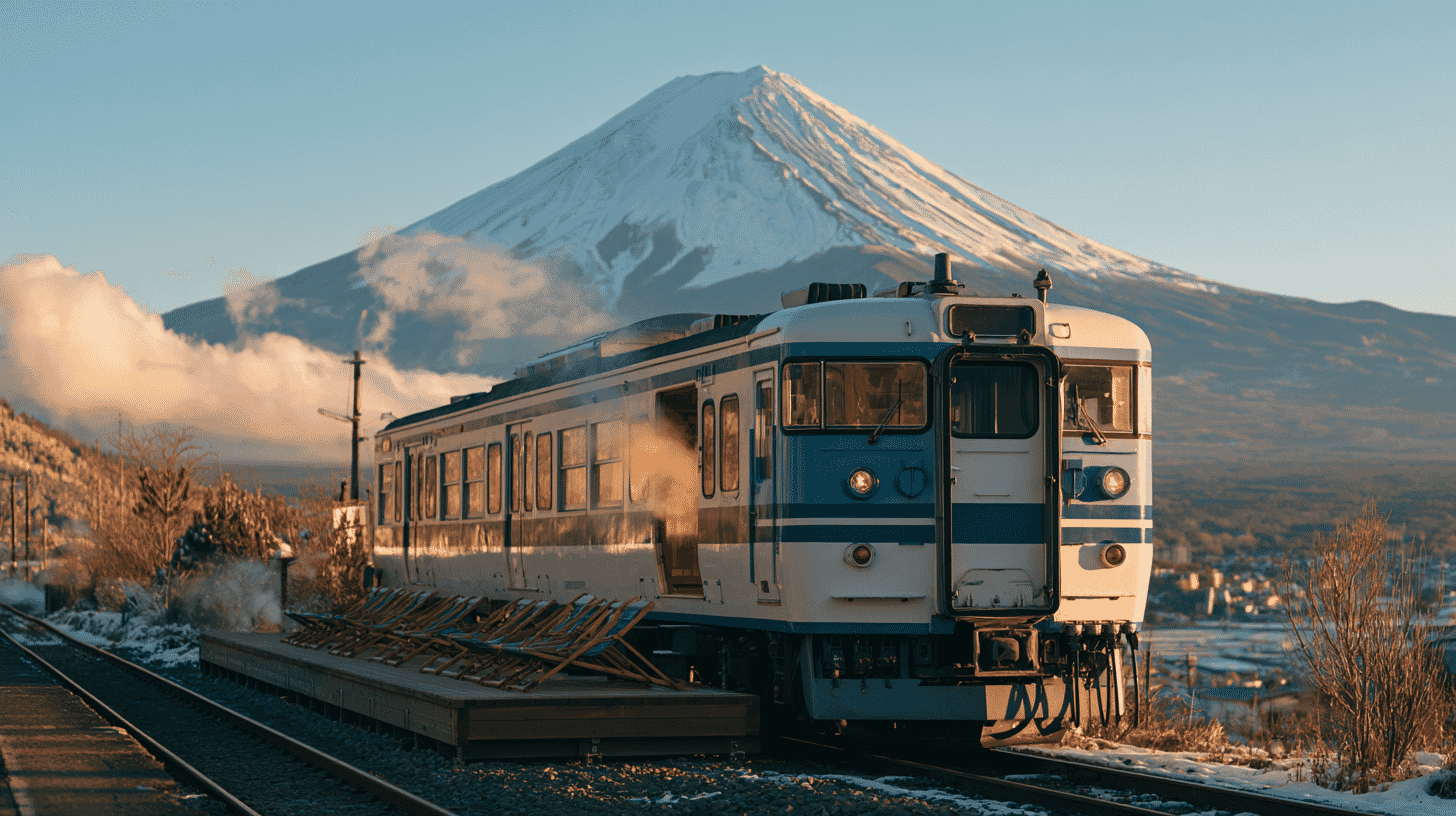
🚃 This December, a retired commuter train will sit on a track at a small station near Mt. Fuji with steam rising inside it. It will not move again. Not moving is the whole idea.
A sauna parked on the rails
Fujikyu, the transport and tourism group whose railway carries visitors to the northern foot of Mt. Fuji, is converting a retired train into a public sauna. The facility is called SADEN, a squashing together of sauna and densha, the Japanese word for train. It opens at Shimoyoshida Station in Fujiyoshida, Yamanashi Prefecture, in December 2026, with the exact date still to be announced. It will be run by PICA, the Fujikyu group's outdoor resort operator. According to Fujikyu's own research, nobody in Japan has previously turned a train that finished commercial service into a sauna.
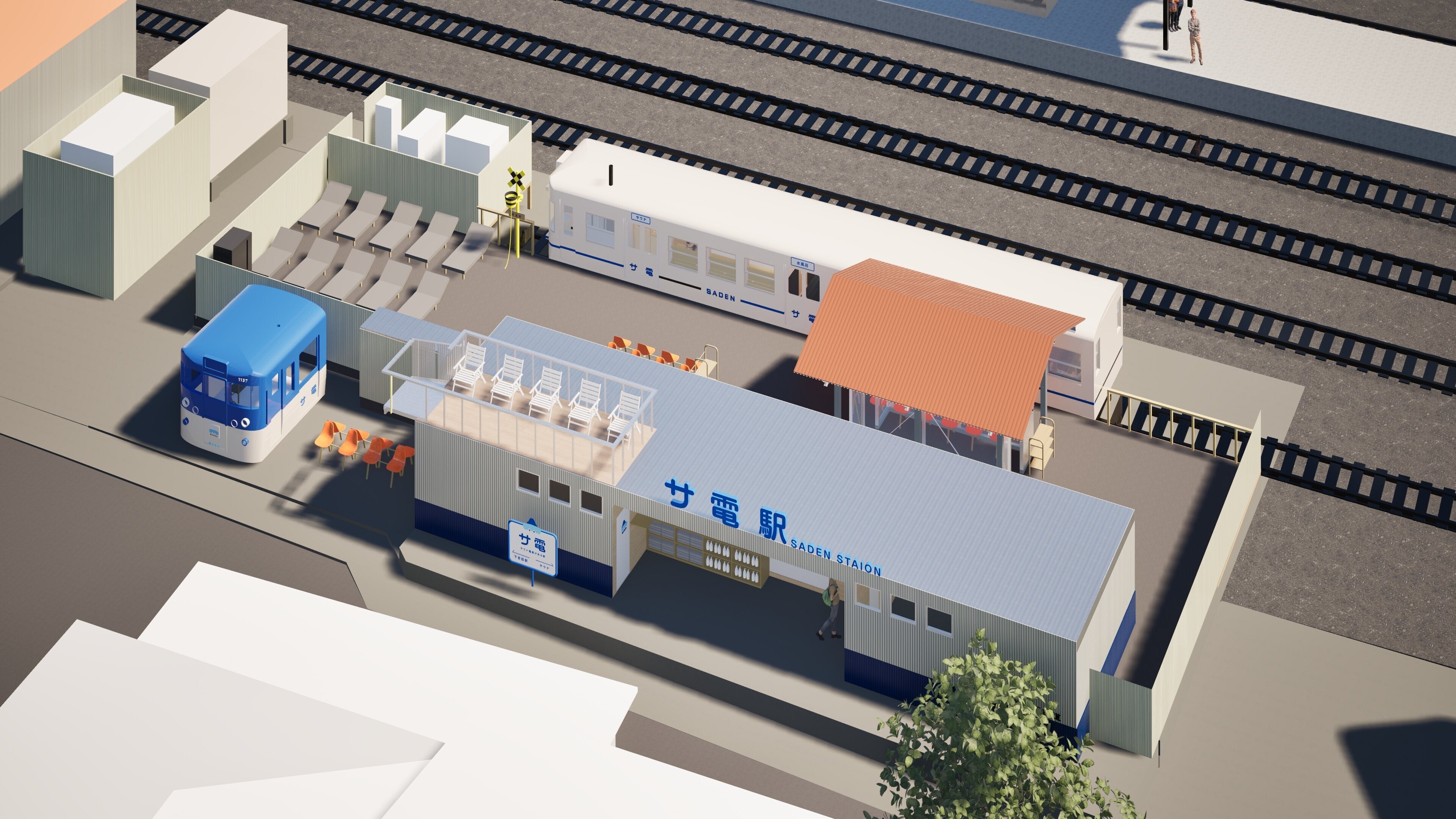
Source: Fujikyuko Co., Ltd. press release
The car in question is Series 1000, set 1001. It started out in Tokyo on the Keio Teito Electric Railway as part of the original 5000 series, which debuted in 1963, moved to the Fujikyuko Line in 1994, and worked there for three decades. In 2012 it was repainted into its old Keio colours, which made it a minor pilgrimage site for railway photographers. Its last scheduled run was on December 15, 2024.
Now it gets a white body with a blue stripe and a heater. The sauna room and the cold plunge both sit inside the car, on the rails, in the station. Alongside go a reception area and an indoor cool-down space styled like a platform, plus an outdoor lounging area facing Mt. Fuji. The driver's cab is being worked into the design rather than stripped out, and a speaker inside still carries the "KTR" monogram of the old Keio Teito Railway. The official site says plainly that SADEN is not going to run anywhere.
Why a sauna, and why inside a station
If you have only met the sauna as a tiled box at the gym, the Japanese version has grown into something more elaborate. Regulars talk about totonou, roughly "getting tuned", the floaty, level-headed calm that arrives after cycling between the hot room, a cold water bath and a spell of sitting outdoors doing very little. Sauna-Ikitai, the search site co-producing SADEN, lists over 15,000 sauna facilities across the country, and its users have logged more than ten million sessions.
What SADEN adds to that is noise. Shimoyoshida is a working station, so trains keep arriving while you sit in the heat, and Fujikyu is selling the sound and the vibration as part of the experience rather than apologising for them. One practical detail matters more to overseas visitors than it might sound: SADEN requires swimsuits and is open to men and women together. Most Japanese bathhouses and saunas separate the sexes and require you to be naked, which filters out a lot of first-time foreign guests.
Pricing has not been announced. Keiichiro Otsuka, a deputy editor on Kyodo News's business desk who covers rail travel, asked whether the fare might be set at ¥1,000 as a joke on the Series 1000 and was told the business would not survive on that. Given a hint that it would land in line with other sauna facilities, he estimates a base price of roughly ¥2,500 to ¥3,500, about US$16 to US$22.
The blue sleeper that vanished from the rendering
For fifteen years, the ground where SADEN is being built held a dark blue sleeping car. Suhanefu 14-20 is a Series 14 carriage built in 1972, back when Japanese National Railways ran the country's trains, and the type won that year's Blue Ribbon Award from the Japan Railfan Club. In service it worked the Hokuriku, an overnight express between Ueno in Tokyo and Kanazawa on the Sea of Japan coast, which was discontinued in 2010.
Carriages like this are known in Japan as Blue Trains, after the livery of the locomotive-hauled sleeper expresses that once ran the length of the country. Almost all of them are gone. Bullet trains got faster and overnight buses and budget airlines got cheaper, and the reason to spend twelve hours in a berth went with them.
Fujikyu acquired the carriage and opened the Shimoyoshida Blue Train Terrace in April 2011. A ticket cost ¥100, about 60 cents, for adults and children alike, and anyone travelling on the line got in free. Inside were the berths, 70 centimetres wide, upper and lower, the folding jump seats along the corridor, the drinking water cooler and the washbasin. On the front, the carriage carries the headmark of a different service altogether, the Fuji, which ran between Tokyo and Oita until March 2009, plus a side destination board reading Fuji, Nishi-Kagoshima, via the Nippo Line. Nishi-Kagoshima is now called Kagoshima-Chuo.
The terrace closed on April 17, 2026 for construction work in the station. The carriage was shunted to a temporary spot beside the station building, and then it dropped out of the SADEN rendering. Fans started asking online whether it was headed for the cutting torch.
Otsuka put the question to several people connected to the project. Scrapping, he was told, is not happening. Fujikyu will continue to own the carriage and is considering moving it to another station on the line to keep it on public display. Which station, nobody would say. He tried a couple of guesses, including Mt. Fuji Station two stops toward Kawaguchiko, on the grounds that a carriage wearing a "Fuji" headmark belongs there, and got nowhere. As of early August 2026 the destination has still not been announced.
The station's other preserved vehicles are staying where they are: a Series 5000 that Fujikyu ordered new in 1975 and which won the Japan Railfan Club's Laurel Prize the following year, the Series 2000 cab car of the first-generation Fujisan Express, and a wagon from the freight services the line dropped in 1978. One survivor is joining the sauna instead. The nose of a KuMoHa 169-27, built in 1969, has stood at the station in the orange-and-green "Shonan" colours of old national railway expresses. In the rendering, it has been repainted white and blue to match SADEN.
Why Shimoyoshida
Shimoyoshida is not a big station. National Land Numerical Information data from the Ministry of Land, Infrastructure, Transport and Tourism puts it at 1,851 passengers boarding and alighting per day in fiscal 2024, fourth on the Fujikyuko Line. According to Norimono News, though, it handles a lot of inbound tourist traffic.
Roughly thirty minutes uphill on foot is Arakurayama Sengen Park, where an observation deck lines up a five-storey pagoda, cherry blossom and Mt. Fuji in a single frame. The pagoda is not a temple building, incidentally, but a memorial to local war dead. The composition landed on the cover of the revised fourth edition of the Michelin Green Guide Japon, published in 2015, and the crowds followed. Trains from Shinjuku reach the station directly on the Fuji Excursion limited express. Fujikyu is putting a sauna right beside the station where those climbers get off.
What other countries do with dead trains
Reusing retired carriages is not a Japanese invention. One of the earliest well-documented examples is British, and it ran at scale. In 1933 the London and North Eastern Railway parked ten worn-out coaches at scenic country stations and rented them out as holiday accommodation. Rival companies copied the idea within two years. By 1935, according to accounts of British railway history, there were 215 of these "camping coaches" at 162 sites. Guests were expected to arrive by train, which was rather the point.
A rail carriage sauna is not unprecedented either. In Imatra, in south-eastern Finland, Wake Park runs a summer sauna inside an old cattle wagon on the bank of the Vuoksi River, where €10 per person buys an hour and you can drop straight into the river to cool down. Closer to Japan, the Singaporean government agency JTC and the startup Tiny Pod have turned a decommissioned MRT carriage into an eight-room co-living hotel in the one-north district. Japan has a closer case of its own. Sauna Metsa Oimachi Tracks, which opened in Tokyo in March 2026, contains a "tram sauna": the interior of a streetcar rebuilt in timber. That one is a replica rather than a real vehicle, which is where Fujikyu's claim to a national first rests.
What is unusual about SADEN is the combination: a train that carried commuters until 2024, left on its own rails inside a working station, rebuilt by the listed railway company that owned it as part of a corporate centenary. Fujikyu was founded in 1926 and turns 100 on September 18, 2026.
Every country ends up with trains it no longer needs. What changes is what each one does next. Where you live, do the old carriages get cut up, or has one of them turned into something else?
References
- https://prtimes.jp/main/html/rd/p/000002026.000001110.html
- https://saden.jp/
- https://trafficnews.jp/post/694981
- https://www.fujikyu-railway.jp/upload/file/2026/20260418001.pdf
- https://gosaimaa.com/en/train-sauna/
- https://www.jtc.gov.sg/about-jtc/news-and-stories/press-releases/singapores-first-train-carriage-co-living-hotel-to-open-at-launchpad-in-one-north
- https://www.theoldie.co.uk/blog/olden-life-what-were-railway-camping-coaches-by-bill-riley
- https://nlftp.mlit.go.jp/ksj/gml/datalist/KsjTmplt-S12-2024.html
- https://www.atpress.ne.jp/news/583315

Global Discussion
3 comments