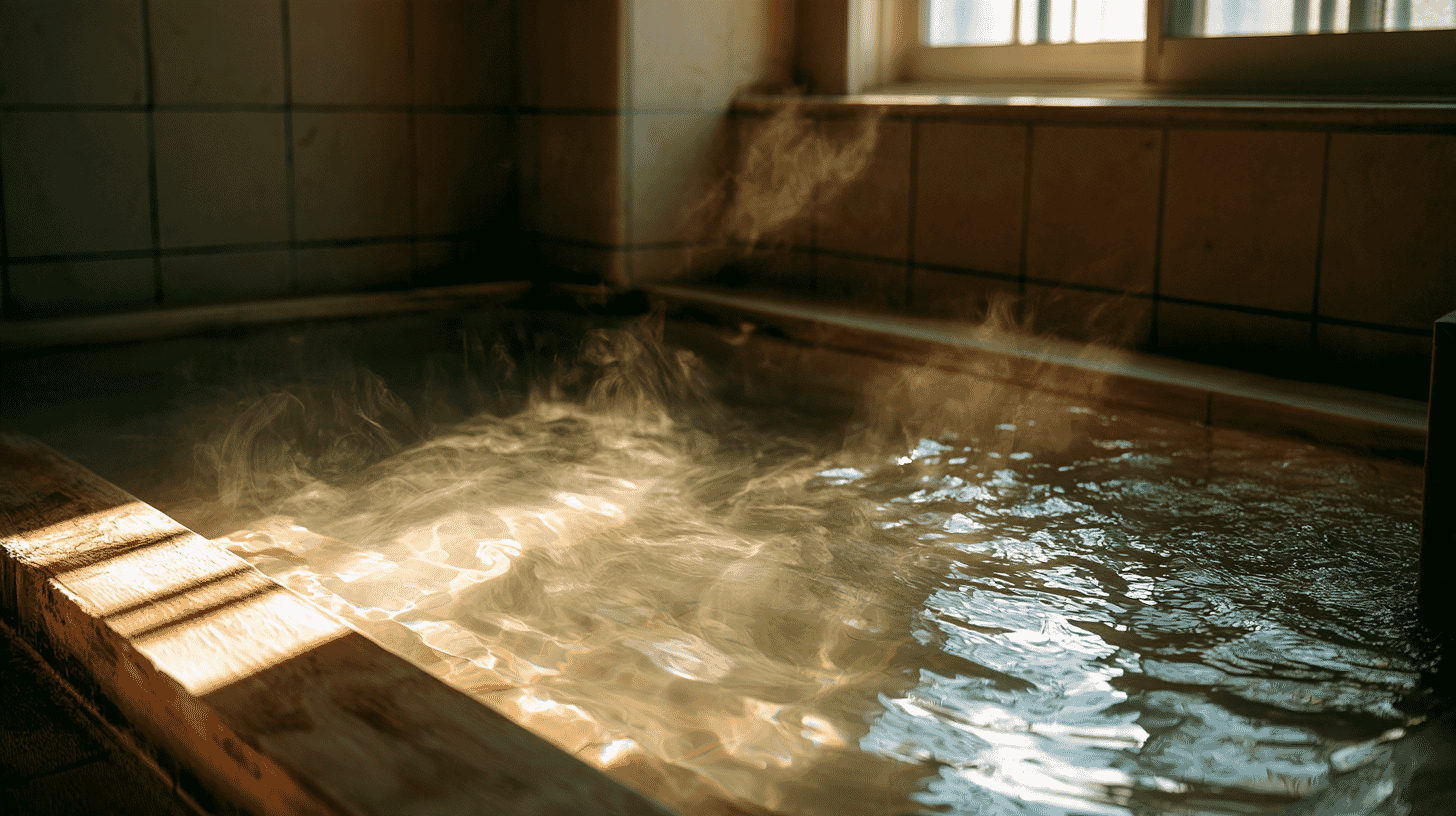
♨️ Climb into the bath at Toyotomi Onsen, about 40 kilometers (25 miles) south of Wakkanai at the top of Hokkaido, and the first thing you notice is the smell: petroleum. The water is pale yellow and cloudy, with oil drifting on the surface. Often called Japan's northernmost hot spring village, Toyotomi turned 100 on May 17, 2026. Leave the white towel at home.
They were looking for oil
The hot spring was an accident. According to a timeline published by the town's centennial committee, Murai Mining began surveying the area for oil in 1924 and started drilling in November 1925. Late on the night of May 17, 1926, water at 43°C (109°F) burst out of the well from about 960 meters (3,150 feet) down, along with natural gas.
By 1927, a thatched hut stood next to the well, and locals were soaking in a wooden tub for 5 sen a bath. That November, three Murai Mining executives took over the rights, built a bathhouse and opened it as Toyotomi Onsen.
The gas underground changed the town too. In 1932, a gas well dug near the spring fed a gas-engine power plant, and that December electricity reached the hot spring area and the town center, which the timeline marks as the start of electric power in Toyotomi. The town bought the hot spring company in 1958, and in 1988 today's town-run Fureai Center opened on the old bathhouse site.
Water with an oil slick
The official spring analysis on the town's website describes the water as pale yellow and cloudy, salty, and smelling of petroleum. It is an iodine-containing sodium chloride spring, and because it rises up the well with petroleum and natural gas, it contains oil.
A writer for Norimono News bathed at the Fureai Center in late September 2026 and described brownish, cloudy water, a strong smell of oil and a floor that felt slick with it. The center doesn't rent towels, and since the water can leave color and odor behind, he suggests buying one there. His own clothes came away clean, though he notes the water may change with the season.
The town's FAQ warns that underwear and clothes touching your skin will pick up the oil's smell and color, so bring things you don't mind ruining. The amount of mineral flakes and oil changes through the day, and for the first one to two hours after opening the water is, in the FAQ's words, very thick. In the long-stay bath, crude oil sits in pump bottles for guests to rub on their skin.
The tourists left, the long-stay guests stayed
According to a plan for the hot spring that Japan's Ministry of the Environment revised in January 2022, overnight guests peaked at about 130,000 in 1993, with tour groups from outside Hokkaido in summer and local farmers and fishermen soaking through the winter. By fiscal 2019, the figure had fallen to about 35,000. The plan blames the collapse of group travel after Japan's economic bubble burst, and the fading boom in trips to the far north and the outlying islands.
What remained was toji, the custom of staying at a hot spring for weeks to heal. The same plan estimates that of those roughly 35,000 overnight stays in fiscal 2019, about 14,000, or roughly 40 percent, came from guests treating skin conditions, mostly atopic dermatitis (eczema) and psoriasis. According to the timeline, a psoriasis patients' group first brought a tour to Toyotomi in 1993 and has come every year since.
The town built around them. The Fureai Center has a public health nurse, a nurse and an exercise instructor on staff, and in 2009 it opened a concierge desk to advise people planning long stays. According to the Environment Ministry plan, in July 2017 the center became the first facility in Hokkaido certified by Japan's health minister as a hot spring health-promotion facility, and it accounts for more than half of all users of such facilities nationwide. In an August 2020 message, the mayor wrote that a growing number of people end up moving to Toyotomi after a stay.
Three weeks, two or three baths a day
The town's FAQ says that, going by people who have come for eczema or psoriasis, about three weeks is typical. It recommends two or three baths a day, about 30 minutes each. Of the nine places to stay in the hot spring area, six are self-catering. There is no convenience store or supermarket nearby; groceries mean a trip to the town center about 5 km away. One ticket at the Fureai Center covers two baths a day. Since January 1992, Toyotomi has been one of Japan's officially designated health-resort hot springs, a list the government began in 1954 and which had 79 entries as of December 2025.
On what the water does, the Environment Ministry plan sticks to hearsay: the tar in the oil is said to calm skin inflammation. The town's website makes stronger claims, but its FAQ also lists warnings. Rubbing the crude oil straight onto the skin can be too harsh for people with eczema and make them itch. The thick water in the first hours after opening can make skin worse. Long soaks raise the risk of skin infections. And a stay is not a permanent fix: the FAQ says eczema symptoms often return within one to several weeks of going home.
Up to the neck in crude oil
According to a 2019 AFP report carried by Arab News, Naftalan, a spa town in Azerbaijan about 300 kilometers (185 miles) away from Baku, the capital, has bathers sit up to their necks in crude oil heated just above body temperature for about 10 minutes. At its 1980s peak, it drew upward of 70,000 people annually. The report also cited a 2017 book noting that Western doctors have condemned the medical use of crude oil as potentially carcinogenic.
Toyotomi's water itself is not crude oil; it is hot spring water that contains oil. The mayor describes Toyotomi as a spring said to be one of two in the world and the only one in Japan, but doesn't say where the other one is. Japan does have at least one other oil-scented spring: Niitsu Onsen in Niigata City draws on a source that surfaced during oil drilling, and the Niigata Prefectural Tourist Association lists a strong petroleum smell as its defining feature.
Getting there
The northernmost label applies to Toyotomi as a hot spring village; Wakkanai, farther north, has natural hot spring facilities of its own. According to the centennial site, Toyotomi is about five hours from Sapporo by train, then about 10 minutes by car from Toyotomi Station. From Wakkanai Airport it is about 50 minutes by car. The Fureai Center is open from 10 a.m. to 9 p.m. (last entry 8:30 p.m.), and adults pay 510 yen (about $3.20). Check the official site for closing days. Toyotomi Station, which also turns 100 in 2026, is hosting a panel exhibition on the hot spring's history in its waiting room through March 31, 2027.
Some people spend weeks soaking in water that smells of petroleum. Is there a spa or spring in your country where people still go to stay that long?
References
- https://trafficnews.jp/post/717719
- https://anniv100th.toyotomi-onsen.com/history
- https://anniv100th.toyotomi-onsen.com/toyotomi-onsen
- https://toyotomi-onsen.com/history
- https://toyotomi-onsen.com/quality
- https://toyotomi-onsen.com/faq
- https://toyotomi-onsen.com/hotspring
- https://toyotomi-onsen.com/fureai-eigyo
- https://www.env.go.jp/nature/onsen/area/pdf/hoyo_003.pdf
- https://www.env.go.jp/council/content/12nature08/000360911.pdf
- https://www.mhlw.go.jp/stf/seisakunitsuite/bunya/kenkou_iryou/kenkou/seikatsu/index_00002.html
- https://www.jrhokkaido.co.jp/CM/Info/press/pdf/20260819_AS_HP_toyotomionsen100th.pdf
- https://www.arabnews.com/offbeat/crude-oil-touted-as-health-cure-in-azerbaijan-1481401
- https://niigata-kankou.or.jp/spot/11336
- https://www.visit-hokkaido.jp/spa/spot/detail_12168.html








Global Discussion
4 comments