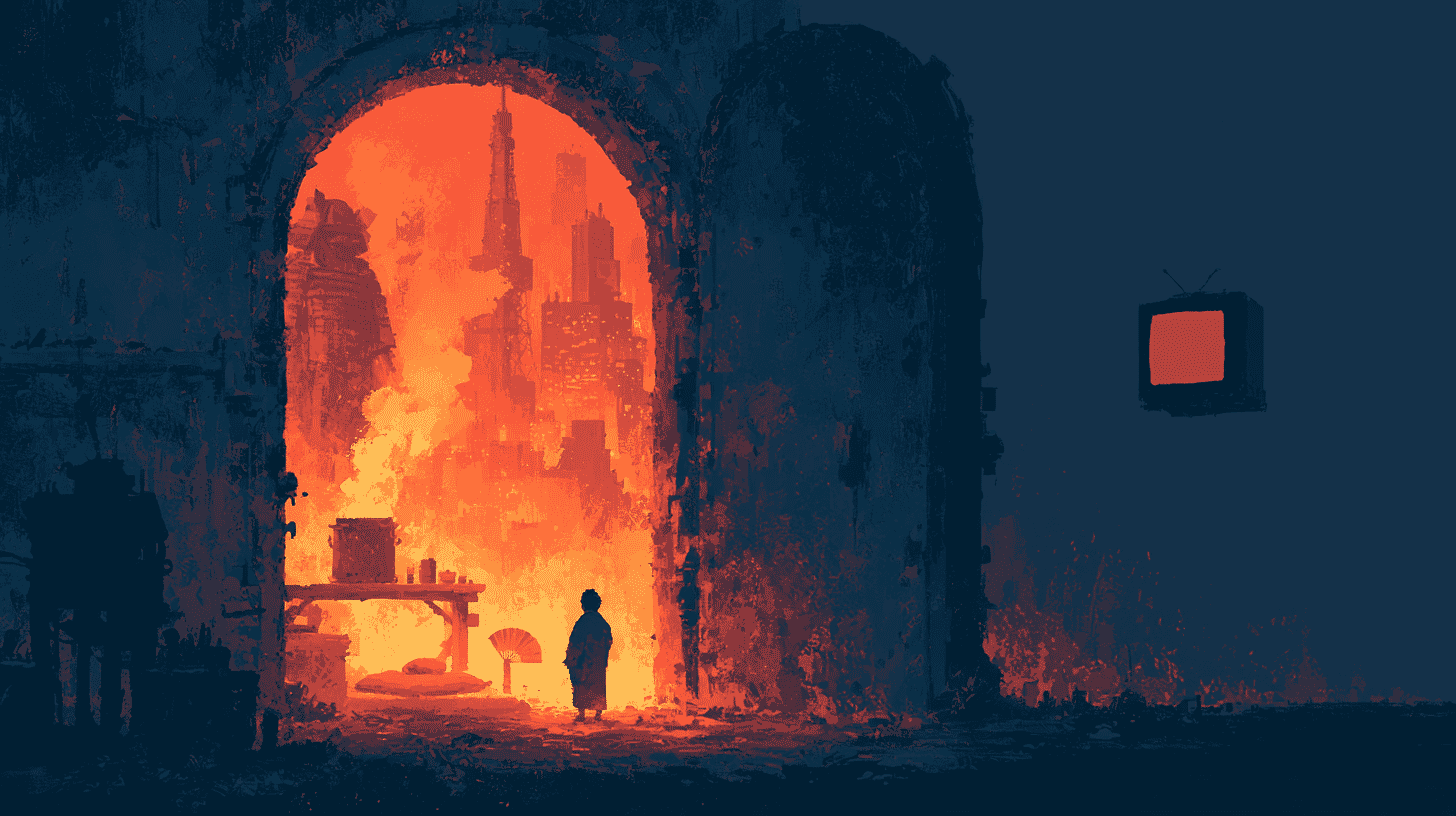
📺 For decades, NHK's drama vault was a kind of Japan-only treasure box. The year-long Taiga historical epics, the morning serials watched at breakfast tables across the country, the prestige Drama 10 slots: most of it locked behind a Japanese-residence paywall called NHK On Demand. That changed on June 22, 2026, when the first six of those shows started streaming on Netflix in 190 countries, with the rest to follow. The lineup is interesting. What's missing from it is arguably more interesting.
What actually launched on June 22
NHK and Netflix announced on May 20 that the first batch of six titles will drop simultaneously in Japan and worldwide on Netflix on June 22, 2026, with the full 19-title rollout continuing through the end of NHK's 2026 fiscal year in March 2027. The launch went ahead on schedule.
The opening lineup pulls from three of NHK's flagship drama formats:
Strategist KANBE (2014, 50 episodes) is a Taiga drama, NHK's signature year-long Sunday-night historical epic, a format that has run continuously since 1963. It stars Junichi Okada as Kuroda Kanbei, the brilliant tactician who guided Toyotomi Hideyoshi through the unification of Sengoku-period Japan. For viewers who liked FX's Emmy-sweeping Shōgun, this is the genuine domestic article: same era, same political brutality, but produced by the broadcaster that has been making this kind of show longer than anyone else.
Mampuku (2018, 151 episodes) is a renzoku terebi shōsetsu, the "morning serial" or asadora, the 15-minute breakfast-time drama that has been a Japanese household ritual since 1961. This one fictionalizes the life of Masako Ando, wife of Momofuku Ando, the Taiwanese-Japanese inventor who developed instant ramen in a backyard shed in 1958 and changed how the planet eats. Nissin's Chicken Ramen and Cup Noodles trace back to that shed. Sakura Ando, internationally known for Shoplifters and the Oscar-winning Godzilla Minus One, and a multiple-time Japan Academy Award winner, leads.
Descending Stories: A Life in Rakugo (2018, 10 episodes) adapts Haruko Kumota's manga Shōwa Genroku Rakugo Shinjū, already beloved internationally as an anime that ran on Crunchyroll across two seasons. The live-action version stars Masaki Okada as an ex-convict who apprentices himself to a master of rakugo, the traditional Japanese solo-storytelling art form. The anime built a devoted English-speaking fanbase; many of those fans never knew the live drama existed.
The other three opening titles are more recent. My Family (2023) is a 10-episode prestige drama starring Yumi Kawai about the messy weight of family obligation. The Science Club (2024) follows a high-school night-class science teacher who pulls a group of struggling students into a JAXA-affiliated experiment to recreate a Martian crater in their classroom, based on a novel inspired by a real Tokyo night school whose science club ended up presenting research alongside university teams. Tokyo Salad Bowl (2025) pairs Nao and Ryuhei Matsuda as a green-haired international-investigations cop and a translator with secrets, working cases inside the roughly 700,000-strong foreign-resident community of Tokyo. That last one might be the most interesting test case of how a Japanese drama about non-Japanese characters plays to non-Japanese audiences.
Why this is a bigger deal than it sounds
To understand why Japanese viewers are reacting strongly to this news, you need to understand how walled-off NHK's archive has been until now.
NHK is Japan's public broadcaster, comparable in role to the BBC, but funded under a system that has become genuinely unpopular at home. Under Article 64 of the Broadcasting Act, anyone in Japan with a device capable of receiving NHK has to sign a contract and pay a monthly reception fee, currently around ¥1,100 (roughly $6.90) for terrestrial, ¥1,950 (about $12.30) for satellite. In fiscal 2023, NHK pulled in ¥653.1 billion in business revenue, with ¥632.8 billion of that, about 97%, coming from those fees.
That funding pays for some of the most expensive television produced anywhere in Asia. Taiga dramas in particular are notoriously costly: location shoots, period costumes, multi-year planning, the works. Until now, watching that older content from outside Japan required either NHK World's limited international channel or a paid NHK On Demand subscription that explicitly blocks overseas IPs. The dramas existed; the world just couldn't get to them.
The timing of this Netflix deal is not accidental. Shōgun hauled in a record-breaking 18 Emmy wins in September 2024, including Best Drama Series and acting awards for Hiroyuki Sanada and Anna Sawai. Godzilla Minus One took the visual effects Oscar. The international appetite for Japanese historical and prestige storytelling has rarely been more obvious. NHK Chairman Tatsuhiko Inoue framed the deal to Nikkei as a new revenue stream: the broadcaster supplies its catalog "for a fee" under Article 20-2-3 of the Broadcasting Act, and the global reach of Netflix becomes a way to monetize the archive beyond Japan's shrinking domestic audience.
For comparison: Netflix's cheapest ad-supported plan in Japan costs ¥890 a month. NHK's satellite reception fee is ¥1,950. A lot of Japanese households have, for years, been quietly noting this asymmetry.
What's not in the deal, and why fans care
Here's the part that has surprised some longtime NHK viewers.
Notable by absence: NHK Special.
NHK Special is the broadcaster's flagship documentary slot, running since 1989 on Sunday and Saturday evenings. It is what a lot of Japanese viewers, even those who skip the dramas entirely, would argue is the strongest argument for the reception-fee system. Long-form investigative journalism, multi-year Amazon expeditions, atomic-bomb survivor archives, climate-change field reporting, COVID-era global montages stitched together from selfie footage in dozens of countries. The kind of work that requires a budget no commercial broadcaster will spend.
A common view among Japanese viewers reads something like this: yes, the reception fee is intrusive and the door-to-door collection has been a nuisance for decades, but the documentary work it produces is genuinely world-class, and that, more than the dramas, is what justifies the system. NHK Special episodes routinely become books, win major nonfiction prizes, and sit at the center of national conversations about war memory, demographic decline, and Japan's place in the world. The instinct to want that work exported is strong.
The Netflix announcement focuses entirely on scripted drama. There is no mention of documentaries. NHK has said titles for fiscal 2027 onward are still being decided "based on requests received," which leaves the door open, but for now, the work many Japanese viewers consider NHK's strongest cultural export is staying inside the wall.
The bigger picture: a public broadcaster looking outward
Beyond the catalog question, this announcement reflects something broader happening in Japanese media.
Domestic viewership for NHK's Taiga and morning dramas has been sliding for years, hit by the same streaming-driven erosion every legacy broadcaster faces. The 2024 Taiga Hikaru Kimi e was praised but landed below ratings expectations; the genre's audience skews older every year. Meanwhile, Netflix has spent the past several years methodically partnering with Japan's commercial networks (Fuji TV, TBS, TV Asahi) and turning their dramas into reliable international hits. NHK, the holdout, is finally joining that table.
The choice of opening titles tells its own story. Strategist KANBE and Mampuku are pre-pandemic productions chosen for proven domestic popularity and broad themes (warlord politics, the invention of a global food product) that translate cleanly. Descending Stories leverages an existing international fanbase built by the anime. Tokyo Salad Bowl may be the boldest pick: a drama that asks Japanese viewers to think about the foreigners living among them, now being shown to those very foreigners abroad.
Whether the deal works will depend less on the prestige titles and more on whether casual Netflix browsers actually click "play" on a 50-episode Sengoku drama they've never heard of. Shōgun proved the appetite exists when the production values are right and the marketing is loud. NHK's older Taiga dramas are visually closer to a 1990s American epic than to Shōgun, and that is going to be the test.
June 22 marked the moment a previously sealed library opened. The 13 remaining titles are due to be announced over the rest of NHK's 2026 fiscal year, which runs to March 2027. And somewhere on a wishlist, a lot of Japanese viewers are quietly hoping the next phase of this deal includes the documentaries.
What about where you live? Does your country have a public broadcaster funded by a mandatory license fee, like NHK or the BBC? And if you had to pick: would you rather watch the dramas it produces, or the documentaries? Tell us in the comments.
References
- https://about.netflix.com/ja/news/nhk-dramas-on-netflix-june-22
- https://about.netflix.com/en/news/nhk-dramas-on-netflix-june-22
- https://www.cinematoday.jp/news/N0154911
- https://www.oricon.co.jp/news/2455795/full/
- https://news.yahoo.co.jp/articles/9a10f9e4643d23ed8942e27f3b6b77d10359121a
- https://www.nikkei.com/article/DGXZQOUC074HX0X00C26A5000000/
- https://blog.gaijinpot.com/nhk-fees-in-japan-explained/
- https://www.nippon.com/en/views/b07206/
- https://en.wikipedia.org/wiki/Descending_Stories:_Showa_Genroku_Rakugo_Shinju






Global Discussion
4 comments