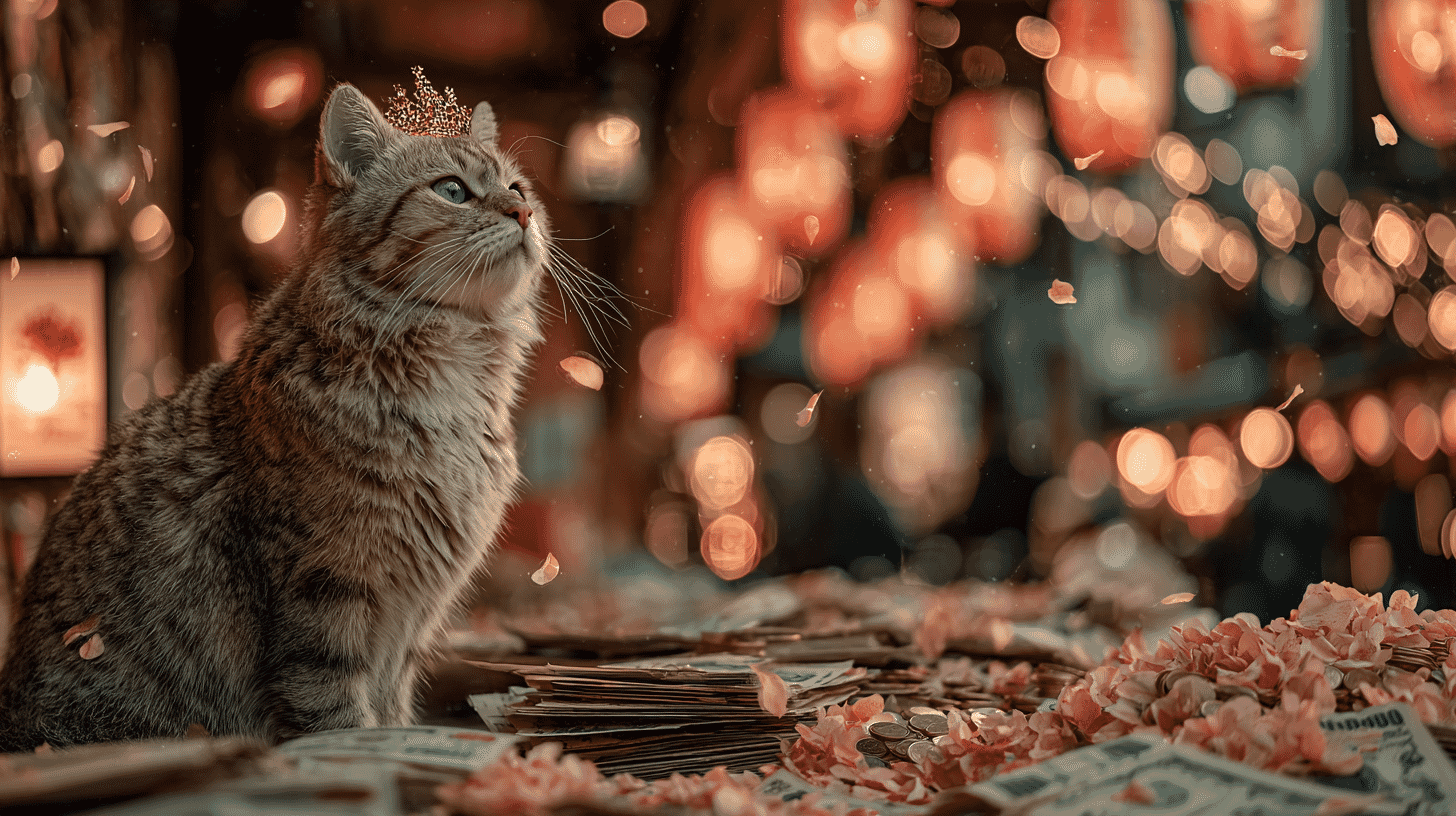
Keeping one cat in Japan costs only about $920 a year. But add up the country's roughly 9 million cats and the ripple effects, and you get an economic force of around ¥3 trillion (about $19 billion), rivaling the 2025 Osaka World Expo. Cat cafés, cat islands, cat tech: in Japan, cats are generating a huge economy. Here is a look at "Nekonomics."
What Is "Nekonomics"?
"Nekonomics" is a portmanteau of "neko" (the Japanese word for cat) and "economics," coined as a playful riff on "Abenomics", the economic policies of former Prime Minister Shinzo Abe. The term entered mainstream Japanese media around 2015 and has since become a fixture of Japan's economic vocabulary.
Every year on February 22, celebrated as "Cat Day" in Japan because 2-2-2 sounds like "nyan-nyan-nyan" (meow-meow-meow), Professor Emeritus Katsuhiro Miyamoto of Kansai University publishes his annual estimate of Nekonomics. His 2025 calculation put the figure at approximately ¥2.9 trillion (about $19 billion), an all-time high. That number closely mirrors the government's initial projection of the Osaka World Expo's economic impact (also around ¥2.9 trillion). The 2026 estimate, released on February 22, 2026, came to about ¥2.95 trillion, just short of the ¥3 trillion mark, but cats' contribution to Japan's economy remains far from negligible.
Breaking Down the $19 Billion
Where does all this money come from? The calculation starts with direct pet-care expenses.
According to the Japan Pet Food Association, the average annual cost of keeping one cat is approximately ¥141,732 ($920), covering cat food, litter, scratching posts, and veterinary care. With Japan's cat population surpassing 9.15 million in 2024, and 359,000 new cats welcomed that year alone, total direct spending on cat care reaches approximately ¥1.34 trillion ($8.7 billion).
On top of that, Professor Miyamoto estimates about ¥2.5 billion ($16 million) in ancillary spending: cat cafés, photo books, cat-themed merchandise, and "cat tourism" (yes, people travel specifically to visit cat destinations).
These direct expenditures then generate a cascade of secondary economic activity. Pet food manufacturers buy raw materials, employ workers, and pay taxes. Those workers spend their wages, creating further demand across the economy. When these ripple effects are added up using standard economic multiplier models, the total reaches ¥2.9 trillion. In other words, every $920 spent on one cat generates roughly $2,100 in total economic activity across Japan.
Why Japan Became a Cat Superpower
Several uniquely Japanese factors explain the country's outsized cat economy.
Urban living conditions play a major role. Most Japanese city dwellers live in compact apartments where dogs, which need daily walks and outdoor space, are less practical. Cats are content indoors, require no rabies vaccination (unlike dogs in Japan), and are generally lower-maintenance. Since 2017, the number of pet cats has exceeded pet dogs, and the gap keeps widening.
The rise of solo households is another factor. Single-person households now account for about 38% of all Japanese households, an all-time high. For people living alone with demanding work schedules, cats offer companionship without the time commitment that dogs require.
The COVID-19 pandemic accelerated the trend. As remote work became widespread and people spent more time at home, many sought the comfort of a pet, and cats, with their independent nature, were the top choice. This pandemic-era adoption surge has not reversed.
Social media has turbocharged cat culture globally, but Japan has been at the epicenter. The YouTube channel "Mochimaru Diary," featuring a Scottish Fold named Mochimaru, was certified by Guinness World Records in 2021 as the most-viewed cat channel. Cat memes originating in Japan have become a global phenomenon, driving awareness and demand for cat-related content and products.
The Cat Business Ecosystem
Nekonomics encompasses a surprisingly diverse range of industries.
Cat cafés are perhaps Japan's most famous feline export. The country's first opened in Osaka in 2004, and there are now more than 300 nationwide. Major chains like Cat Café MOCHA operate across regions and even overseas. A growing number are "rescue cat cafés", social enterprises that combine café operations with adoption services. Neco Republic, for instance, brands itself as a "self-sustaining rescue cat café" that merges business viability with animal welfare.
Cat islands draw tourists from around the world. Tashirojima in Miyagi Prefecture, Aoshima in Ehime Prefecture, and Ainoshima in Fukuoka Prefecture are islands where cats outnumber human residents. The narrow alleyways of Onomichi in Hiroshima, known as the "Cat Path", and Tokyo's Yanaka Ginza shopping street have also become pilgrimage sites for cat lovers.
Cat tech is a fast-growing sector. Toletta Cats developed a smart cat toilet that uses AI to analyze health data from a cat's bathroom habits, raising ¥850 million ($5.5 million) from investors including Yusaku Maezawa's fund. Uniam leverages big data from pet insurance giant Anicom to develop functional cat food targeting kidney disease and immune health. The AIM Medical Research Institute and IAM CAT are working on breakthrough treatments for feline kidney disease, backed by over ¥1 billion ($6.5 million) from Cygames (under CyberAgent) and other investors.
Retail and consumer goods companies ride the Nekonomics wave every February. Convenience store chains Seven-Eleven and FamilyMart release limited-edition cat products, while Uniqlo launches cat-themed apparel collaborations. On the Tokyo Stock Exchange, traders even watch for a "Cat Day rally" in pet-related stocks like Nippn (pet food) and Kao (cat litter).
From Family Member to Economic Engine
The bond between Japanese people and cats stretches back over 1,400 years, to when cats were first brought to Japan in the 6th century to protect Buddhist scriptures from mice. The "maneki-neko" (beckoning cat) figurine, believed to bring good fortune, sits at the entrance of countless shops. Cats appear throughout ukiyo-e woodblock prints, and Natsume Soseki's "I Am a Cat" (1905) remains one of the most celebrated works in Japanese literature.
Today, cats are treated not as pets but as family members. Stories abound of owners running air conditioning year-round at monthly costs exceeding ¥40,000 ($260) to keep their cats comfortable, or spending ¥40,000 in a single visit to a feline beauty salon. This level of devotion is quintessentially Japanese, rooted in a culture that values "kawaii" (cuteness) and sees emotional connection with animals as entirely natural.
However, challenges loom. Professor Miyamoto has cautioned that Japan's declining population, falling pet adoption rates, and shrinking household sizes cast uncertainty over the long-term growth of cat ownership. As cats live longer, often into their late teens, chronic diseases like kidney failure and heart conditions are driving up veterinary costs, adding financial strain for aging pet owners.
In Japan, cats now rival a World Expo in economic impact. But what about in your country? How important are pets to your economy and culture? Are cat cafés popular where you live? What unique pet-related businesses exist in your part of the world?
References
- https://www.kansai-u.ac.jp/ja/about/pr/pressrelease/2025/02/post_81799.html
- https://www.jiji.com/jc/article?k=2025022000722&g=eco
- https://www.bloomberg.co.jp/news/articles/2024-02-22/S98QTZT0G1KW00
- https://www.nikkei.com/article/DGXZQOUC22CK10S4A220C2000000/
- https://www.nikkei.com/article/DGXZQOUA253X60V21C25A2000000/








Global Discussion
16 comments