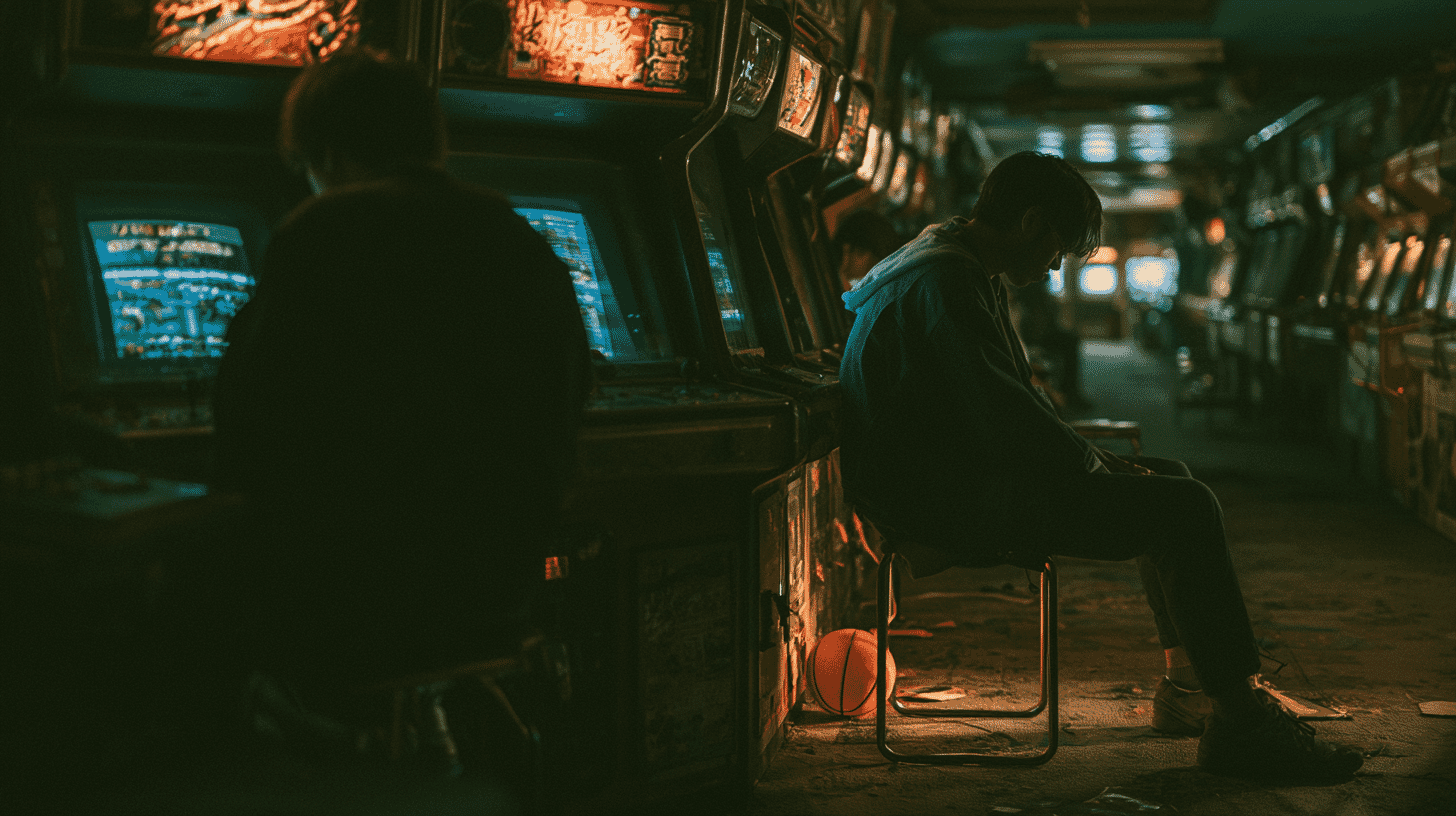
🕹️ In 2005, a Japanese arcade fighting game shipped with a bug that made characters bounce off the floor like basketballs. Some 21 years later, the man who programmed it has explained what happened. The code written to stop infinite combos is what created them.
The bounce that was never supposed to exist
If you have spent any time around the fighting game community, you have probably seen the clip. A character gets hit, the combo counter climbs, and then the victim starts slamming into the ground and popping back up, over and over, while the attacker keeps hitting them. Players call it basuke, short for basketball.
This is Fist of the North Star, an Arc System Works title that Sega put into arcades in December 2005, running on Atomiswave hardware. Outside Japan it has a reputation as the definitive kusoge, a word that translates roughly to "garbage game" and functions in the FGC as a compliment. Every character has infinites. Evo's own 2026 preview described openings ripe for exploitation and endless basketball combos, and meant it warmly.
The final of the Hokuto no Ken bracket at Evo Japan 2026 is on the event's official stream, and Famitsu points readers to it at around the two-hour-thirty-seven-minute mark.
The gravity that was meant to end the combo
On August 27, 2026, Famitsu.com published an interview with Hideyuki Anbe, now a board member and head of product development at Arc System Works. On Fist of the North Star he was the director, the lead planner and the lead programmer, and, he says, for the first stretch of the project he was the only programmer on it.
According to the interview, the team built the game around a deliberate absence of restrictions. Anbe had been working on Guilty Gear, where knockback kept cutting combos short, and he wanted a game in which attacking felt unrestrained. That produced Boost, the system K.I, the player interviewed alongside him, calls the greatest invention in fighting game history.
But a game with no combo limits becomes a game with infinites. So the team added a brake. As the hit count rose, gravity acting on the airborne character would increase, making the combo progressively harder to continue until it collapsed on its own.
It did not collapse. Anbe told Famitsu this was his own inexperience as a programmer showing. The game also had a separate rule where a character falling from a greater height bounces harder on landing. Increase the gravity enough and the character falls faster, from higher up, and bounces higher. The brake was the accelerator.
Two weeks in, they went to the arcade to look
Anbe puts the discovery at about two weeks after release. Someone on the team heard that characters were bouncing during combos. He went to a game center to see for himself. They were bouncing.
The arcade version was never patched. Elsewhere in the interview Anbe describes it as a game that has never been updated.
Before combo theory had developed, roughly three stocks of Boost gauge was enough to send most characters into basket, so players assumed it was a designed mechanic, K.I says. Anbe's answer in the interview is a flat denial.
Toki was adjusted. Nagi still had no recovery frames
Basket is only half of the game's reputation. The other half is Toki, widely cited as one of the strongest characters in fighting game history, largely because of Hokuto Muso Ryubu, known to players as Nagi.
Anbe says Toki was adjusted. The design brief was that Toki, who is afflicted by illness in the source manga, should be powerful but carry penalties, such as coughing blood and leaving himself open. Nagi came from a different idea, that Toki's soft style should flow around opponents like water.
The problem was the test build. When moves are first implemented they have no parameters set, including recovery frames, and Nagi in that state was extraordinarily fun to play. Adding the intended penalties would have killed the feel. So the recovery frames never went in. K.I recalls that the manager of Nakano TRF, a Tokyo arcade, warned a developer at a location test that Toki was dangerous and needed adjusting. The game shipped unchanged.
Mamiya's lack of a normal throw was intentional, on the grounds that she could not plausibly throw Kenshiro or Raoh; the team had also argued about whether a Fist of the North Star fighting game should include a woman at all. Jagi, by contrast, was not meant to be weak; his guard breaks because the team decided a stone statue realistically would not survive Raoh punching it repeatedly.
The bug that saved the game
Fist of the North Star was picked up by Tougeki the year after launch. That was the Arcadia magazine tournament series, which ran from 2003 to 2012 and was for years considered Evo's counterpart in Japan. K.I says that after the 2006 edition, players abandoned the game almost everywhere. It survived at Nakano TRF and not much else.
What reversed that was video. Combos including basket were discovered and posted to Niconico, which had launched in December 2006. Watching a character get dribbled across the screen turned out to be irresistible to people who had never touched the game, and players started coming back to arcades to try it. K.I's summary is that the bug rescued the game.
By the 2008 Tougeki, every character had touch-of-death combos. The community's vocabulary adapted accordingly: because killing in one combo is assumed, an "expensive" combo is not the one that does the most damage but the one that leaves you the most meter for the next round.
Anbe himself says a bug of this magnitude should never have shipped, and that the players' research turned the outcome around.
The same story exists outside Japan
None of this is uniquely Japanese. Marvel vs. Capcom 2, long a fixture of the American competitive scene, treats infinites and damage exploits as legal in tournament play; what rulesets ban is the game-breaking category, such as the freeze that can be triggered by holding taunt during a Ruby Heart special. Street Fighter II's combo system, the foundation of the entire genre, was a side effect of input leniency: lead designer Akira Nishitani has said the team noticed you could cancel normals into specials and decided to leave it in.
The difference is scale: in those games the accident became a technique, and in Fist of the North Star it became the game.
Sega did distribute the arcade version in North America, but the PlayStation 2 port, released in Japan in March 2007, never left the country, which is why so many players abroad know Hokuto only as footage. For most of the world it stayed a rumor on video until Evo Japan 2026 put it on the main stage in Tokyo this May.
21 years on, still no port
K.I won that tournament using Rei, a character he has mained for over two decades, and he had decided in advance what he would say in the winner's interview: put it on a current console. Both the PS2 disc and the arcade boards now trade as collector items, and he told Famitsu he keeps losing auctions for boards to the same buyer.
Anbe was careful about promising anything. The rights are spread across Arc System Works as developer, Sega as publisher, the manga's rights holder, plus voice actors and music. He also raised a technical objection that comes from having written the code. The game, he says, is a sandcastle of precise balance and programming, and a port that failed to reproduce the arcade version exactly would be a problem, because a Fist of the North Star without basket is not really Fist of the North Star.
He wanted to close the interview by borrowing one of the manga's most quoted lines and declaring no regrets in his development career. He decided he could not say it while players are still asking for a home version.
Every competitive scene has one of these somewhere: a game everyone agrees is broken, kept alive for decades by the people who love it most. Which one is it where you live, and does anyone still run tournaments for it?
References
- https://www.famitsu.com/article/202608/84433
- https://en.wikipedia.org/wiki/Fist_of_the_North_Star_(2005_video_game)
- https://www.gamedeveloper.com/business/-i-street-fighter-ii-i-designer-opens-up-about-the-cancelling-bug-
- https://www.eventhubs.com/news/2021/mar/13/marvel-vs-capcom-glitch/
- https://evo.gg/news/evo-japan-2026-what-to-expect/
- https://www.dustloop.com/w/HNK
- https://en.wikipedia.org/wiki/Tougeki_%E2%80%93_Super_Battle_Opera
- https://blog.nicovideo.jp/niconews/ni036699.html
- https://www.start.gg/tournament/community-showcase-at-evo-2023/event/marvel-vs-capcom-2-dreamcast/overview/rules




Global Discussion
4 comments