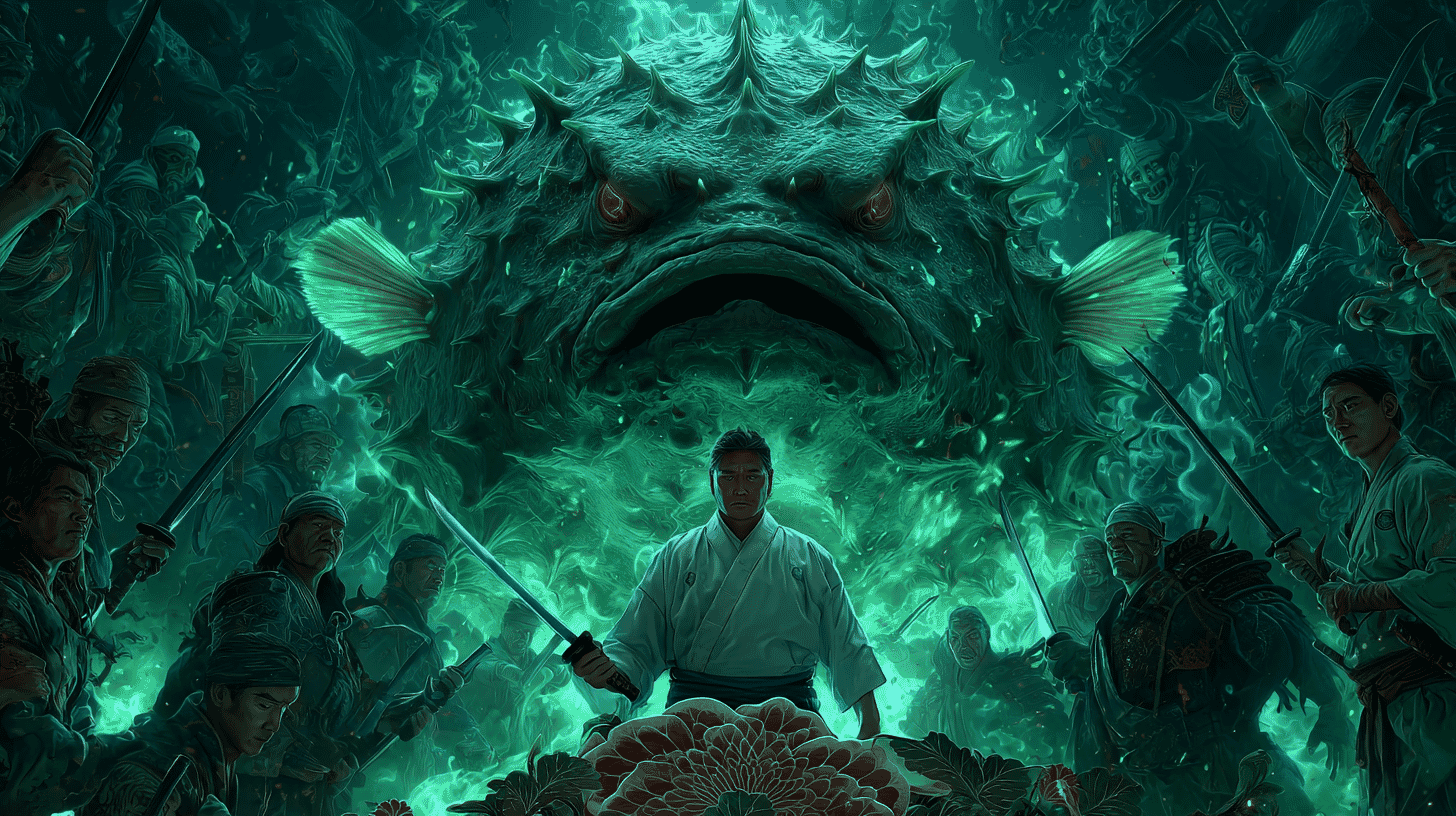
🐡 Did you know? For over 6,000 years, the Japanese have been eating a fish carrying a toxin that Japanese authorities describe as 500 to 1,000 times more potent than cyanide, and there's no antidote. They ate it when warlords banned it. They ate it when samurai risked having their entire family name erased from history. They kept eating it even when people died at the dinner table. This is the story of how one nation turned the world's deadliest fish into high art.
A Poison That Survives Everything You Throw at It
The toxin lurking inside fugu is called tetrodotoxin (TTX), first named by Japanese chemist Yoshizumi Tahara in 1909. The lethal dose for an adult is just 1 to 2 milligrams, according to the Pharmaceutical Society of Japan. Estimates of its potency vary by source, but the Tokyo and Osaka municipal governments both put it at 500 to 1,000 times that of cyanide. A standard tiger pufferfish (torafugu) carries roughly enough toxin to kill about ten adults.
Here's the truly terrifying part: this toxin doesn't break down below 300°C (572°F). You can boil it, fry it, freeze it, or dry it, the poison remains. It concentrates most heavily in the liver (some specimens contain enough in a single gram to kill), ovaries, intestines, and skin, though the distribution shifts unpredictably between species, seasons, and individual fish.
What makes fugu poisoning uniquely nightmarish is what happens to victims. The clinical progression, first systematized by researchers Fukuda and Tani in 1941, begins with tingling lips and tongue within 20 minutes to 3 hours. This escalates to facial paralysis, slurred speech, and loss of coordination. In severe cases, total flaccid paralysis sets in, the victim cannot move, speak, or breathe. But here's the horror: they remain fully conscious. Because TTX doesn't easily cross the blood-brain barrier, survivors have reported hearing every word spoken by medical staff while lying completely motionless. Death comes from respiratory failure, typically within 4 to 6 hours. There is no antidote. The only treatment is mechanical ventilation until the toxin clears the body in 1 to 2 days, survive 24 hours on life support, and full recovery is expected.
6,000 Years of Bones Hidden in Shell Mounds
Archaeological evidence places fugu consumption deep in Japanese prehistory. Fugu teeth and bones have been excavated from Jōmon-period shell mounds dating back approximately 6,000 years, making pufferfish one of the oldest continuously consumed foods in Japanese culture. The alkaline environment inside these mounds, created by calcium carbonate from discarded shells, miraculously preserved bones that would have dissolved in Japan's naturally acidic soil.
The most famous site is the Ubayama Shell Mound in Ichikawa, Chiba Prefecture, where archaeologists found fugu bones alongside five human skeletons stacked in a pit dwelling, leading some scholars to speculate they died from fugu poisoning, though this remains unconfirmed. Other key sites include the Satohama Shell Mound in Miyagi Prefecture (around 6,000 BCE), the Hishine Site in Shimane Prefecture, and the Ōmori Shell Mound in Tokyo, first excavated by American zoologist Edward S. Morse in 1877 during Japan's first scientific archaeological dig.
The earliest written warning about fugu appears in the Chinese classic Shan Hai Jing, compiled about 2,300 years ago, which states bluntly: eating pufferfish kills. In Japan, the Nihon Shoki (720 CE) references fugu, and the Heian-era pharmaceutical text Honzō Wamyō (918 CE) records it under the name "fuku." The Song dynasty poet Su Shi famously declared fugu "worth dying for", a sentiment that profoundly shaped Japanese food culture. The first Japanese cooking instructions for fugu appeared in the Ryōri Monogatari of 1643.
There's a fascinating hypothesis that ancient fugu may have been less deadly: since TTX isn't produced by the fish themselves but accumulated through the food chain from marine bacteria, prehistoric pufferfish living in different ecological conditions could have carried significantly lower toxin levels.
Warlords, Samurai, and the Threat of Erased Bloodlines
The most consequential fugu ban in Japanese history came in 1592, when the warlord Toyotomi Hideyoshi issued his Fugu Eating Prohibition Decree. As samurai massed in Kyushu for his planned invasion of Korea, soldiers unfamiliar with pufferfish preparation ate the organs along with the flesh and started dying from tetrodotoxin poisoning before reaching the battlefield. An enraged Hideyoshi reportedly declared: "This fish must not be eaten."
The Tokugawa shogunate (1603–1868) continued and expanded the ban, especially for the warrior class, whose lives were considered property of their feudal lords. The Chōshū Domain (present-day Yamaguchi Prefecture) enforced the harshest penalties: a samurai caught eating fugu faced confiscation of the family's hereditary stipend and extinction of the family name, punishment that erased not just the individual but the entire lineage from official records. The Owari Domain codified fugu penalties in its legal code, and the Meiji government's 1882 ordinance made eating pufferfish an imprisonable offense.
Yet the bans were largely theatrical. Common people, and many samurai, continued eating fugu throughout the Edo period, simply using code words. In Osaka, fugu acquired the slang name "teppō" (meaning "rifle" or "gun") because, like a firearm, "if it hits you, you die." This wordplay survives in modern cuisine: tessa (fugu sashimi) and tecchiri (fugu hot pot) both derive from "teppō." Residents of Shimonoseki ate fugu openly and daily through the entire prohibition era.
Japan's great haiku poets captured the national ambivalence beautifully. Matsuo Bashō wrote with dry relief about waking up alive after eating fugu soup. Yosa Buson composed a verse about the surprise of still being alive the morning after. But Kobayashi Issa, tasting fugu for the first time at age 50, took the opposite stance, essentially declaring that anyone lacking the courage to eat fugu didn't deserve to see Mount Fuji.
A Prime Minister, a Storm, and the End of the Ban
The most dramatic moment in fugu history arrived in late 1887 when Itō Hirobumi, Japan's first Prime Minister and a native of the former Chōshū Domain, visited Shimonoseki and stayed at Shunpanrō, a ryokan (traditional inn) overlooking the Kanmon Strait. A fierce storm had prevented all fishing, and the proprietress Fujino Michi found herself in the impossible position of having no fish to serve the prime minister. In desperation, at what she later described as the risk of execution, she served fugu.
According to Shunpanrō's official history, the plot twist was that Itō had actually eaten fugu before, in his revolutionary youth with the famous activist Takasugi Shinsaku. But he "pretended it was his first time" and exclaimed how delicious it was, praising the fish with a poetic phrase meaning "in one body, it perfectly harmonizes a hundred flavors." He then worked with the governor of Yamaguchi Prefecture to lift the prohibition.
In 1888, fugu was officially legalized in Yamaguchi Prefecture, the first and initially only prefecture to permit it. Shunpanrō became Japan's first publicly licensed fugu restaurant and later hosted the Treaty of Shimonoseki ending the Sino-Japanese War in 1895. Other prefectures followed slowly: Hyōgo in 1918, Osaka not until 1941. Today, Shimonoseki handles roughly 80% of Japan's nationally distributed wild torafugu through its Haedomari Market, the world's only dedicated fugu wholesale market, established in 1974. At 3:30 AM, buyers and auctioneers conduct a unique "bag auction" where prices are negotiated through hand signals hidden inside a black cloth bag, a tradition that continues to this day.
Locals call the fish "fuku" rather than "fugu," because "fugu" sounds uncomfortably like the Japanese word for "misfortune," while "fuku" evokes "good fortune." In 1989, Yamaguchi Prefecture designated fugu as its official prefectural fish.
The Exam Where Half the Candidates Fail
Japan's fugu chef licensing system is the regulatory masterpiece that transformed a deadly gamble into a statistically safe dining experience. Established with Osaka's 1948 ordinance and Tokyo's first exam in 1949, anyone who commercially prepares fugu must hold a prefectural license.
The examination has three components. A written test of 30 to 35 questions covers food sanitation law, fugu biology, species-specific toxicity, and regulatory knowledge. A species identification test requires candidates to correctly name five actual fugu specimens within five minutes, critical because while Japan's waters contain over 40 pufferfish species, only 22 are approved for human consumption, and misidentification can be fatal. The practical exam demands candidates break down a whole fugu within 20 to 30 minutes, separating every organ into "edible" and "inedible" trays with correct labels.
Pass rates hover around 50 to 60% nationally, with Tokyo's most recent exam recording a 44.8% pass rate. The system has been evolving: a 2019 directive from Japan's Ministry of Health urged prefectures to eliminate experience requirements and standardize exams nationwide, driven by the aging crisis in the industry (60% of Yamaguchi Prefecture's license holders are over 65) and the push for fugu exports.
The results are dramatic: deaths from professionally prepared fugu are virtually nonexistent in modern Japan. Over the decade from 2014 to 2023, Japan recorded 173 incidents and 235 patients, with only 5 deaths, a fatality rate of 2.1%, down from roughly 80% in the early 1900s. Approximately 80% of modern fugu poisoning comes from amateur home preparation, typically recreational fishermen who catch and try to prepare their own pufferfish.
Fugu liver has been banned nationwide since 1983–84, even for demonstrably non-toxic farmed fish. Saga Prefecture spent 12 years (2004–2017) campaigning to legalize farmed fugu liver, testing over 5,000 toxin-free specimens, but Japan's Food Safety Commission rejected the proposal three times, ruling that the mechanism by which fugu accumulate toxin remains insufficiently understood. Today, about 90% of fugu consumed in Japan is farmed (around 5,000 tons annually), raised on controlled diets that prevent toxin accumulation, yet their livers still cannot legally be served.
Chrysanthemum Flowers Made of Translucent Fish
Fugu cuisine represents the intersection of deadly danger and extreme aesthetic refinement that defines Japan's relationship with food. The centerpiece is tessa, fugu sashimi sliced so impossibly thin that the decorative pattern of the plate beneath is visible through the flesh. Using a specialized knife called a fugubiki, the chef arranges paper-thin slices into the shape of a chrysanthemum flower, a darkly resonant choice, since the chrysanthemum traditionally symbolizes death in Japanese culture. Diners pick up two or three translucent slices, wrap them around scallions, and dip in ponzu sauce with chili-spiked grated daikon radish.
Tecchiri, the fugu hot pot, simmers bones, skin, and flesh with vegetables in kelp broth. The meal traditionally finishes with zosui, rice and egg stirred into the remaining broth to create a rich porridge considered the true climax of the fugu course. Hire-zake (fin sake) involves roasting dried fugu fins to an amber color, dropping them into hot sake, then lighting the surface on fire, producing a dramatic blue flame and filling the room with smoky fragrance. Shirako (fugu milt), available only from December through April, is prized for its extraordinarily creamy texture, served grilled, raw with ponzu, or floating in warm sake.
A full fugu course spans a wide price range. Budget options start around ¥4,000 to ¥6,000 ($27–40), mid-range courses run ¥10,000 to ¥15,000 ($67–100), and high-end experiences at Michelin-starred restaurants reach ¥30,000 to ¥80,000 ($200–533). At Shimonoseki's Karato Market, you can buy fugu sashimi for as little as ¥1,000 ($7).
A Living National Treasure's Fatal Demand for More
The most infamous fugu death in modern Japan struck on January 16, 1975, when kabuki actor Bandō Mitsugorō VIII, designated a Living National Treasure just two years earlier, died of tetrodotoxin poisoning after eating fugu liver at a Kyoto restaurant.
The 68-year-old actor, known as a great gourmet who told younger performers that "an actor must know which restaurants serve the best food," was dining at a restaurant on Kiyamachi-dōri with companions including Gion geisha. The licensed chef prepared torafugu sashimi and liver. Bandō, who savored the intense tingling that trace toxin levels produced on his lips and tongue, kept demanding: "Bring me more, bring me more!" He consumed four portions of fugu liver. Three companions ate one portion each without ill effects; only Bandō, with his quadruple dose, was poisoned.
He returned to his hotel room in high spirits, boasting to his wife about how delicious the liver was. Around 2:30 AM, he woke her saying he desperately needed water, by then, his entire body was already paralyzed. The hotel doctor arrived, but nothing could save him. He died of respiratory paralysis at approximately 4:40 AM. His daughter reportedly cried: "Father, why did you eat the liver! To die so soon..."
The chef was convicted of professional negligence causing death. The case became a turning point: in 1984, Japan banned fugu liver from restaurant service nationwide. The name "Mitsugorō" remains permanently linked with fugu poisoning in Japanese collective memory.
The Day a Supermarket Triggered the Missile Alert System
Recent incidents show that danger persists at the edges of Japan's regulatory system.
In January 2018, a supermarket in Gamagōri, Aichi Prefecture, sold five packages of pufferfish without removing the livers. The city activated its emergency public address system, the same infrastructure used for North Korean missile warnings and tsunami alerts, to warn residents. All but two packages were recovered. The supermarket manager's response? "We've been selling it for decades. There hasn't been a single poisoning."
A growing modern concern is hybrid fugu, crossbreeds between species whose toxic organ distribution can't be reliably predicted, forcing disposal of any unidentifiable specimen. Rising sea temperatures are making this worse, pushing fugu habitats northward. According to the agriculture ministry's marine fisheries statistics, Hokkaido led the country in fugu catch volume from 2019 through 2022; in 2021 it accounted for 1,990 tons of a national total of 6,172, close to a third. Yamaguchi, the traditional heartland, is now less the place where fugu is caught than the place where it is gathered.
The Emperor of Japan, by the way, remains forbidden from eating fugu under a longstanding unwritten ban. When Emperor Shōwa (Hirohito) visited Shimonoseki in 1964, his attendants enjoyed fugu while he could not, reportedly prompting him to remark with obvious envy: "Fugu has poison, you know!"
The Craftsman's Spirit That Turns Danger into Art
Fugu's survival as a culinary tradition is inseparable from the Japanese philosophy of food as a craft worthy of a lifetime's devotion. The concept of shokunin, the master artisan who combines technical excellence with a moral obligation to serve the public good, applies to fugu preparation with particular intensity. The years of training, the pressure of species identification under exam conditions, the anatomical precision required to remove every trace of toxin, these embody the same spirit that kept sushi legend Jiro Ono chasing the right rice temperature into his nineties.
Japanese food culture treats ingredients with seasonal reverence. Fugu is a quintessential winter delicacy (peak season November through March), and an Edo-period saying about pawning one's wife to buy the first bonito of the season reflects a culture that has always been willing to sacrifice for the finest ingredients at their peak. In 2013, UNESCO inscribed washoku (traditional Japanese cuisine) as an Intangible Cultural Heritage, explicitly citing the importance of seasonal ingredients and the intimate connection between food and cultural identity.
A Japanese proverb that has echoed for centuries captures fugu's place in this worldview perfectly: "I want to eat fugu, but I value my life." For six millennia, Japan has consistently resolved this tension in favor of the fish.
Does your country have a food worth risking your life for? Cassava, sannakji (live octopus), casu marzu (maggot cheese), hákarl (fermented shark), dangerous food traditions exist around the world. Tell us about yours in the comments!
Reference URLs
- https://en.wikipedia.org/wiki/Fugu
- https://ja.wikipedia.org/wiki/%E3%83%86%E3%83%88%E3%83%AD%E3%83%89%E3%83%88%E3%82%AD%E3%82%B7%E3%83%B3
- https://www.nippon.com/en/column/g00468/a-taste-for-danger-the-hazardous-history-of-fugu.html
- https://www.ncbi.nlm.nih.gov/books/NBK507714/
- https://www.hokeniryo1.metro.tokyo.lg.jp/shokuhin/hugu/
- https://www.fsc.go.jp/sonota/hazard/doubutu_6.pdf
- https://itsjapantime.com/fugu-the-fish-you-need-a-license-to-prepare/
- https://www.byfood.com/blog/japan-fugu-puffer-fish-p-703
- https://tsurinews.jp/75701/








Global Discussion
15 comments