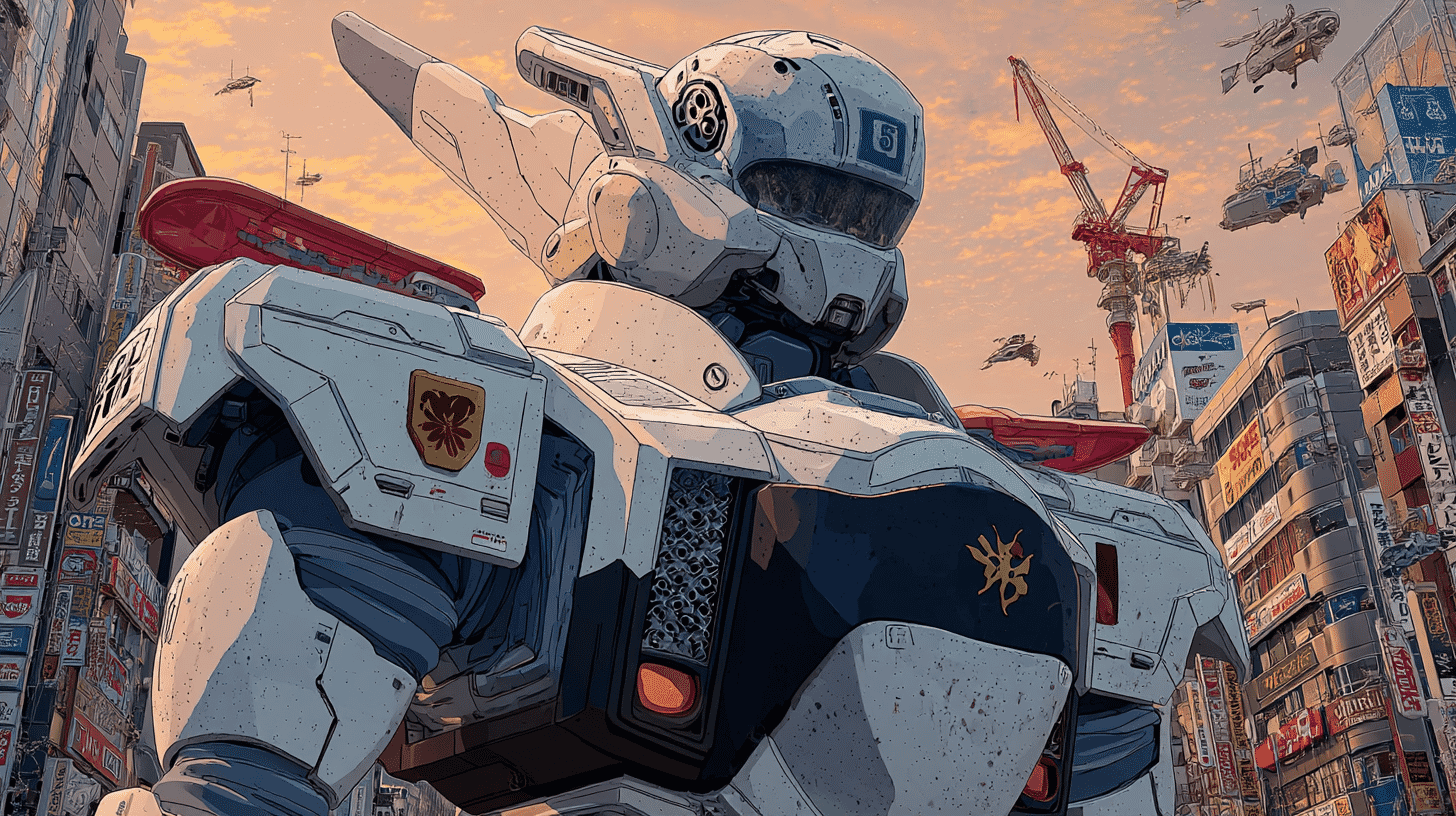
🤖 Mobile Police Patlabor, the cult-classic mecha manga that ran from 1988 to 1994, is "moving" again, 32 years after its final chapter. Masami Yūki drew a brand-new one-shot titled Mobile Police Patlabor 2026, which ran as the color opening feature in Weekly Big Comic Spirits issue 25, on sale May 18. The real-world calendar has now overtaken the manga's once-near-future Tokyo setting, and Noa Izumi, the Ingram, and Special Vehicles Section 2 are back to ride it.
When the "near future" became the present
On May 11, Shogakukan's Weekly Big Comic Spirits and Masami Yūki's official Spirits account announced a new Patlabor one-shot by Yūki, his first since the manga ended in 1994. According to coverage from Magmix and Toonippo Shimpo, the new chapter is titled Mobile Police Patlabor 2026. When the manga ran in Weekly Shōnen Sunday from 1988 to 1994, it was set in a "near future" Tokyo of the late 1990s and early 2000s. The new one-shot picks up the franchise in the present, after real history has overtaken that fictional timeline.
The teaser copy reads: "It's been 32 years since the ending. Across time, they finally move again." For overseas readers, that "move" carries a double meaning in Japanese: new work is coming, and the giant robots literally start moving on the page again.

https://x.com/spiritsofficial
The chapter ran as a ten-page color opener, with a bonus insert of "manga-version panel stickers" drawn by Yūki himself. The same issue carried a feature on the new anime Mobile Police Patlabor EZY, which opened in Japanese theaters on May 15, an interview with director Yutaka Izubuchi, and previously unreleased character design roughs by Yūki. The issue sold through quickly enough that the editorial desk began pointing readers to the digital edition.
The manga and the anime were always separate stories
A point that surprises a lot of overseas fans: Patlabor's manga, OVA, TV, and theatrical incarnations are not adaptations of each other. They are parallel timelines, each built by a different member of the same creative collective.
That collective is HEADGEAR, a five-person unit of manga artist Masami Yūki, director Mamoru Oshii, screenwriter Kazunori Itō, mechanical designer Yutaka Izubuchi, and character designer Akemi Takada. HEADGEAR, not any one member, is credited as the franchise's original creator, which is why calling Yūki's manga "the original" is a common but inaccurate shorthand. The project launched in April 1988 as an OVA, with the manga starting alongside it.
Yūki's manga ran in Shōnen Sunday from 1988 to 1994 across 22 volumes and won the 36th Shogakukan Manga Award in the shōnen category. It follows rookie pilot Noa Izumi of the Tokyo Metropolitan Police's Special Vehicles Section 2, Division 2, who pilots the AV-98 Ingram patrol mech. Same characters as the anime, different timeline, different ending.
Yūki, now 68, has remained an active manga artist throughout. After finishing Patlabor in 1994 he serialized Jaja Uma Grooming Up! (1994-2000), Birdy the Mighty: Evolution (2008-2012), Hakubo no Chronicle (2013-2017), and is currently drawing the long-running historical manga Shinkurō, Hashiru! (about a 15th-century Japanese warlord). A creator returning to a series he closed 32 years ago, while still working at the front of the industry, is a rare combination even by Japanese standards.
Why "2026" specifically
The choice of title isn't decoration. Several things are landing at the same window.
The most obvious is the new anime Mobile Police Patlabor EZY, a project with a very long run-up: production was announced in 2017, a pilot film screened at events in 2022, and a "2026 project launch" was declared in September 2024. EZY is set in a 2030s Japan reshaped by AI-driven automation, and runs as eight episodes packaged into three theatrical "Files": File 1 opened in Japan on May 15, 2026, File 2 follows on August 14, 2026, and File 3 in March 2027. Yutaka Izubuchi directs. He is HEADGEAR's mechanical designer, but hardly a first-timer in the chair, having directed RahXephon and Space Battleship Yamato 2199. Kazunori Itō handles series composition, Kenji Kawai returns on music, and animation is by J.C.STAFF.
The other thing is the real world. The manga showed a Tokyo where humanoid work machines called Labors filled construction sites, freight yards, and police forces. In actual 2026, Boston Dynamics' Atlas, Figure 02, Unitree's H1, Tesla's Optimus, Kawasaki Heavy Industries' Kaleido, and Japan's own ride-on mech Archax (a 4.5-meter, 3.5-ton manned machine roughly Ingram-sized) all exist as working hardware. Mass deployment is still some way off, but the tagline about reality catching up to the story is not empty marketing.
The overseas situation: can foreign fans read the manga?
This is the awkward part. Patlabor has long been undersupplied internationally compared to its peers.
VIZ Media released English-language versions of volumes 1 and 2 in 1998 and then stopped. Anime News Network's coverage of the new one-shot notes that the remaining volumes never followed. There is still no announced English release of the other 20 volumes, or of this new chapter.
Anime distribution is healthier. Manga Entertainment in the UK dubbed the first two films in the mid-1990s, Central Park Media licensed the OVA and TV series in North America in the 2000s, and Maiden Japan currently holds the OVAs, The New Files OVA, and films 1-3 (including WXIII). Crunchyroll has marketed a Patlabor Special Edition Blu-ray bundling TV series, OVAs, and movies, and the 1989 TV series is currently available on Amazon Prime Video in the US.
As for EZY, Gamesradar+ reported in January that no western streaming release had been announced, and that remains the case. Many overseas fans are bracing for a long wait, which is slow for a 2026 anime project of this profile.
"The most underrated mecha franchise"
Among overseas mecha communities, Patlabor occupies a specific niche: the show people recommend after Gundam, Macross, and Evangelion have been exhausted, and the one critics tend to praise more than fans actually watch. A 2024 CBR feature argued that Patlabor is "the most underrated mecha anime franchise" and pointed to its influence on Western mecha-adjacent works including Pacific Rim.
Genre-history-wise, Patlabor sits as a third evolution of mecha. The 1970s gave the world super robot shows like Mazinger Z: cartoonish, kid-friendly, fight-of-the-week. Mobile Suit Gundam (1979) brought the real robot, grounded and military, with war as trauma. Patlabor then took a further step: mechs as ordinary government equipment, with traffic accidents, paperwork, union complaints, and bored police officers playing baseball in the back lot between calls.
The Mamoru Oshii films pushed in a different, much darker direction. Patlabor 2: The Movie (1993) is regularly cited in lists of essential anime films; Reactor Magazine framed it as demanding but unmissable, crediting its refusal to soften its political argument and the starkness of its imagery. Between them, the Japan Times, the New York Times, and Variety have covered the franchise more often than its cult-classic label suggests.
Why one ten-page chapter matters
Issue 25 did double duty. For readers who have been there since 1988, it offered a 32-years-later one-shot with bonus stickers. For newcomers arriving through EZY, it put Yūki's current line work and his own character design roughs right next to the new anime's coverage. One issue, both audiences.
The franchise had not pulled this move before. Yūki has drawn one-shots for other titles, but never for Patlabor. That the publisher held it in reserve and timed it to EZY's opening week says something about how seriously Shogakukan is treating the 2026 relaunch.
Has anything like this happened in your country?
A 68-year-old manga artist, still working full-time on a flagship historical series, takes a side trip to draw a new chapter of the hit he finished 32 years ago. That is unusual even in Japan, where long-running creator-owned franchises are common. Most American comics keep the character and rotate the writers; the closest Western analogue might be Ridley Scott returning to Blade Runner, or George Miller returning to Mad Max. Or, on the print side, Frank Miller revisiting his own '80s Daredevil and Dark Knight characters decades later.
Does your country have moments like this, when the original creator returns to their own work after a generation has passed? Or have you ever lived through a piece of science fiction whose "near future" your real world walked right past? Let us know in the comments.
References
- https://magmix.jp/post/353165
- https://www.animenewsnetwork.com/news/2026-05-11/masami-yuki-draws-new-patlabor-1-shot-manga/.236864
- https://www.toonippo.co.jp/articles/-/2270026
- https://news.denfaminicogamer.jp/news/260511y
- https://us.oricon-group.com/news/7516/
- https://www.gamesradar.com/entertainment/anime-movies/classic-sci-fi-anime-patlabor-returns-with-a-surprise-movie-trilogy-from-the-divisive-studio-behind-one-punch-man-season-3/
- https://en.wikipedia.org/wiki/Patlabor
- https://www.cbr.com/patlabor-most-underrated-mecha-anime-franchise/







Global Discussion
14 comments