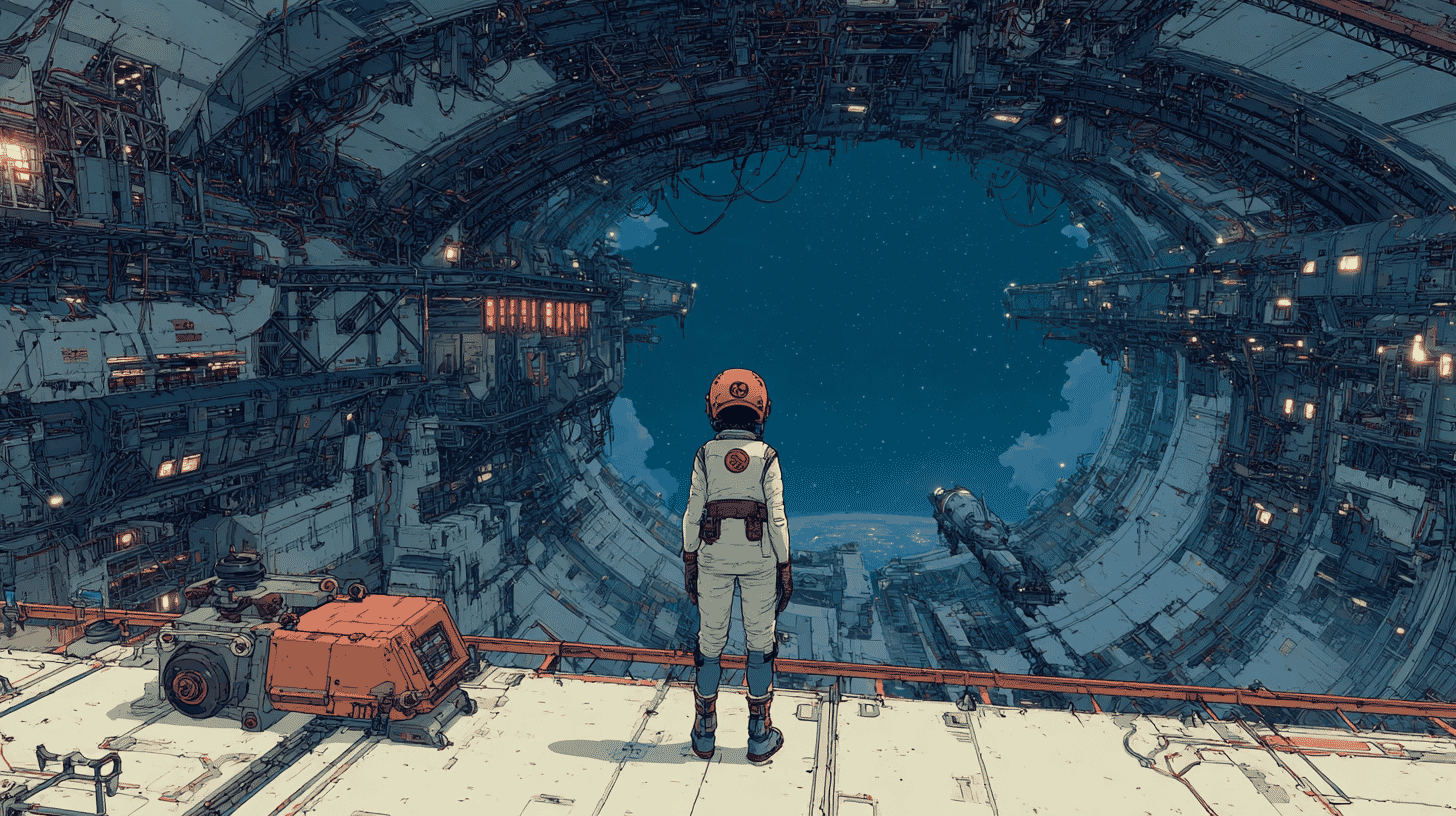
🎬 The man who reshaped global pop culture with a single 1988 film just opened a new animation studio in Tokyo. After seven years of near-silence on his long-promised projects ORBITAL ERA and a new AKIRA adaptation, Katsuhiro Otomo has founded OVAL GEAR animation studio, and a feature-length title is already in production. Fans around the world are asking the same question: is the next masterpiece finally on its way?
A studio bearing the name of a master
On May 11, 2026, an announcement landed that AKIRA fans worldwide had been waiting years for. Katsuhiro Otomo, the creator of AKIRA, Domu, Steamboy, and Memories, announced the establishment of OVAL GEAR animation studio in Tokyo. According to the official press release, the studio was created with two stated purposes: to pass on the filmmaking methods and authorial sensibility Otomo has cultivated over decades to a new generation of animators, and to produce new animated works for global release.
The press release confirms that a first title is already in production, though no details about the project have been revealed. Recruitment for animators and production staff has also opened, with the listing specifying involvement in "the planning and production of a feature-length theatrical animation."
The studio operates inside Oval Gear Inc., a subsidiary of ANDENT Inc. (formerly known as stu Inc., the creative production company behind anime like Yesterday wo Utatte and the Touken Ranbu musical 10th anniversary exhibition). ANDENT rebranded on the same day as the studio launch.
Who is Katsuhiro Otomo, for those who don't know the name
Manga critics in Japan often split the medium's history into "before Otomo" and "after Otomo." His hyper-detailed, photo-realistic line work in the late 1970s and 1980s overturned the conventions Osamu Tezuka had established. Where earlier manga leaned on cartoonish symbols, large eyes and exaggerated emotion lines, Otomo drew Asian faces with realistic proportions, cinematic perspective, and the uniform line weight of French bande dessinée, particularly Mœbius.
He received Japan's Medal with Purple Ribbon in 2013, was promoted from Chevalier (2005) to Officier of France's Order of Arts and Letters in 2014, and in 2015 became the first Japanese recipient of the Grand Prix at the Angoulême International Comics Festival. His influence on filmmakers ranges from the Wachowskis (The Matrix) to Rian Johnson (Looper) to Jordan Peele.
But it was AKIRA, both the 1982-1990 manga and the 1988 anime film he directed himself, that made him an international name.
Why AKIRA still matters in 2026
AKIRA is more than an anime. It's a cultural artifact that, almost 40 years after its release, continues to shape how the world sees Japan, the future, and animation itself.
The 1988 film was the most expensive Japanese animated feature made up to that point. Because most of it takes place at night, the production used 327 colors in total, 50 of them reportedly mixed specifically for the film, across more than 160,000 hand-painted cels. It was also one of the first anime to record dialogue first and animate the mouths to match, reversing the standard Japanese practice. When it hit Western cinemas and home video, it broke the dominant Western perception of animation as "for children." Generations of filmmakers, musicians, fashion designers, and game developers point to AKIRA as the moment they realized animation could be adult, political, terrifying, and beautiful at once.
Visual quotations from AKIRA appear constantly in global pop culture. The famous "Kaneda bike slide" pose has been recreated in everything from Stranger Things to Star Wars: The Last Jedi to countless music videos and video games. Kanye West's "Stronger" video is essentially an AKIRA homage. Streetwear brands continue to release AKIRA-themed collections that sell out within hours.
For non-Japanese fans, AKIRA was often the gateway: the film that revealed Japanese animation as a serious art form and led them deeper into the medium.
The seven-year silence that frustrated global fans
To understand why the OVAL GEAR announcement is generating such excitement, you have to understand what came before it.
In July 2019, at Anime Expo in Los Angeles, Otomo took the stage and made three major announcements at once: a new animated feature film called ORBITAL ERA to be produced with Sunrise (now Bandai Namco Filmworks), a brand-new anime adaptation of the AKIRA manga, and the launch of OTOMO: THE COMPLETE WORKS, a deluxe retrospective of his manga career. The audience at the panel reportedly cheered for minutes.
Then... almost nothing.
OTOMO: THE COMPLETE WORKS has continued to publish volumes, but on the two animation projects fans actually came for, there have been virtually no updates for nearly seven years. No concept art beyond the original teaser. No release window. No cast announcements. The new AKIRA anime adaptation became something of a meme among fans: a project that may or may not exist anywhere outside a slide deck.
The frustration was real. Forums like r/anime and r/Akira were full of threads titled "Is ORBITAL ERA dead?" and "Will we ever see the new AKIRA?" Theories ranged from "Otomo is a perfectionist and just won't release anything until it's right" to "Sunrise priorities have shifted away from auteur director projects."
The clue everyone is staring at: the OVAL GEAR logo
Here's where the OVAL GEAR announcement gets interesting.
Anime News Network and Korea's Inven Global both noted that the OVAL GEAR logo and key visual resemble the 2019 ORBITAL ERA art, which featured a lone figure with a skateboard in space wearing a helmet with a CCCP-style logo. ANN was careful to add that nothing confirms a link between the studio's first project and ORBITAL ERA.
Combined with the recruitment listing specifying a feature-length theatrical animation, this has produced a widely shared fan reading: that OVAL GEAR's first project is, in some form, ORBITAL ERA itself, possibly moved away from Sunrise and onto Otomo's own studio so he keeps creative control. None of it is officially confirmed.
What fans around the world are hoping for
Within hours, reactions poured in from fans across Latin America, Europe, Southeast Asia, and North America. They cluster around four themes.
"Please don't let this be vaporware." The single biggest hope is simply that this time, something gets finished and released. After seven years of nothing, fans are cautiously optimistic but emotionally guarded.
"Bring back hand-drawn animation." Many international fans associate Otomo with the era of impossibly detailed cel animation. The intricate machine and crowd work AKIRA was famous for has largely given way to 3DCG. With the studio's stated mission of passing on Otomo's methods, fans are hoping for a deliberate return to that craft.
"Train the next Otomo." The fact that the studio explicitly states a goal of mentoring the next generation is being received warmly. Many cite that animators who worked with Otomo on AKIRA went on to define later masterpieces (the Ghost in the Shell team famously absorbed many of his principles).
"Finally, an AKIRA Hollywood can't ruin." Warner Bros. held live-action rights from 2002 and attached Taika Waititi to write and direct, but the film never got made; in June 2025 the studio handed the rights back to Kodansha, according to The Hollywood Reporter. With more than two decades of development reset to zero, many fans would rather see a new Otomo-directed animated project carry the legacy forward.
What we still don't know
A lot. The OVAL GEAR press release is intentionally minimal. No project title has been announced. No release year. No studio partnerships. No cast. The recruitment page is the most informative document available, and it just says "feature-length theatrical animation."
What we do know is that Otomo, 72, is back in the producer/director chair, has built infrastructure under his own name, and has a project actively moving forward. His last directing credit was the short Combustible in the 2013 omnibus SHORT PEACE. For a creator this selective, the step matters.
How does animation auteurism land in your country?
In Japan, Otomo represents a specific kind of cultural prestige: the artist who refused to compromise, who walked away from manga at the peak of his fame to chase a different vision, and who is given near-total reverence in critical circles. He doesn't license merchandise loosely. AKIRA has never been released digitally, reportedly at the author's wish, and remains a print-only manga. In 2026 that is quietly radical.
This kind of figure exists in every culture, but the relationship is different everywhere. In France, an auteur of this caliber would be on talk shows weekly. In the U.S., the conversation tends to be more transactional: what's next, when, where can I buy it.
What's the equivalent of Otomo in your country? An artist whose silence is as significant as their work? Whose every announcement feels like cultural news? Tell us. We'd love to know who shapes how your country thinks about animation and storytelling.









Global Discussion
15 comments