🪑 Ginza is where Tokyo goes to look expensive. One spot on its main avenue has carried Japan's highest official land valuation for 41 years in a row. On a sunny holiday weekend this October, a TV Asahi news segment showed people sitting on that avenue's pavement and outside its shop fronts, eating and resting. Older passersby told the camera it looked untidy and did not suit the Ginza name.
The report, broadcast on October 12, 2026, framed the scene as a manners problem. Asked why visitors end up on the ground, though, Tsukiji Police said benches would be hard to add, because Ginza's merchants and residents put great weight on the streetscape and the district's brand, and space is limited. A visitor from Malaysia interviewed in the same segment said their feet hurt after about an hour of walking and that a few benches would help. The reporters also noted that cafes and restaurants were full.
The benches were a few blocks up the same avenue
Ginza's main street is Chuo-dori, part of national Route 15, which runs north through Kyobashi to Nihonbashi. From September 16 to October 9, 2026, five benches stood along that avenue, a short walk north of Ginza, as part of a trial called the Hito Aruki, Hito Yasumi ("walk a little, rest a little") Project.
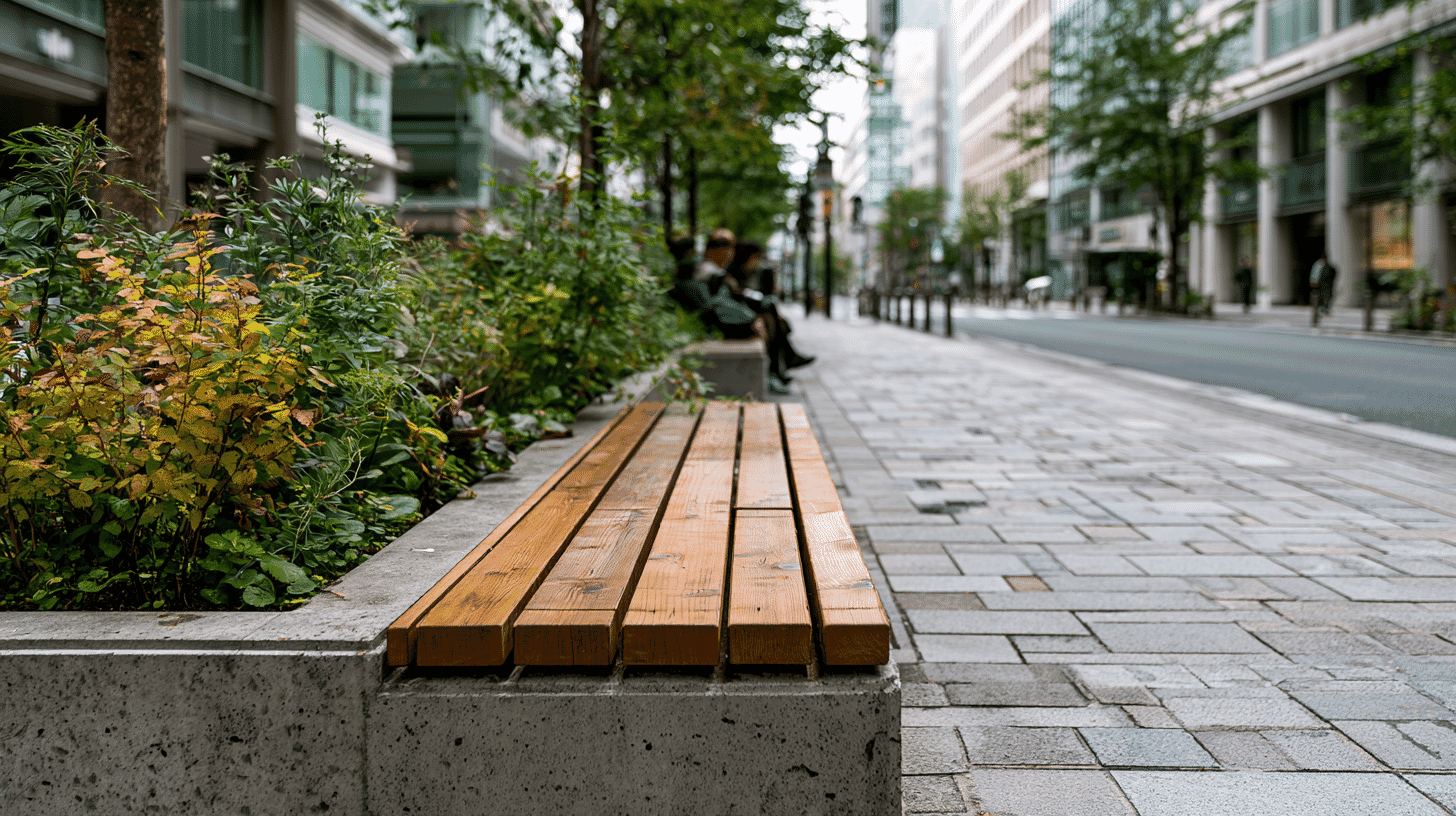
The trial was run by a parking-policy council and a town-development association for the area in front of Tokyo Station, both administered by the developers Tokyo Tatemono and Mitsui Fudosan. The national government's Tokyo road office cooperated, and Chuo City, the ward that also covers Ginza, was a sponsor. The benches were built into planters, some made from timber grown in Tokyo's Tama region, and the organizers planned to record how they were used and what upkeep they needed.
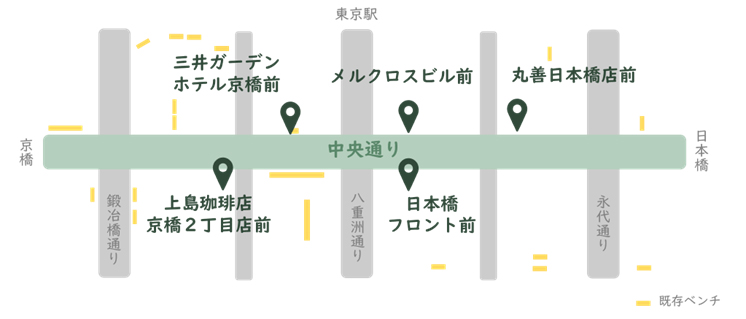
Source: Tokyo Station east district councils (Mitsui Fudosan release)
Chuo City's basic plan calls for extending the car-free pedestrian zone along the avenue, and the organizers described the trial as groundwork for using the road space permanently.
It was not the first attempt. In 2022 the nonprofit Hana Kaido, which tends the avenue's flowerbeds, ran a bench trial with Tokyo Tatemono at six spots, until November 13 that year. According to this year's organizers, a user survey in that trial found strong support for more benches.
Ginza has had the same conversation. At a symposium on September 9, 2016, hosted by Ginza's town-planning council, the head of the town-planning committee of the district's main merchants' federation said they were discussing with officials and experts how to plant tall trees for shade and add benches along the main street. The event's program noted that Ginza has few parks, but that its streets are public space too.
This year's trial was scheduled to end on October 9, three days before the TV segment aired. At the time of writing, no results had been published, and it was not clear whether any of the benches had stayed.
Benches on this avenue, then, are not unthinkable. But even next door to Ginza, they came only as a temporary experiment.
Why Japanese streets were not built for sitting
Under Japan's road design rules, a sidewalk was defined as space exclusively for pedestrians to pass through, with no category for lingering or street life. Explanatory material from the Ministry of Land, Infrastructure, Transport and Tourism quotes local governments saying this left them with no legal grounds to point to when negotiating such projects with police and local stakeholders.
That changed on paper on November 25, 2020, when an amended Road Act created "pedestrian convenience roads," nicknamed hokomichi. On designated stretches, permits to occupy the road are granted more flexibly, and operators chosen through public calls can hold them for up to 20 years instead of the usual five.
Security is another factor. Architectural historian Taro Igarashi has long documented what Japanese critics call haijo āto, or "exclusion art": spiky objects under building overhangs and armrests that split benches so no one can lie down. He dates them to the late 1990s. In 1996, after homeless people were forcibly removed from an underground passage at Shinjuku Station's west exit, objects were installed in their place. His 2004 book Kabobi Toshi ("The Over-Defended City") tracked them alongside the spread of security cameras. Igarashi argues that a city built to keep homeless people out ends up unkind to everyone, leaving older people, the unwell and pregnant women nowhere to rest, as he told the Kobe Shimbun in 2021.
Urban affairs writer Kazuki Tanigashira, writing in Toyo Keizai in 2024 about Shibuya, named three causes for the area becoming hard to sit in: redevelopment, a stronger focus on crime prevention, and a shift in Japanese attitudes. In his account, sitting down there increasingly means paying for a cafe seat, if you can find one.
Then there is the reason the police gave: Ginza's merchants and residents, they said, put great weight on the district's look and image.
Japan once said the same thing about its own teenagers
The disapproval in the TV segment did not begin with foreign visitors. Around 1997, Japanese slang picked up the word jibetarian, a pun on "vegetarian" and jibeta, the bare ground. It meant someone who sits on floors, streets and steps, and it was aimed at young Japanese people. Tanigashira notes that in the 1990s Shibuya was known as a mecca for them, especially around Center Gai. The 2000 edition of the Chiezo current-affairs yearbook blamed the habit on a loss of any sense of public space. Within a day of the Ginza story airing, users of the bookmarking site Hatena Bookmark were recalling those old complaints.
Nor does the rest of the world let people sit anywhere. In August 2019, Rome's local police began strictly enforcing a ban on sitting on the Spanish Steps, which are treated as a monument. The fine is 250 euros, and up to 400 euros for anyone who soils or damages them.
Tanigashira cites a common observation that Japanese cities lack plazas and that people are not used to using them. The man from Kosovo interviewed by TV Asahi said he was enjoying the view and planning his next stop, and since no cars were passing, he thought it was fine. In Europe, he said, sitting on the street is part of the culture too, but while in Japan he should respect Japanese customs.
What the law actually says
Police told TV Asahi that sitting on the street is not, by itself, an immediate violation. It could become one, they said, if it obstructs a shop's business or the flow of people.
The police did not name a specific law in the report. The Road Traffic Act provision that covers the traffic side is Article 76(4)(ii), which bans lying, sitting, squatting or standing on a road in a way that obstructs traffic. The penalty is a fine of up to 50,000 yen (about $320, at 158.4 yen to the dollar on October 12, 2026). Under that wording, resting on a quiet corner and blocking a narrow sidewalk on a crowded holiday are different situations.
If you need to rest in Ginza
Within Ginza itself, one free option is the GINZA SIX rooftop garden. Tokyo's official tourism site lists it as the area's largest rooftop garden, at about 4,000 square meters, and a little-known place to take a break.
Hibiya Park, 16 hectares and opened in 1903, is within walking distance of Ginza. Some sections are closed while the park is renovated area by area.
A street that already changed once
On August 2, 1970, at the Tokyo governor's initiative, Chuo-dori was first closed to cars for pedestrians. Ginza's official site describes the move as a statement against an era in which cars seemed to matter more than people. Today the pedestrian hours run on weekends and holidays, from noon to 5 p.m. between October and March. People on foot won the middle of the avenue more than half a century ago. Whether they also get to stop there is still open.
On your city's main shopping street, can you sit down without buying something first? And who decided that?
References
- https://news.tv-asahi.co.jp/news_society/articles/900201709.html
- https://www.mitsuifudosan.co.jp/corporate/news/2026/0908/
- https://www.bcnretail.com/topics_detail9/20221014_300450.html
- https://www.ginza.jp/wp-content/uploads/13c03d56c4805d2ff102acc5184757f4.pdf
- https://www.mlit.go.jp/road/hokomichi/index.html
- https://www.mlit.go.jp/road/hokomichi/pdf/s01.pdf
- https://www.kobe-np.co.jp/news/sougou1/202108/0014630865.shtml
- https://toyokeizai.net/articles/-/836959
- https://ja.wikipedia.org/wiki/%E3%82%B8%E3%83%99%E3%82%BF%E3%83%AA%E3%82%A2%E3%83%B3
- https://b.hatena.ne.jp/entry/s/news.tv-asahi.co.jp/news_society/articles/900201709.html
- https://www.ansa.it/amp/english/news/2019/08/06/sitting-on-romes-spanish-steps-banned_6d9d8906-4ed8-478e-9ea3-fd46f956eeb4.html
- https://laws.e-gov.go.jp/law/335AC0000000105
- https://www.ginza.jp/?p=19921
- https://www.nta.go.jp/information/release/kokuzeicho/2026/rosenka/01.pdf
- https://www.zeiken.co.jp/zeikenpress/column/0020zp20260730/
- https://www.gotokyo.org/jp/new-and-now/new-and-trending/240325/topics.html
- https://www.enjoytokyo.jp/article/109399/
- https://www.gotokyo.org/jp/spot/26/index.html








Global Discussion
4 comments