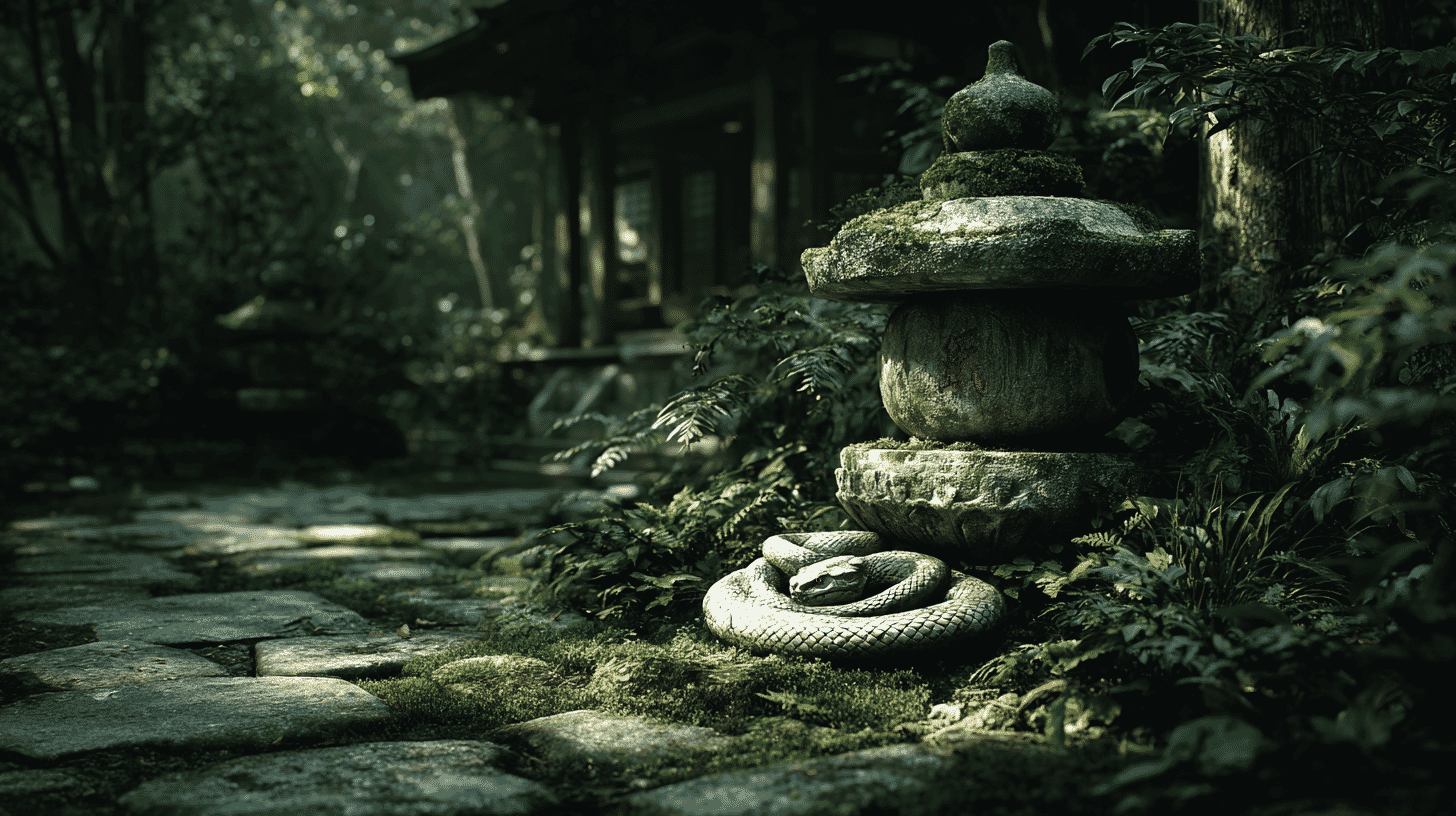
🐍 On August 16, a small shrine in western Japan held a memorial service for 281 snakes. Not ordinary ones: they are white from nose to tail, their eyes are red, they are protected as a national natural monument, they have been on record in Iwakuni for close to three centuries, and people here treat them as messengers of a goddess. The number 281 is the highest in records that go back to 2009.
The deadliest year on record
The service took place at Iwakuni Shirohebi Shrine in the Imazu district of Iwakuni, Yamaguchi Prefecture, hosted by the Iwakuni White Snake Preservation Society, the foundation that breeds and cares for the animals. According to the Chugoku Shimbun, the 281 snakes died over the twelve months starting in July 2025. That is the most since record-keeping began in 2009, and 91 more than the previous year.
The year from July 2023 brought 122 deaths, the next 190, and now 281. The living population is moving the other way. The society was caring for 896 snakes at the end of June 2025, down 65 from a year earlier, and 804 at the end of June 2026.
Set 281 against that starting figure of 896 and you get roughly one in three. The net loss over the year was 92, which puts the number added at roughly 190. Births did not keep up with deaths.
The society attributes the deaths to parasitic infection and to summer heat. It says it plans to improve the soil inside the enclosures and work with the city on further measures.
Why one town has white snakes
The Iwakuni snakes are albino Japanese rat snakes, Elaphe climacophora. The species is common across Japan and normally wears a grayish brown coat with a faint green cast. Albino individuals cannot produce melanin at all. Their eyes look red not because of red pigment but because you are seeing blood vessels through tissue that has no pigment to hide them.

Source: Wikimedia Commons (Totti / CC BY-SA 4.0)
Albinism is recessive. Breed a white snake with a normally colored one and the next generation looks ordinary again. A white body is also easy to spot in a field, and the usual assumption is that predators find these animals long before they find a mate. Whatever the mechanism, albino lines that persist across generations are almost always ones humans manage, the way white mice and white rabbits are.
Iwakuni has been the exception. In its designation notes, the Agency for Cultural Affairs explains that few animals of any kind hold on to a whitened form generation after generation in one locality, and that reptiles make it rarer still.
The reasons are food, shelter and the way people behaved. During the Edo period the domain's rice storehouses stood near the mouth of the Nishiki River. Rice drew rats, rats drew rat snakes, and the thick-walled storehouses, stone embankments and irrigation channels held steady temperature and humidity. Then the human factor: residents did not kill the white ones. They treated them as household guardians that brought good fortune. The selective pressure that normally erases conspicuous animals was, in effect, cancelled by belief.
The paper trail is old. The first mention appears in the Ganyu Nendaiki chronicle of 1738, describing a white snake at Sengokubara, in what is now the Yokoyama district. An 1862 record, the Nishikigawashi, notes two of them living in the domain's rice stores.
Adults reach about 1.8 meters and more than 15 centimeters around. They are non-venomous and placid. The society puts their usual lifespan at 15 to 16 years, and says they are most comfortable at around 25°C and 70 percent humidity.
Three centuries of faith as protection
Japan has a long habit of reading white animals as divine messengers or incarnations. In Iwakuni the snakes that kept rats out of the rice merged with the cult of Benzaiten, a water goddess of Indian origin, and small halls and shrines to the white snake went up around the city. She is still invoked for money and business luck.
Officialdom caught up in 1924. On December 9 of that year, the Imazu, Marifu and Kawashimo districts along the Nishiki River were designated a natural monument as a white snake habitat. But as the city built out, the storehouses, stone walls and channels went with it, and postwar rodent control took away the food. The good habitat kept moving. So on August 4, 1972, the designation was transferred from the place to the animal itself, and the following year the city of Iwakuni became the managing body.

Source: Wikimedia Commons (Totti / CC BY-SA 4.0)
Residents organized as well. As numbers fell in 1955, people in the Imazu district founded the preservation society. On December 16, 2012, deities were invited from Itsukushima Shrine on Miyajima and Iwakuni Shirohebi Shrine was founded. Worship and conservation now share the same address.
Around 1925, something like 1,000 snakes were thought to live across roughly 400 hectares. Yamaguchi Prefecture says breeding facilities have brought the count back above 1,000. This year's 804 sits well under that recovered level. White snakes are also almost never seen outdoors now. Neither the city's nor the prefecture's public materials give a figure for the wild population. What reaches the city is the occasional sighting.
The snakes have found an unlikely route to recognition abroad. Obanai Iguro, the Serpent Hashira in Demon Slayer, keeps a white snake named Kaburamaru around his neck. In 2021 the Chugoku Shimbun reported that after the film's release the shrine had become a pilgrimage site, with fans hanging votive plaques and turning up in costume.
The problem with a closed population
The snakes now live across six facilities in the city. Hatchlings from the outdoor enclosures are raised indoors for about three years, then moved to open-air pens. The city and the preservation society run the operation jointly, and functionally this is a closed population with no traffic in or out.
That creates a structural bind. Reliably producing white snakes means pairing white with white, and the gene pool narrows with every generation that follows. Public materials do not say how far pedigrees are tracked. But in a closed group the question does not go away.
A Kyushu University team reported in 2018 that the albino Japanese rat snakes sold in the pet trade carry a mutation in the tyrosinase gene, and that the Iwakuni snakes do not carry it. The two whites have separate origins, and the gene behind the Iwakuni one has still not been identified.
Conservation biology knows this territory well. As genetic diversity drops, inbreeding depression tends to show up as reduced fertility, developmental abnormalities and a weaker immune response, including poorer resistance to parasites and infection.
The society blames parasites and heat, not genetics, and no published study appears to link the Iwakuni population to inbreeding. The heat, at least, is a pressure that is not going away. The Japan Meteorological Agency puts the country's average temperature for June to August 2025 at 2.36°C above the baseline, the highest in a series that starts in 1898, ahead of the previous joint record of 1.76°C shared by 2023 and 2024. For an animal that does best around 25°C, that matters.
How other countries handled the same problem
The Florida panther is the case most often cited. By the early 1990s fewer than 30 remained in southern Florida, carrying the full inventory of inbreeding damage: kinked tails, atrial septal defects, undescended testicles, poor resistance to infection. In 1995 managers released eight female pumas from Texas. The aim was not replacement but the introduction of outside alleles, an approach known as genetic rescue. Heterozygosity rose, later work puts the population at roughly 200, and the distinctive Florida ancestry was not swamped after all. The state's Fish and Wildlife Conservation Commission still notes that the population remains small and isolated, and that further releases may eventually be needed.
The counter-example is the white tiger. Scientific American has laid out the sequence: the captive population goes back to a single animal, Mohan, captured in India in 1951 and bred to his own daughter to fix the color, with decades of further inbreeding after that. The result is high neonatal mortality, impaired vision, cardiac defects, spinal and facial deformities, compromised immune systems. The Association of Zoos and Aquariums ended the practice at its member institutions.
Iwakuni sits somewhere else entirely. This is not a line manufactured for display. Even so, genetic rescue here would mean bringing in normally colored rat snakes. The first generation would all look ordinary, and white animals would reappear only after further crosses. What the natural monument designation protects is the whiteness itself. Adding diversity would mean, at least for a while, putting that whiteness away.
These snakes made it nearly three centuries because a community decided they were worth keeping. For most of that stretch, what protected them was not a law but a belief. The number 281 is a question about whether that arrangement still holds.
Is there an animal where you live that people protect mainly because they consider it sacred? And who decides how it gets protected now?
References
- https://www.chugoku-np.co.jp/articles/-/880355
- https://www.shirohebi.com/material.html
- https://www.shirohebi.com/class.html
- https://online.bunka.go.jp/heritages/detail/173735
- https://kankou.iwakuni-city.net/%E5%B2%A9%E5%9B%BD%E3%81%AE%E3%82%B7%E3%83%AD%E3%83%98%E3%83%93.html
- https://bunkazai.pref.yamaguchi.lg.jp/sp/bunkazai/summary.asp?mid=30022
- https://www.shirohebijinja.com/history
- https://www.chugoku-np.co.jp/articles/-/52046
- https://doi.org/10.1266/ggs.18-00021
- https://www.data.jma.go.jp/cpdinfo/temp/sum_jpn.html
- https://ondankataisaku.env.go.jp/carbon_neutral/topics/20251023-topic-80.html
- https://www.ncbi.nlm.nih.gov/pmc/articles/PMC12337334/
- https://myfwc.com/wildlifehabitats/wildlife/panther/genetics/
- https://www.scientificamerican.com/article/tragedy-of-the-white-tiger1/









Global Discussion
4 comments