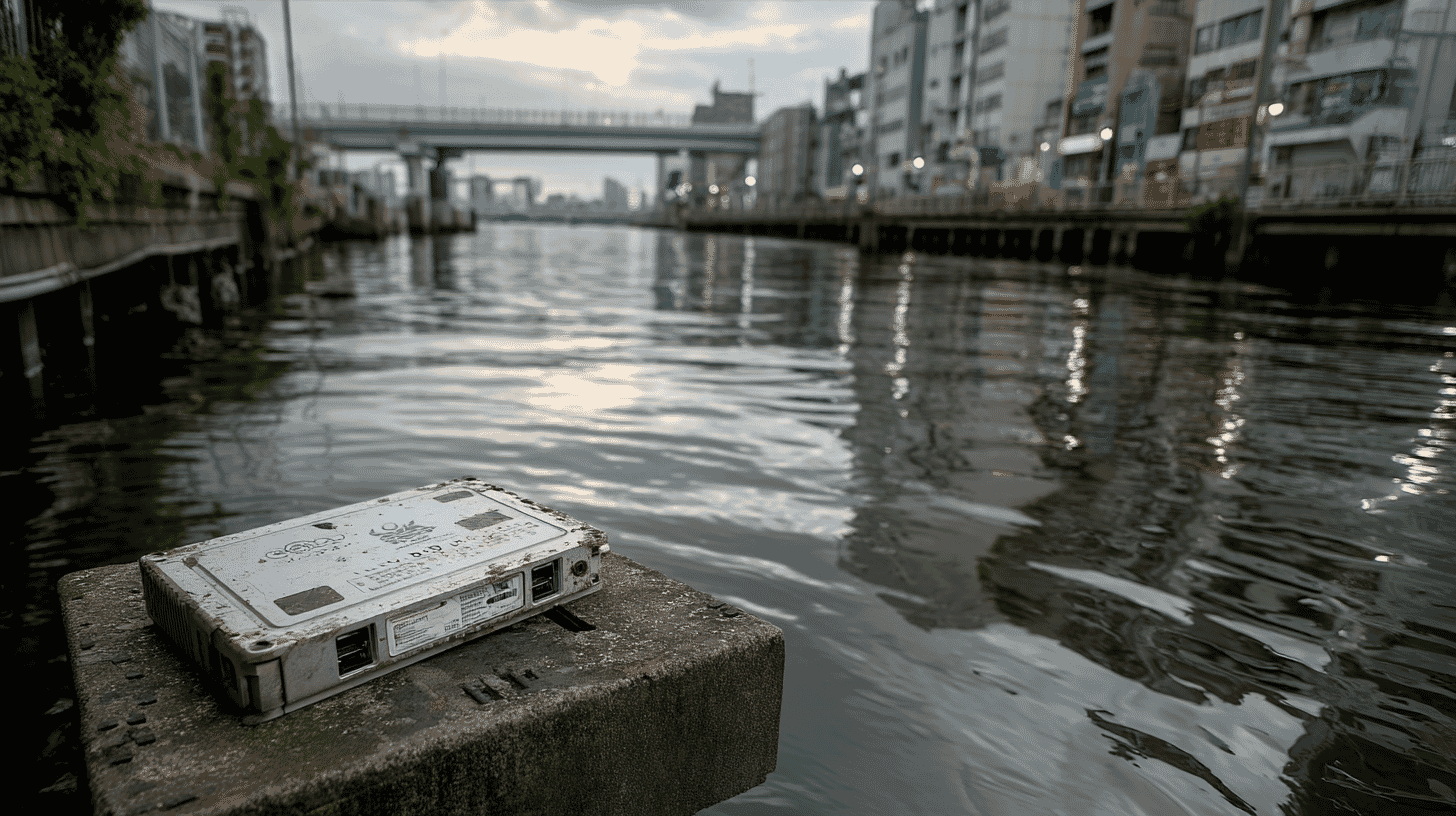
💾 Somewhere in a Tokyo canal, a hard drive sat on top of a concrete pillar, about ten meters out of reach, baking in the sun and soaking in the rain for at least three years. According to the internet, it might hold "trillions of yen in Bitcoin." Someone finally zoomed in close enough to identify it. The story did not end there.
The drive nobody can touch
Near Oi-Kitafuto Bridge, a five-minute walk from Shinagawa Seaside Station, a 3.5-inch hard drive sat on a concrete piling rising out of the water.
Photos of the lonely drive had floated around for a while, but the story caught fire in mid-June 2026 when gadget writer Kudo Hikyo-Meshi (@kudo_pon) visited in person and called the scene "pure romance." By most accounts the drive had sat there for at least three years.
Here's the spot on video:
What the zoom-in revealed
The same writer is the one who cracked its identity, working from a high-resolution photo taken in 2025 by an X user named Nasuno. Enhanced and read carefully, the label gave it away: an HGST Ultrastar 7K6000 (model HUS726020ALA610), a 2 TB, 7,200 rpm enterprise SATA drive built around September 2017.
That one detail deflates the legend. The 7K6000 isn't the kind of drive a lone crypto millionaire keeps under the mattress. It's a five-platter workhorse engineered for data-center RAID arrays, rated for 24/7 operation, a 550 TB-per-year workload, and a two-million-hour mean time between failures. In other words, it was built to grind away inside a server rack. Which, ironically, is probably why it shrugged off three years of Tokyo weather better than a cheap consumer drive would have.
About those "trillions"
Let's run the math the rumor skips. One bitcoin trades around $63,000 in mid-June 2026, roughly ¥10 million at ¥160 to the dollar. To stash even ¥1 trillion you'd need over 100,000 coins; "several trillion yen" means a few hundred thousand, a hoard on the scale of the largest known holders on Earth.
For perspective, the most famous lost-Bitcoin drive in the world belongs to Britain's James Howells, who tossed out a drive holding around 8,000 BTC in 2013 and has spent more than a decade trying to dig it out of a Newport landfill. Even that legendary fortune is worth a few hundred million dollars, tens of billions of yen, sure, but an order of magnitude short of "trillions." (A UK High Court dismissed his bid to excavate in January 2025, ruling the drive became the council's property the moment it hit the landfill.)
The odds that a weathered enterprise server drive on a Tokyo pillar is sitting on a bigger fortune than that? Let's call them slim.
The legal twist
Suppose you pulled off a Mission: Impossible and retrieved it anyway. In Japan, simply pocketing found property is a crime (misappropriation of lost property). You're meant to hand it to police within seven days. If no owner turns up within three months, the person who turned it in usually gets to keep it. Usually.
Here's the catch. Article 35 of Japan's Lost Property Act carves out items holding electronic records of private matters, or personal-data databases, from what a finder can come to own. A hard drive is, more or less, a box of electronic records. So even after all that effort, you probably couldn't legally claim it, plug it in, and start treasure hunting.
The juiciest mystery, at least, never got solved: who set a server drive on a pillar ten meters offshore, and how, and why. The "trillions in Bitcoin" was always a fairy tale.
And then it was gone
The story has an epilogue. The day after Kudo's posts blew up, on June 13, the user who first documented the drive, iP (@_127001), returned to the spot and found the pillar empty. Something that had sat there ignored through three years of weather vanished within about a day of going viral.
Nobody knows who took it, or how. A magnet would have wrecked the platters, pulling alongside in a boat risked dropping it in the water, and drones are banned from that airspace. The place everyone called "unrecoverable" got cleaned out anyway. That whole legal analysis assumed the drive would stay put. The assumption vanished first.
iP put it wryly: with the drive gone, the "internet's hundred sights" was down to ninety-nine. A textbook case, he added, of information lending value to plain garbage. For three years it was junk. The moment attention slapped a price tag on it, it was gone.
Every city seems to have one of these, an object the locals build a legend around. And maybe vanishing the instant it's noticed is just the fate of such things. If there's a strange little landmark in your town that no one has found yet, maybe leave it be.
References
- https://getnews.jp/archives/3724064
- https://togetter.com/li/2708952
- https://www.cnn.com/2025/02/14/uk/james-howells-landfill-bitcoin-gbr-intl-scli
- https://www.npa.go.jp/bureau/soumu/ishitsubutsu/otoshimono/chart/choice_pick8.html
- https://documents.westerndigital.com/content/dam/doc-library/en_us/assets/public/western-digital/product/data-center-drives/ultrastar-sata-series/product-manual-ultrastar-7k6000-sata-oem-spec.pdf








Global Discussion
4 comments