
🛫 On New Year's Day 2024, a magnitude 7.6 earthquake cracked Noto Airport's single runway, leaving broken sections that sat as much as 12 centimeters out of line. For weeks, no airliner could land. On July 7, 2026, that same runway welcomed passengers who stepped off their flight and walked beneath a giant Pikachu floating in the terminal. Noto Airport has become the first airport in the world to officially carry the Pokemon name, and it isn't a marketing gimmick. It's a bet that delight can help a region heal.
Every Flying-type, hidden in one terminal
The renamed "Noto Satoyama Pokemon With You Airport" opened on July 7, and the date was no accident: it's the terminal's own birthday. Noto Airport first opened on that day in 2003, so Ishikawa Prefecture and the Pokemon With You Foundation timed the relaunch to its 23rd anniversary.
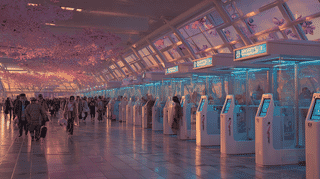
The theme runs deeper than a few posters. Because an airport is a gateway to the sky, the designers leaned into Flying-type Pokemon: all 111 known as of May 2026 (Mega Evolutions and regional forms aside), tucked across nine indoor spots and three outdoor ones. Spotting them turns a wait between flights into a game of hide-and-seek.
The centerpiece is a balloon Pikachu drifting beside a balloon airplane in the terminal's two-story atrium, ringed by Pokemon that look like they're coasting on a thermal. Downstairs, the arrivals lobby is wrapped in "Bright Future," a recovery-themed artwork first drawn in 2024 that shows Pokemon playing across Noto's scenery, including the Shiroyone Senmaida, the seaside rice terraces of Wajima. Statues of Pikachu, Plusle, and Minun wait to greet you, and up on the third-floor observation deck a wall of countless Pikachu hides a few other Pokemon among them, if you look closely.
There's a subtler piece of storytelling built in, too. Scattered around the terminal are sculptures that emit Pokemon cries; catch one with your phone and it unlocks a short "side story" video. In one, a Bagon, a small dragon that can't fly but longs to, gazes up at a soaring Salamence. The metaphor is not subtle. In a place rebuilding from disaster, subtlety may not be the point.
Practical rewards await the hunt. On the third floor, the restaurant Annon serves a Pokemon menu built around local Noto ingredients, and the second-floor shop sells goods printed with the airport's original artwork, "Sky of Hope."
The runway that became a lifeline
To see why this feels like more than a theme park, rewind to January 1, 2024. At 4:10 p.m., the strongest shaking Japan measures, a "7" on its seismic intensity scale, struck the Noto Peninsula. Cracks opened across the runway, roughly 10 centimeters deep and more than 10 meters long, and ceiling panels fell inside the terminal.
The terminal is a designated disaster-response station, and it earned the title that night. As roads across the peninsula collapsed, around 600 people took shelter at the airport, drawing on its stockpiled blankets, water, and food. Crews then patched the worst of the runway's level differences, and on January 11 it reopened, not for tourists. The following day an Air Self-Defense Force C-130H and a larger C-2 landed with personnel and heavy equipment.
Passenger service took far longer. ANA flew again from January 27, and only as extra sections, one round trip on Tuesdays, Thursdays, and Saturdays. Scheduled service stayed cancelled through the end of March. So there's a particular symbolism in that runway now receiving travelers who step off and walk under a Pikachu. The building that took the hit is the one throwing the welcome party.
Why Japan rebuilds with characters
If turning disaster recovery into a character campaign sounds strange, it helps to know where the Pokemon With You Foundation came from. In 2011, after the Tohoku earthquake and tsunami, a group of Pokemon Company employees loaded a car with supplies and drove north with Pikachu. Because shelters had no electricity, they brought origami and card games. The project took the name Pokemon With You, ran on the proceeds of a Pokemon Center opened in Sendai that December, and became a formal foundation in September 2021. Noto isn't a one-off stunt. It's the latest chapter of a model refined over 15 years.
That model treats a beloved franchise as a kind of soft infrastructure. The airport is one node in a growing Noto Pokemon network: a Pokemon footbath that opened at Nanao's Wakura Onsen in May 2026, a "Sylveon with LOVE" monument in Suzu at the peninsula's tip, and, from mid-July, Pokemon-wrapped buses stitching them together. The rebrand also lands during Pokemon's 30th-anniversary year, giving one of the world's most valuable entertainment properties a reason to point its global fanbase at a place that badly needs visitors.
The obvious objection is fair: a Pikachu balloon cannot rebuild a collapsed house or restart a fishing economy. Nobody claims it will. Recovery in Noto is slow and unfinished. What an airport can do is give people a reason to come, and in a region that lives on tourism, arrivals are their own kind of aid.
How to actually go
Getting there is simple, if a little remote. ANA flies the only scheduled route, Tokyo (Haneda) to Noto, roughly an hour, twice a day each way. The terminal doubles as a roadside station and sits on inland hills straddling Wajima, Anamizu, and Noto Town, about 20 to 30 minutes from central Wajima and 40 from Suzu. The Noetsu Expressway runs nearby, so a rental car is the easy way to explore.
You don't need a boarding pass to look around. Much of the Pokemon decor sits in publicly accessible areas, so the airport works as a destination in itself. Since July 18 two Pokemon-wrapped buses have been running. One is the guided "Pokemon Noto Meguri Bus," which links Wakura Onsen and the airport while touring themed spots and Pokemon manhole covers around the peninsula. It requires online booking, costs ¥5,000 for adults and ¥2,500 for children (roughly $32 and $16), runs during the summer holidays and on weekends and public holidays from September to November and in March 2027, and picks up only at Wakura Onsen and the airport. The other is the existing Wajima to Kanazawa express, one round trip a day in Pokemon livery. One caveat for train fans: the Noto Railway's "Pokemon with You Train" is paused for inspection until early August.
The airport keeps its Pokemon name until September 30, 2029. Three years sounds long, until you remember how much of Noto's recovery is still ahead of it. Noto is asking whether a pocket monster can help carry a region back to its feet. When disaster hits where you live, who or what does your community rally around?




Global Discussion
0 comments