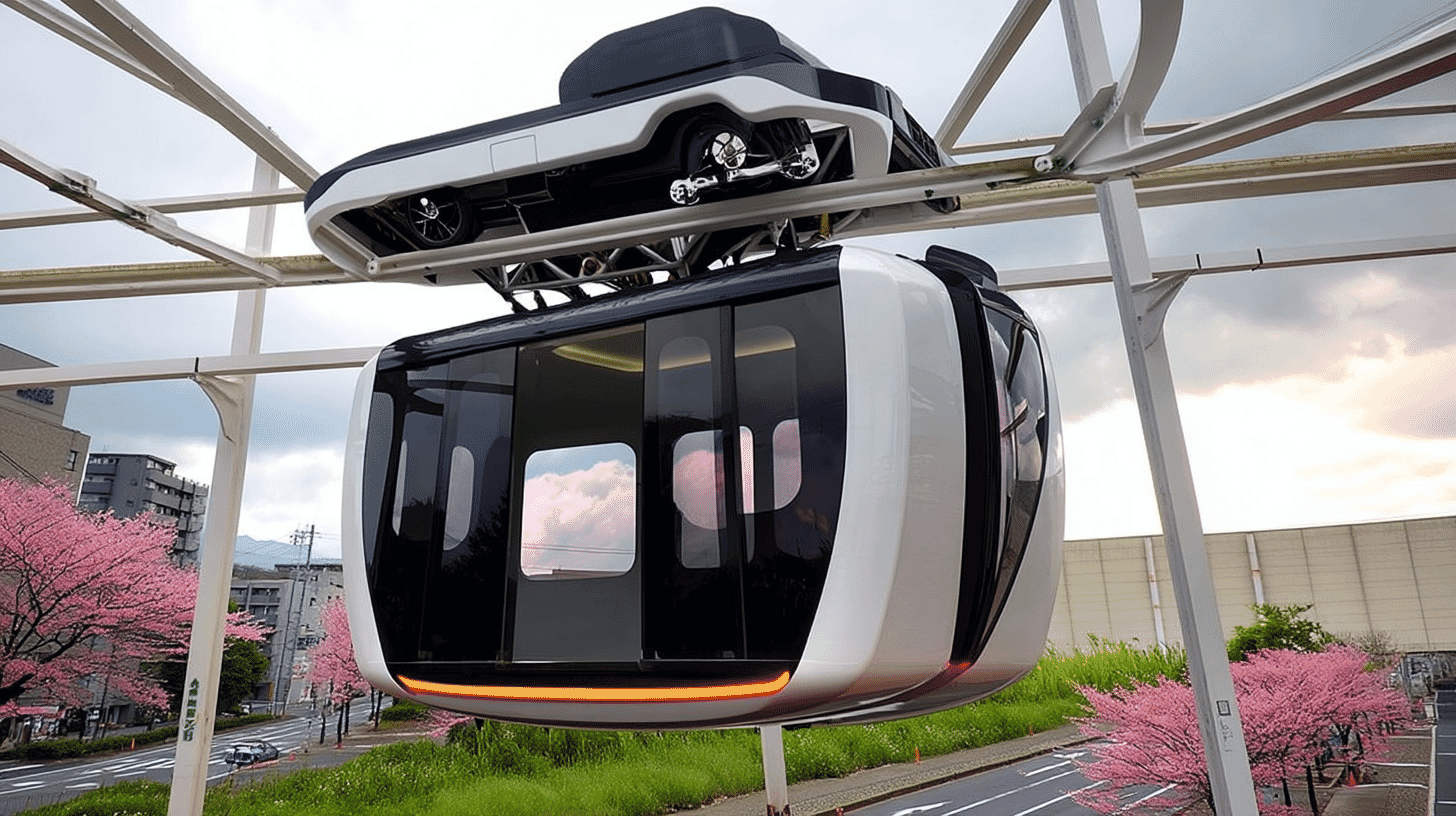
Imagine waiting 30 minutes for a bus that never shows up because there's simply no one to drive it. That's becoming the everyday reality for many Japanese towns where the bus system is quietly collapsing under the weight of an aging population.
Now a startup in Fukushima is pitching a radical answer: a driverless, self-propelled ropeway called Zippar that glides overhead every 12 seconds, bends around street corners, and costs a fraction of a subway line to build.
So, what exactly is Zippar?
Zippar is a next-generation urban transit system developed by Zip Infrastructure, a startup headquartered in Minamisoma City, Fukushima Prefecture. The easiest way to describe it: imagine a ropeway where the rope stays still and the cabin drives itself.
In a classic ropeway (like the ones at ski resorts), a big motor on the ground pulls the entire cable, and the gondolas simply hang on for the ride. Zippar flips this model. Each 12-passenger cabin carries its own motor and battery on top, gripping a fixed cable and propelling itself along.
That small-sounding change opens up a lot of possibilities:
- As short as 12-second headways between cabins
- Tight curves with a 20-meter turning radius, tighter than many tram lines
- Up to 3,600 passengers per hour per direction
- Top speed of 36 km/h, fully autonomous (no driver needed)
Straight sections run on cables; curved sections switch to lightweight steel rails. That hybrid design means Zippar can snake through twisty urban streets, something traditional ropeways simply can't do.
References
Why Japan desperately needs something like this
Japan's public transit is quietly cracking.
When new overtime regulations for bus drivers kicked in on April 1, 2024, the so-called "2024 Problem", things got worse fast. According to Teikoku Databank, roughly 80% of Japan's route bus operators had already cut service or closed routes by 2023. In September 2024, Kyoto City actually issued a "bus driver state of emergency" declaration, warning that maintaining current schedules would soon be impossible.
The root cause is no secret: Japan is running out of drivers. About half of all current bus drivers are in their 50s or 60s, while drivers in their 20s and 30s together make up just over 4% of the workforce. Class 2 commercial license holders keep shrinking year after year. A decade or two from now, staffing today's bus networks will be mathematically impossible.
In Inagi City (western Tokyo), officials have already been forced to abandon plans for a new bus route, not because demand was lacking, but because they simply couldn't hire drivers. This is no longer a rural problem.
"Zippar aims to create a world with no traffic congestion, where every destination is within a 5-minute walk of a station,", Takamasa Suchi, CEO of Zip Infrastructure
Because Zippar is fully autonomous, it eliminates the driver from the equation entirely. A whole line can be supervised by a handful of staff. For a country where the workforce is shrinking every single year, that's not a nice-to-have, it's arguably the entire point.
References
1/20 the cost of a subway, 1/5 the cost of a monorail
Beyond the clever mechanics, the real shock factor is the price tag.
| Transit type | Approximate cost per km |
|---|---|
| Subway | ~30 billion yen (~$200 million) |
| Monorail | ~7.5 billion yen (~$50 million) |
| Zippar | ~1.5 billion yen (~$10 million) |
Zip Infrastructure puts Zippar's construction cost at around 1.5 billion yen per kilometer (about $10 million), roughly one-fifth of a monorail and one-twentieth of a subway. Construction time drops to about a year. Elevated stations run around 500 million yen ($3.3 million); ground-level stations are about 100 million yen ($700,000).
Why so cheap? The core trick is that Zippar uses the empty air above existing roads. No eminent domain battles. No tunnels. No massive viaducts. Just support pillars planted along the curb. In dense Japanese cities where land is the single most expensive ingredient of any infrastructure project, that changes the math dramatically.
From space elevators to street-level transit
Here's an unexpected twist: Zippar's DNA comes from space technology.
Founder and CEO Takamasa Suchi, still just 28 years old, was researching space elevators as a student at Keio University's Faculty of Science and Technology. A space elevator lifts people and cargo vertically from Earth into orbit using a fixed tether and a self-propelled climbing vehicle. Suchi realized the same principle, a fixed cable plus a self-driving cabin, could be rotated 90 degrees and applied horizontally.
He founded Zip Infrastructure in July 2018 while still an undergraduate, and was later named to Forbes "30 Under 30 Asia 2022". A vision originally aimed at the stars has landed, somewhat ironically, at the neighborhood bus stop.
References
A test track in Fukushima, public roads by 2033
In March 2024, the company relocated its headquarters from Hadano, Kanagawa to Minamisoma, Fukushima, partnering with local contractors to build a full-scale test line. In October 2025, the 40-meter "Fukushima Test Line" opened, with 12-passenger Zippar cabins now running actual test operations.
The roadmap rolls out in three phases:
- Now through ~2027: Limited commercial operation on the Fukushima test line; safety certification work
- Around 2028: Deployment in private spaces, airports, theme parks, large industrial sites
- By 2033: Full public transit operation along public roads
Multiple airports and municipalities have already expressed interest. Feasibility studies and cooperation agreements are underway in Ishikari (Hokkaido), Tomiya (Miyagi), Inagi (Tokyo), Narita Airport (Chiba), and Shimizu (Shizuoka), among others. Internationally, the company signed an MOU with the Philippines' Bases Conversion and Development Authority (BCDA) in June 2024 and is now studying a deployment in Baguio City; Manila's chronic gridlock makes the country a natural target market.
Minamisoma itself is worth a note. This coastal Fukushima city, hit hard by the 2011 earthquake and tsunami, is now a designated hub for next-generation tech under Japan's Fukushima Innovation Coast Framework. Drone testing grounds, humanoid robotics startups, and space-launch ventures now cluster together in the same neighborhood, a quiet transformation from disaster zone to deep-tech corridor.
References
- Hama Tech Channel: Interview with CEO Takamasa Suchi
- TV Tokyo Plus: The new transit that arrives every 12 seconds
Tourist destinations are a natural fit
Zippar's potential isn't limited to daily commutes. Some of the most exciting use cases might be in tourism and airport logistics.
Narita International Airport has publicly floated Zippar as a candidate for its inter-terminal transit system under its "New Narita Airport" plan. And the wider tourism applications practically write themselves:
- Historic cities like Kyoto, where preserving street-level views rules out elevated concrete viaducts
- Mountainous destinations like Hakone or Nikko, where tour buses clog winding roads
- Island resorts struggling with last-mile access
- Snow country, where two-cable stability shrugs off wind and heavy snowfall
For destinations where "just add more tour buses" is no longer an option, a self-driving ropeway arriving every 12 seconds is a legitimately interesting third path.
The unfinished homework
None of this is a done deal. Several real obstacles stand between today's test line and tomorrow's commuter system.
- Legal framework: Japan's existing ropeway laws don't quite fit, Zippar is being registered as a new-style rail/transit system, which requires fresh regulatory work
- Resident acceptance: Persuading people that a cabin passing over their house every 12 seconds is actually fine
- Visual impact: Support pillars in heritage districts or residential streets will face pushback
- Gradient and scale: Handling steeper slopes and eventually carrying more passengers per cabin
- Unit economics: A single line may not pencil out; multiple lines sharing infrastructure are likely needed
CEO Suchi himself has called "how cheaply we can build it" the single biggest challenge going forward. The technology is essentially there. The harder question now is whether society is ready to look up and say yes.
Could a Japanese idea ride the world?
The problem Zippar is trying to solve, a shrinking workforce collapsing public transit, is very much not a Japan-only issue. Europe and North America are aging too. Southeast Asian and Latin American megacities choke daily on gridlock that drags down their economies.
That's exactly why Zip Infrastructure's COO, Mario Ian Carlos Felid Revonkin, a Philippine-born engineer, joined the company: to bring the technology home to Manila. It has already signed an MOU with the Philippine government's BCDA and is studying a rollout in Baguio City.
The idea of treating the dead air above a road as a resource may feel distinctly Japanese, a thrifty, land-scarce country squeezing use out of every cubic meter. But the problem it answers is universal.
In Japan, driver shortages and a shrinking population are forcing cities to rethink what public transit even looks like, and ideas like Zippar are getting a serious second look. How is it in your country? Is your public transit running out of drivers? Would you actually ride a driverless ropeway gliding over your street every 12 seconds, or would you prefer to keep the sky above your neighborhood empty?
We'd love to hear what mobility looks like where you live, and what you honestly think of Zippar.






Global Discussion
18 comments