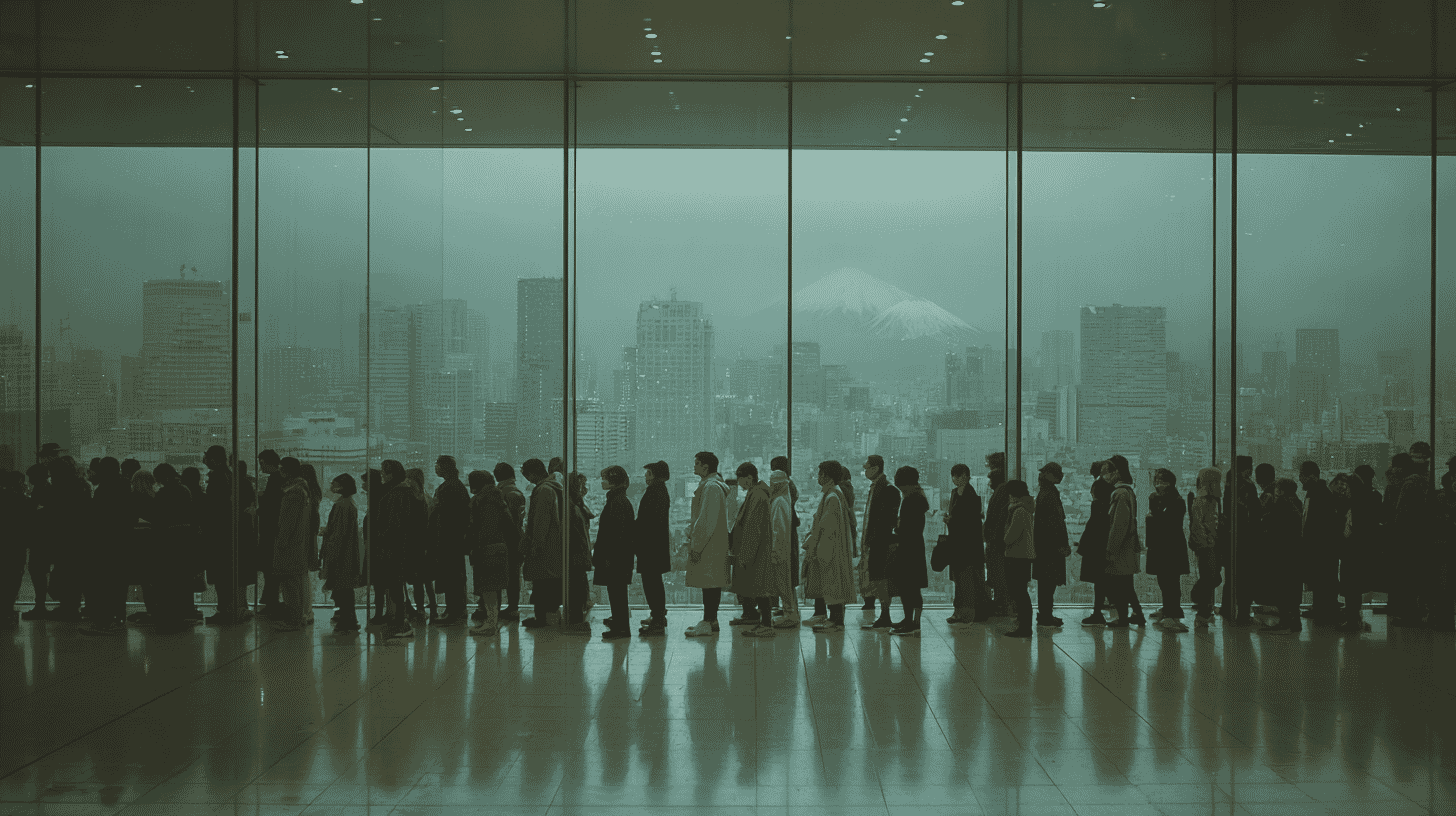
🚨 The fee to apply for permanent residency in Japan goes from 10,000 yen to 200,000. Twenty times. It applies to applications accepted from October 1, 2026, and it isn't a proposal anymore: the draft ordinance is already out for public comment. Around the same time, a system takes effect in April 2027 allowing permanent residency to be revoked from anyone who deliberately fails to pay taxes or social insurance. Language requirements and income thresholds are under discussion. Meanwhile, the number of foreign workers in Japan hit a record 2,571,037 at the end of October 2025. Needing foreign labor and raising the walls are happening at the same time.
The 20x Is Already Decided
The amended immigration law passed on May 29, 2026 and was promulgated on June 5. What the law set were ceilings: 100,000 yen for status changes and renewals, 300,000 for permanent residency. The actual amounts are set by ordinance.
That draft ordinance appeared on July 3. Permanent residency: 10,000 yen to 200,000. Status changes and renewals drop the flat 6,000 and go tiered by the length of stay granted. Ten thousand yen for three months or less, 33,000 for one year, 64,000 for three-to-five years, 75,000 for five years and up. Public comment runs to August 2, and the new fees apply to applications accepted from October 1.
The weight of it becomes obvious at family scale. Say someone on an Engineer/Specialist in Humanities/International Services visa has a spouse and two children with them. Everyone renews on a five-year period and then all four apply for permanent residency: 300,000 yen for the renewals (75,000 x 4), 800,000 for the permanent residency (200,000 x 4). That's 1.1 million yen. Under the current system it would be 24,000 plus 40,000, so 64,000.
There is relief, of a kind. Online filing gets a 3,000 to 10,000 yen discount depending on the tier. But three-months-or-less and permanent residency are excluded, meaning the discount does nothing for the most expensive item. There's also a reduction for financial hardship: 10,000 yen for residence procedures, 20,000 for permanent residency. It exists on paper; what evidence you need and how you file remain to be worked out.
(For the full picture of the law and the new JESTA travel authorization, see our separate piece: Permanent Residency to Cost 200,000 Yen: Japan's Immigration Law Passes, JESTA Arrives)
Permanent Residency You Can Lose
The deeper change might not be the money.
From April 2027, permanent residency can be revoked from residents who deliberately fail to pay taxes or social insurance. Permanent residency has until now been the stable status you never renew, the destination for anyone settling in Japan long-term. It becomes conditional.
The trigger is deliberate non-payment. But "deliberate" isn't clearly drawn, which is why the anxiety running through foreign communities is about the forgotten payment, the botched paperwork. On top of that, a system linking municipalities, the National Tax Agency and immigration through the My Number ID is being built out. Non-payment and lateness become visible in real time.
The requirements themselves are moving too. Revised guidelines in February 2026 made it mandatory that the period of stay you hold when applying be the maximum for that status, which in most cases means five years. A Japanese language requirement and an income threshold are being considered, with nothing settled. For naturalization, there's a proposal to extend the current five-year residence requirement to ten, matching permanent residency. These are still proposals and shouldn't be treated as decided.
2,571,037. But the Growth Is Slowing.
Per figures the Health, Labour and Welfare Ministry released on January 30, 2026, there were 2,571,037 foreign workers in Japan at the end of October 2025. Up 268,450, or 11.7%, a record for the thirteenth consecutive year, and the first time the count has passed 2.5 million since tallying began in 2008. That's about 4% of all employees.
By status, professional and technical categories lead at 865,588, up 20.4%, of which Specified Skilled Worker accounts for 286,225. Status-based residence follows at 645,590, then Technical Intern Training at 499,394.
The rate is the story. That 11.7% is down 0.7 points from the previous year's 12.4%. By nationality it's sharper. Vietnam, still the largest source at 605,906, has slipped from 24.8% of the total to 23.6%. The fastest-growing country is Myanmar at 42.5%, but it was 61.0% a year before. Indonesia is at 34.6%, down from 39.5%. Sri Lanka, 28.9%, down from 33.7%. Even the countries still growing are growing less.
One reason is what Japan pays. In a Mynavi Global survey, the top reasons for not wanting to work in Japan were the weak yen at 35.5% and low salaries at 26.3%, while "I can earn more elsewhere" rose 8.4 points to 10.5%. Vietnam's own growth plus the weak yen has narrowed the wage gap. South Korea has expanded its foreign worker intake to roughly 2.3 times pre-pandemic levels, and Taiwan is moving too. Japan is not the only option anymore.
The ministry itself acknowledges it now competes with South Korea and Taiwan for talent, while adding that some people still choose Japan for its safety and cultural appeal. That sentence is a fairly accurate description of where Japan currently stands.
So Why Raise the Walls Now
The government has arguments.
One is fairness of burden. The National Health Insurance payment rate among foreign residents is reported at 63%, well under the overall 93%. That gap became political pressure. Two is consistency: permanent residency screening was said to vary by region. Three is the political current. Under the Takaichi government, comprehensive measures on foreign resident policy have made tightened residence management a signature policy. Parties like Sanseito argue foreigners should go home once they've worked, and public caution about immigration runs deep.
On fees specifically, the government says Japan was simply too cheap. It has a point. A US green card application runs about $1,440. Australia's Skilled Independent visa (subclass 189) is about A$4,770. Permanent residency via Canada's Express Entry costs about C$1,365. Japan's 10,000 yen was an outlier. Calling 200,000 a correction to international norms is defensible.
There is criticism. Researchers in migration policy point out that Japan has kept the line between "temporary worker" and "long-term resident" blurred while advancing only the enforcement side. Expanding intake while narrowing the path to settling is likely to show up in motivation and retention.
Japan is among the most aged countries on earth and cannot run without foreign labor. What it's putting forward can be read as: please come, please don't stay. Whether a country can keep being chosen while holding that contradiction is an open question. The answer may show up in the application numbers after October.
What does permanent residency cost where you live, and how many years does it take? And once you have it, can it be taken away?
References
- https://www.mhlw.go.jp/stf/newpage_68794.html
- https://www.nikkei.com/article/DGXZQOUA2785N0X20C26A1000000/
- https://www.jiji.com/jc/article?k=2026070300376&g=pol
- https://www.tokyo-np.co.jp/article/499022
- https://office-tree.jp/blog/immigration/zairyu-tesuryo-seireian-public-comment-2026/
- https://global-saponet.mgl.mynavi.jp/know-how/24993
- https://www.moj.go.jp/isa/applications/resources/nyukan_nyukan50.html
- https://blog.gaijinpot.com/japan-visa-fees-are-rising-in-2026-a-guide-for-foreign-workers-and-employers/







Global Discussion
15 comments