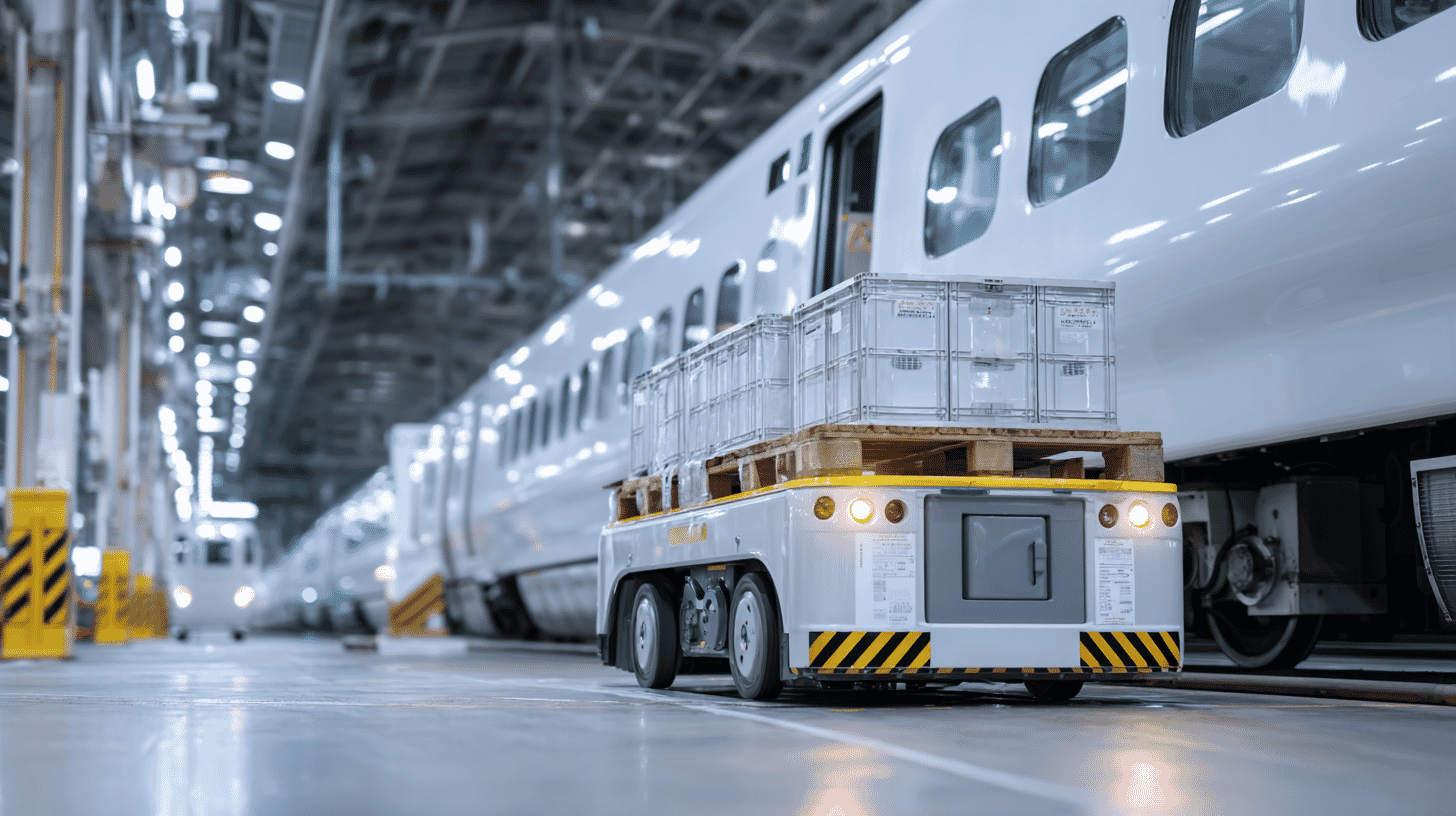
A bullet train with zero seats is no glitch; it is Japan's answer to a serious logistics crisis. A former Yamagata Shinkansen "Tsubasa" train has had all 394 passenger seats removed and been reborn as a "warehouse on rails." At up to 300 km/h and carrying up to 17.4 tons of cargo, Japan's first cargo-only Shinkansen began running in March 2026.
Japan Unveils Its First Seatless Bullet Train
On February 6, 2026, JR East (East Japan Railway Company) publicly revealed the actual vehicle of Japan's first-ever cargo-only Shinkansen at the Morioka Shinkansen Rolling Stock Center. The unveiling came ahead of the train's scheduled service launch on March 23, 2026.
The vehicle is a seven-car E3 Series trainset that previously served passengers as "Tsubasa" on the Yamagata Shinkansen line. Now it has been completely reborn. The exterior features a clean white base with large illustrations of representative cargo items on the lead cars, while the window areas of the middle cars are wrapped with images of 80 different regional products, agricultural goods, seafood, and craft items, from across the Tohoku region.
Step inside, and you won't find a single seat. Instead, the interior is all flat steel flooring with anti-slip coating and belt systems to secure cargo. It's an entirely different world from the Shinkansen tourists know.
Why Use a Bullet Train for Freight? Japan's "2024 Problem"
The creation of this cargo-only Shinkansen is driven by a serious problem facing Japan's logistics industry.
In April 2024, Japan implemented new regulations capping truck driver overtime at 960 hours per year, part of broader labor reforms known as the "2024 Problem" (2024-nen mondai). While this aims to improve working conditions, it effectively reduces the country's freight transport capacity at a time when driver shortages are already chronic. Japan's Ministry of Land, Infrastructure, Transport and Tourism estimates that by 2030, roughly 30% of the nation's freight could go undelivered if nothing changes.
This is where the Shinkansen's strengths come in: speed, punctuality, and environmental efficiency. A bullet train covers the Morioka-to-Tokyo route in about 4 hours. The same trip by truck takes 7-8 hours, with a single driver tied up for the entire journey. JR East estimates that switching to Shinkansen freight on this corridor alone could eliminate approximately 34,310 hours of annual driver labor time.
"Hako-Byun": The Evolution of Bullet Train Logistics
This cargo-only Shinkansen is part of the expansion of "Hako-Byun" (はこビュン), JR East's rail-based cargo transport service launched in 2021. The name combines hako (box) with byun (a Japanese onomatopoeia suggesting something zooming by at speed), essentially "boxes, delivered fast."
Previously, Hako-Byun used spare space on regular passenger trains, a few empty seats or crew areas, to carry limited amounts of cargo. This meant a maximum of about 40 boxes per trip. Shippers consistently asked for higher volume and more frequent service, which led JR East to the radical decision: convert an entire trainset exclusively for freight.
Hako-Byun has already built an impressive track record, transporting fresh fish, agricultural products, precision machinery parts, medical supplies, blood products, and even household moving goods across Japan's Shinkansen network.
Specs of the "Warehouse on Rails"
Here's what this converted E3 Series looks like by the numbers:
All 394 passenger seats across 7 cars have been removed. The floors have been leveled, reinforced with steel plates, and coated with anti-slip material. This allows roll cages (cage carts loaded with goods) to be wheeled directly into the train cars. The maximum payload is 17.4 tons, roughly 1,000 boxes in a single run. That's about five times the capacity of the previous approach using partial passenger cars.
The train runs as a scheduled weekday service, departing the Morioka Rolling Stock Center just before noon and arriving at the Tokyo Rolling Stock Center by around 4:00 PM. During operation, it couples with an E5 Series "Yamabiko" passenger train on the Tohoku Shinkansen line, passenger cars (cars 1-10) in front, cargo cars (cars 11-17) behind.
Loading and unloading happens not at busy station platforms but inside the rolling stock centers (rail depots). JR East has also introduced AGVs (Automated Guided Vehicles) at these facilities. Each AGV can tow about 40 boxes (120-size, approximately 44 lbs each) and navigates slopes and narrow corridors automatically, reducing the need for manual labor.
The train also supports refrigerated transport using onboard power-connected commercial cooler boxes. This means fish caught in the morning in northern Japan can realistically appear in Tokyo shops and restaurants the same evening.
Environmental Impact: 593 Tons of CO2 Saved Annually
The environmental benefits are significant. JR East calculates that shifting the Morioka-Tokyo freight corridor (approximately 335 miles) from trucks to Shinkansen would reduce CO2 emissions by about 593 tons per year, equivalent to the annual emissions of roughly 229 households.
Rail transport produces approximately 1/13th the CO2 per ton-kilometer compared to trucking. In an era when carbon neutrality is a global priority, bullet train freight represents a compelling "green logistics" solution.
Going Global: The JAL Partnership
Hako-Byun's ambitions extend beyond Japan's borders. In January 2026, JR East launched "JAL de Hako-Byun" in partnership with the Japan Airlines Group. This one-stop service moves regional products by Shinkansen to Tokyo Station, then transfers them to JAL cargo flights from Haneda Airport to destinations in Singapore, Kuala Lumpur, Taipei, and Hong Kong.
The first commercial shipment took place on January 13, 2026, when premium seafood from Fukui Prefecture, including Echizen crab and Wakasa grouper, traveled on the Hokuriku Shinkansen "Kagayaki No. 508" to Tokyo, then flew to Taipei, cutting total transit time from over 24 hours to approximately 19 hours.
JR East is also exploring collaboration with Japan Post Group for mail and parcel transport by Shinkansen.
What's Next: Expansion and Purpose-Built Freight Trains
JR East plans to extend Hako-Byun services to the Sendai and Niigata areas. Beyond converting existing trains, the company is also considering developing entirely new Shinkansen vehicles purpose-built for freight, featuring wider doors for more efficient loading.
The company targets annual revenue of ¥10 billion (approximately $66 million) from the Hako-Byun business, envisioning a transformation of the Shinkansen from "a system that moves people" to "infrastructure that moves both people and goods."
Interestingly, this isn't entirely new territory. Back in 1981, Japan National Railways launched "Rail-Go Service" with the slogan "You can send packages by Shinkansen." The service eventually faded as private parcel delivery companies dominated. Now, roughly 40 years later, the concept is being reborn at a completely different scale, driven by a new era of driver shortages and environmental concerns.
A bullet train with no seats. It might just be the quiet beginning of a logistics revolution in Japan.
Does your country face similar truck driver shortages? What do you think about using high-speed rail for freight?
References
- https://trafficnews.jp/post/633268
- https://www.jreast.co.jp/press/2025/20251209_ho02.pdf
- https://www.watch.impress.co.jp/docs/news/2069873.html
- https://livejapan.com/en/article-a0005845/
- https://www.railway.supply/shinkansen-freight-transport-jr-east-e3-cargo-service-set-for-march/
- https://www.nikkei.com/article/DGXZQOCC064L70W6A200C2000000/



Global Discussion
16 comments