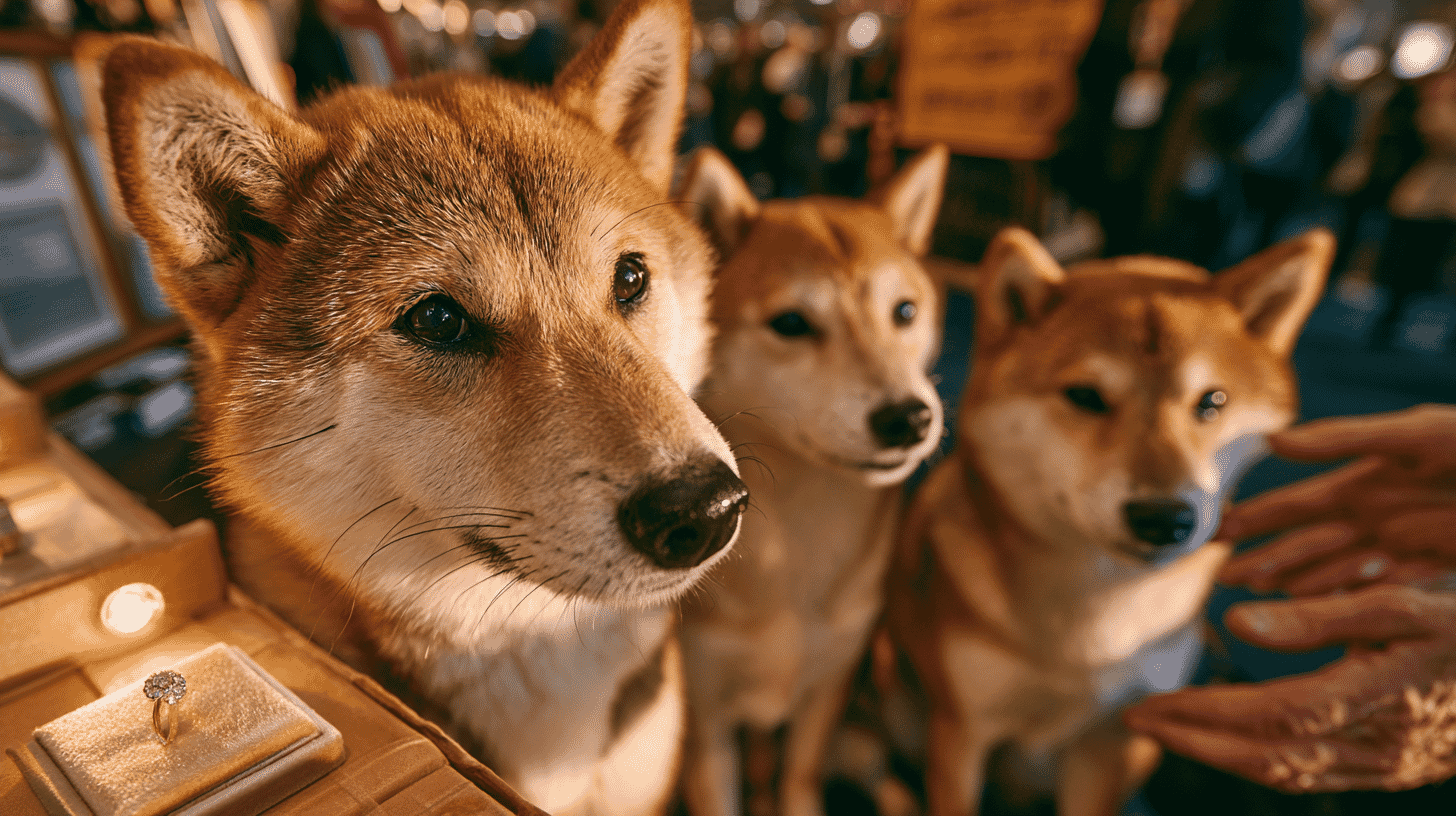
🐾 What becomes of a dog's ashes after a lifetime of walks, naps, and unconditional company? In Japan, a new answer is drawing quiet crowds: a homegrown technology called Livnight that grows a sparkling gemstone from cremated remains, one you can wear every day. At one of the country's biggest pet expos this spring, the Livnight booth pulled in a steady stream of dog lovers, along with some very thoughtful hesitation.
A glittering booth at Japan's biggest pet expo
During Golden Week in early May, Makuhari Messe, a sprawling convention center just outside Tokyo, hosted "Pet博," a national pet expo where families bring their dogs along for the day. Among the booths selling food, toys, and grooming gear, one stood out under a sign that read, more or less, "Gems made from your pet's ashes or fur."
According to a report by Akiko Shigematsu in the Sankei Shimbun, the booth, run under the memorial-jewelry brand Sol & Hug by the Tokyo company Serendipity-Works, drew roughly 1,200 visitors across the three-day event. Some leaned in to study a sample ring, murmuring that it sparkled; others lingered, clearly turning a difficult idea over in their minds. A capsule-toy giveaway kept the mood light, but the product itself asks something serious of anyone considering it.
So what exactly is Livnight?
First, the thing worth clearing up: Livnight is not a diamond. The stone is moissanite, a crystal of silicon carbide that the jewelry world has used for decades as a diamond alternative. The brand name carries the idea of a stone you go on living alongside.
The technology behind it is the part Japan is paying attention to. LIVENT, the Tokyo company that sells Livnight, told the Sankei Shimbun that the process was developed three years ago by a mineral researcher in Funabashi, Chiba. Carbon is extracted from the cremated remains, combined with silicon and a solvent, then sealed and heated so a crystal grows slowly outward from a seed core. Each stone is made by hand, one at a time, in Chiba. According to LIVENT, no one else is producing moissanite from cremated remains in quite this way.
Why Livnight, and not a diamond?
It's a fair question. Turning ashes into an actual diamond has been possible for about twenty years, so why has this homegrown alternative drawn a crowd? Three reasons stand out, and together they explain the appeal.
The first is price. The established route to an ash-diamond uses a high-temperature, high-pressure process dominated by firms in the United States and Switzerland, and a finished stone typically costs well over 1 million yen, roughly $6,300 at the exchange rate when this piece was published, and often considerably more. Livnight is pitched as a far more reachable option: a 4-millimeter stone, equivalent to about 0.2 carats, costs 198,000 yen, around $1,250, with a platinum ring setting starting near 310,000 yen, about $1,950. As one dog owner quoted later in this article put it, that is a realistic number in a way a diamond simply is not.
The second reason is, surprisingly, the sparkle itself. Choosing moissanite is not a downgrade in shine. It bends light more sharply than diamond, a refractive index of about 2.65 against diamond's 2.42, and scatters it into more color. LIVENT says Livnight's light refraction and dispersion both exceed a diamond's, which means it throws off more of the rainbow flashes jewelers call "fire." It is slightly softer than diamond on the Mohs hardness scale, around 9.25 against diamond's perfect 10, but still hard enough to be worn every day for a lifetime.
The third reason is the one that matters most to many owners: the stone never leaves Japan. The diamond route usually means shipping a pet's remains overseas, and to a lot of owners that feels both expensive and unsettling: a long wait with your dog's ashes somewhere on another continent. Livnight is made domestically, by hand, in a single prefecture. For someone reluctant to let those remains travel far, "made in Japan" is not a marketing line. It is the entire point.
A 4-millimeter stone needs roughly 10 grams of remains; a 7-millimeter one, about 15. Test sales began last year, and LIVENT says it has taken 39 orders so far, some of them, notably, for human remains rather than pets.
So is it diamonds only, everywhere else?
Mostly, yes, with an asterisk. If the goal is a gemstone literally grown from the deceased's own carbon, that has meant a diamond just about everywhere, produced by the same high-pressure method and offered by a handful of specialist firms in the United States, Switzerland, and a few other countries. That is exactly what makes Livnight unusual: a moissanite crystal grown from cremated carbon is, by LIVENT's account, close to a first.
But "turning a pet into a gem" is a broader idea than that, and the rest of the world has its own answers. One is memorial glass: a pinch of ashes melted into molten glass and worked into a small colored orb or stone, so the remains become part of the material itself. Another, common across the United States and Europe, is cremation jewelry: a sealed chamber beneath a stone, whether a sapphire, an opal, a cubic zirconia or a lab-grown diamond, holding a tiny amount of ash, sometimes set in clear resin. Pieces like these can start around a hundred dollars.
The real dividing line isn't the name of the stone. It's whether the gem is made of your pet, or made to hold your pet. A memorial diamond and a Livnight stone sit on one side of that line; most ash-infused glass and cremation jewelry sit on the other. Neither is more correct, but it is worth knowing which one you are actually choosing.
"They'll go before we do"
The detail from Sankei's report that stays with you came from a 28-year-old consultant who wandered over to the booth with two Shiba Inu in tow. The price felt realistic next to a diamond, she said, and she had not even known until that moment that a memory could be kept in such a clear, beautiful form.
Then she added something quieter. She already saves her dogs' baby teeth as keepsakes, because, as she put it, they will die before she and her partner do. That sentence holds the whole emotional weight of pet ownership in Japan, where the average dog or cat now lives well into its teens but still, inevitably, leaves first. A memorial gem is, in the end, a way of preparing for a grief you already know is coming.
How Japan learned to say goodbye to its pets
To outside readers, an entire industry built around pet farewells can sound surprising. In Japan it is well established. Pets here are cremated almost as a matter of course, by services run variously by city governments, Buddhist temples, and private companies. Some firms operate mobile cremation vans, smokeless, odorless and deliberately unmarked, that come to the owner's home and return the ashes within the hour.
Temples have offered animal memorial services for generations, with joint memorial pagodas where pets' remains can be interred and prayers offered, an extension of a Buddhist sensibility that animals, too, deserve to be mourned. More recently, a practice called temoto kuyō, keeping a portion of the remains close at home rather than in a distant grave, has taken hold, and memorial jewelry slots neatly into it.
The numbers reflect a real market. The research firm Yano Research Institute estimated Japan's pet funeral and memorial sector at around 79.4 billion yen (roughly $500 million) for fiscal 2021, part of a broader pet industry that exceeds 1.5 trillion yen, or about $9.4 billion. The drivers are familiar: pets are treated as family members, apartment living leaves few households with a garden to bury them in, and an aging, smaller-family society leans on companion animals for company.
A small stone for a long goodbye
What's striking about the Pet博 scene isn't only the technology. It's the care with which people approached it. Handing over an irreplaceable portion of a beloved animal's remains to an unfamiliar process is not a casual purchase, and Sankei noted that plenty of dog owners studied the booth thoughtfully before stepping back. That hesitation isn't a mark against the product. It's a sign of how seriously the decision is taken.
A memorial gem is one option among many, alongside a photo on a shelf, an urn on a small home altar, or simply a collar kept in a drawer. What Japan's pet farewell culture suggests is that there is no single right way to hold on, only the way that lets a particular person keep walking.
In Japan, saying goodbye to a pet has quietly become its own tender, elaborate ritual, and Livnight is its newest chapter. But here is the question worth sitting with. Turning a dog you loved into a gemstone you can wear every day: does that feel like a beautiful way to keep them close, or like a step too far? There is no wrong answer. We would genuinely like to know how the idea strikes you.
References
- Akiko Shigematsu, "「先に死ぬ」犬の遺骨で宝石供養 ペット博出展 国産技術で弔い多様化," Sankei Shimbun / Yahoo! News Japan, May 2026. https://news.yahoo.co.jp/articles/f37bc3ab7a8cf6897d4d73ed6c9f3f5ab7d4ef2d
- Pet博 official site. https://www.pethaku.com/
- "ペット葬儀・供養の種類・費用," PEDGE. https://pedge.jp/reports/funeral/
- "業界レポート: ペット葬祭・霊園" (Yano Research Institute estimate), Buffett Code. https://www.buffett-code.com/articles/industry-report-2009162






Global Discussion
4 comments