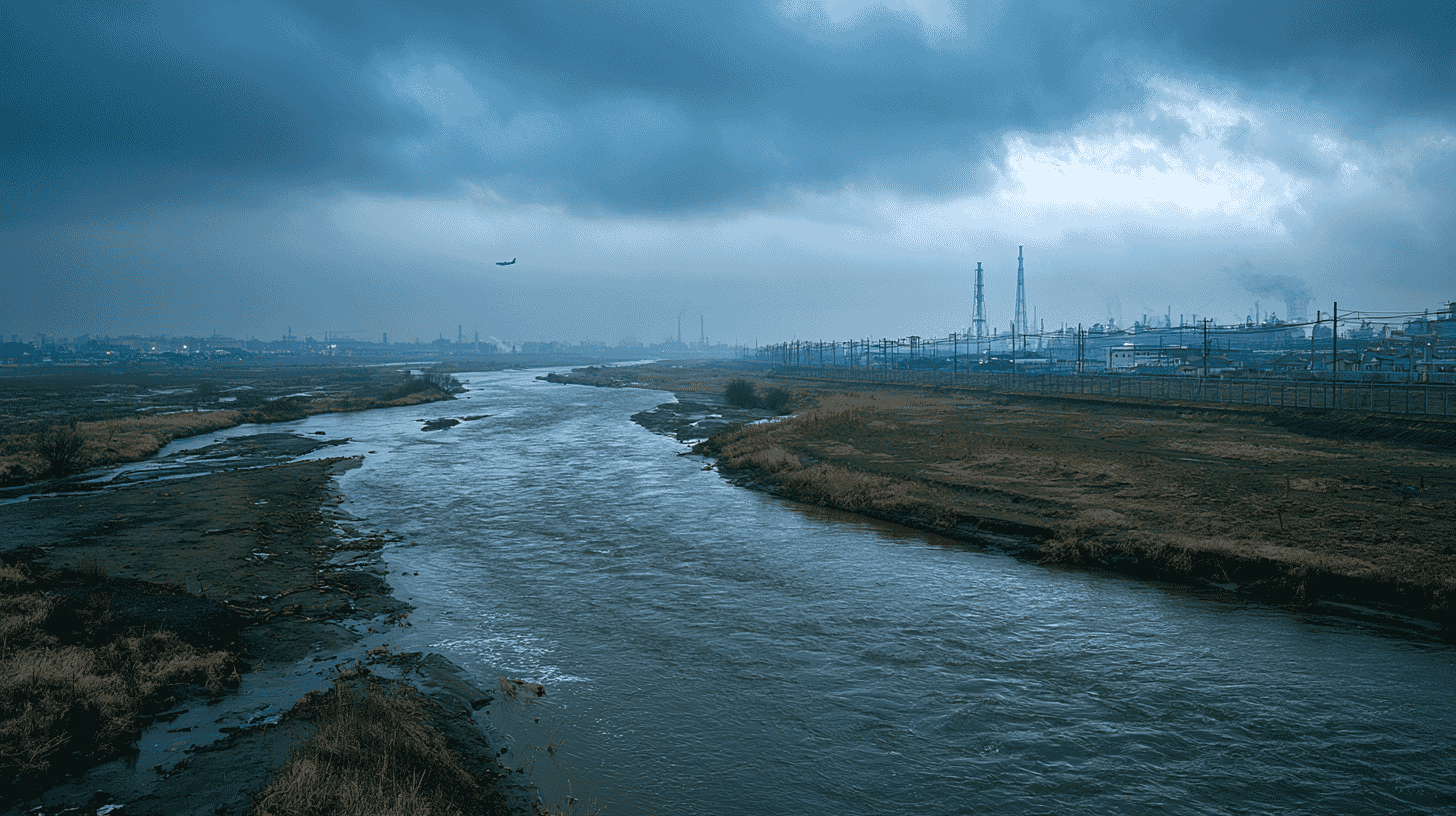
💧 They're called "forever chemicals", and Japan now has them in the tap water reservoirs of half its prefectures. In fiscal 2024, government inspectors found PFAS above the national guideline at 629 monitoring points across 26 of Japan's 47 prefectures. The hotspots cluster around U.S. military bases, factories, and Self-Defense Force installations. A UN special rapporteur has called it a "most serious concern." Japan's drinking-water rules, meanwhile, remain among the loosest in the developed world.
A nationwide map of contamination
On March 27, 2026, Japan's Ministry of the Environment released its annual nationwide water-quality survey for fiscal 2024. The headline number was hard to dismiss.
Of roughly 4,000 sampling points across all 47 prefectures, 629 sites in 26 prefectures exceeded the national guideline of 50 nanograms per liter for the combined total of PFOS and PFOA, two of the most studied compounds in the PFAS family.
The highest single reading was extreme. In the town of Kumatori in Osaka Prefecture, groundwater registered 73,000 ng/L, about 1,460 times the national limit. A river in the town of Kibichuo, Okayama Prefecture, came in at 72,000 ng/L.
For context, the comparable American drinking-water standard for PFOA and PFOS is just 4 ng/L apiece. Japan's 50 ng/L sum, until very recently, was not even legally binding.
The previous year's survey, covering fiscal 2023, had flagged 242 sites in 22 prefectures. Simple comparisons are misleading, since the 2024 survey covered more sampling points, but the geographic expansion is real. Hokkaido in the far north now appears alongside Okinawa in the deep south.
What is PFAS, and why should anyone care?
PFAS stands for per- and polyfluoroalkyl substances, a family of more than 10,000 synthetic chemicals invented in the mid-20th century. They are prized for their ability to repel water, oil, and heat. They are in nonstick cookware, waterproof jackets, fast-food wrappers, stain-resistant carpets, dental floss, cosmetics, and most notoriously in the firefighting foam used at airports and military bases worldwide.
The same chemical bonds that make PFAS useful also make them nearly indestructible in nature. They resist chemical breakdown and may persist for decades or longer, hence the nickname "forever chemicals."
Once they enter a water table, they stay. Once they enter a human body, they accumulate.
The health record reads like a checklist of modern anxieties. Large epidemiological studies in the United States have found that people with higher blood-PFAS levels are more likely to develop kidney cancer, thyroid disease, ulcerative colitis, high cholesterol, and immune-system effects. Other documented risks include fetal and infant growth impairment and reduced antibody response. A 2025 study by the Muribushi Okinawa Clinical Training Center linked elevated blood levels of one PFAS variant, PFHxS, to a higher risk of myocardial infarction and stroke in a sample of 400 Okinawans.
These risks are statistical, not deterministic, exposure does not guarantee illness. But the science has tightened sharply over the past five years, and regulators around the world have responded by tightening limits.
Japan has not, at least not yet at the same pace.
The U.S. military base problem
The map of Japan's PFAS hotspots overlaps unmistakably with the map of its U.S. military installations. The story begins not in Tokyo but in Okinawa, the southern island that hosts roughly 70% of U.S. military facilities in Japan by area.
PFAS contamination in Japan was first publicly confirmed in January 2016, when Okinawa Prefecture's 2014 water survey revealed high levels in the Daikujaku River near Kadena Air Base. The reading of 1,379 ng/L was about 28 times the eventual national guideline.
It got worse. In April 2020, a U.S. Marine Corps base in Ginowan released 140,000 liters of PFAS-laced firefighting foam beyond its perimeter into a civilian neighborhood. The most recent Okinawa survey, released in March 2026, recorded 2,800 ng/L at the Yara Hijaga spring in Kadena town, about 56 times the national standard and the highest reading in a decade. PFAS exceeded Japan's water quality standard at 31 of 44 sampling sites surveyed around U.S. bases.
The Tokyo side of the story centers on Yokota Air Base in the western Tama region, headquarters of U.S. Forces Japan. Tokyo metropolitan groundwater data has detected concentrations 27 times the national guideline about one kilometer southeast of Yokota, the highest reading in the capital. Groundwater in the area flows from west to east, and all 40 wells where Tokyo halted intake since 2019 are located on the east side of the base.
A trove of internal U.S. military documents helped explain why. Between 2010 and 2023, Yokota Air Base experienced eight separate spills involving PFAS-laden firefighting foam. The most serious occurred in 2012, when about 3,000 liters of foam concentrate leaked from a storage tank at building 530, the base fire station, and seeped into the soil over the course of more than a year before being noticed. The U.S. military did not notify Japanese authorities at the time.
More recent incidents have continued. In January 2025, approximately 760 liters of foam-contaminated water leaked from a sprinkler system in a shopping-mall loading dock inside Yokota. The replacement foam, marketed as a PFAS-free alternative, turned out to contain high concentrations of both PFOS and PFOA. In 2024, after heavy rain, PFAS-contaminated water from Yokota's firefighting training area is suspected to have flowed into Fussa City and then into the Tama River.
The U.S. military's position, repeated almost verbatim across statements, is that PFAS is a "shared concern" tied to both military and civilian sources. A U.S. Forces Japan spokeswoman stated PFAS in the environment is associated with not only military operations but also civilian industrial activities throughout Japan, including fire response, sewage treatment plants, solid waste landfills, and chemical plants regardless of nationality.
That framing is technically accurate. It is also conveniently broad.
The wall: a 1960 agreement and a "no-entry" zone
The legal architecture preventing comprehensive investigation is the U.S.-Japan Status of Forces Agreement, signed in 1960.
Article 3 of the agreement grants the United States full management authority within base perimeters, the "exclusive management right." Without U.S. permission, not even the Japanese prime minister can enter a U.S. military base.
In 2015, the two governments signed a supplementary environmental agreement. It commits the U.S. side to give "due consideration" to Japanese requests to inspect, take samples, or visit a site, but only after the U.S. military itself has declared an environmental incident has occurred. Okinawa Prefecture has made six requests to enter U.S. bases to investigate PFAS contamination. Only two have been granted.
Compare this with Germany, which also hosts a substantial U.S. military presence. Under the supplementary agreement to the NATO Status of Forces Agreement, German federal, state, and municipal authorities can enter U.S. bases when they deem it necessary to protect German interests, with prior notice in ordinary cases, and without notice in emergencies. Local governments hosting U.S. bases are issued standing passes for unrestricted entry.
In the United States itself, the legal exposure is even sharper. Under the Comprehensive Environmental Response, Compensation, and Liability Act, the U.S. military bears legal responsibility for cleaning up domestic PFAS contamination. A 2025 GAO report estimated that decontaminating the area around the Joint Base Pearl Harbor-Hickam fuel storage complex in Hawaii could take more than 30 years.
In Japan, that obligation does not legally apply. Japanese environmental law does not extend inside base fences.
A UN rapporteur weighs in
The contradiction has now reached the United Nations. In late 2024, Marcos Orellana, the UN Special Rapporteur on the implications for human rights of the environmentally sound management and disposal of hazardous substances and wastes, visited Okinawa at the prefecture's invitation. He toured U.S. base perimeters, met with the mayor of Kadena, and visited contaminated springs including the Yara Ubuga in Kadena town and Chunnaga in Ginowan.
In February 2025, Orellana, together with Pedro Arrojo-Agudo, the rapporteur on the human right to safe drinking water and sanitation, sent a formal letter to the Japanese government conveying "most serious concern." The letter cited specific contamination data and posed eleven questions about Japan's response.
Among the points raised: that Japan's 50 ng/L provisional guideline lacks legal force and is far weaker than the U.S. EPA's 4 ng/L drinking-water limit; that 2022 surveys around Futenma found PFAS up to 1,400 ng/L (28 times the limit) at 11 spots, and up to 2,100 ng/L (42 times the limit) at 12 spots around Kadena; that soil at a Futenma-area school tested at 6,600 ng/kg for PFOS, with no Japanese soil-PFAS regulation in existence.
The rapporteurs concluded that contamination from U.S. military operations threatens the right to life, health, and a healthy environment for both current and future generations, and that the loss of spring water for traditional rituals such as newborn bathing constitutes an infringement on cultural rights.
In a press conference, Orellana put it directly: "The connection between military facilities and PFAS contamination is clear." He added that the polluter-pays principle is both an international environmental law principle and a human rights one, and that military activity should not be an exception.
Japan's official reply, submitted in April 2025, did not concede the framing. The government stated it was "responding steadily based on scientific knowledge" and pointed to existing measures.
It's not just military bases
The Yokota and Okinawa cases dominate the news cycle, but Japan's contamination map has other troubling clusters that have nothing to do with the U.S. military.
The most striking is Kibichuo, a town of about 10,000 people in the mountainous interior of Okayama Prefecture, roughly 40 minutes by car from Okayama Station.
In October 2023, the town announced that the Enjo water purification plant, which supplied drinking water to about 1,000 residents, had been delivering tap water with PFAS levels up to 28 times the national guideline. The contamination had been ongoing for at least three years.
The source was unexpected. Sacks of "used activated carbon", the very material widely used to filter PFAS out of water, had been stockpiled at an outdoor site since 2008 under a monthly land-lease agreement with a local activated carbon manufacturer. The carbon had presumably been used in industrial PFAS removal somewhere else, then transported to Kibichuo for recycling. Once there, rain leached its absorbed chemicals into the watershed.
Residents who had drunk the water for years began blood testing. The results were sobering. More than half of the residents tested by Kyoto University researchers reported conditions linked in U.S. epidemiology to PFAS exposure: high cholesterol, miscarriage, fertility difficulty, liver dysfunction, and thyroid disorders. One resident, who had moved to Kibichuo in 2011 in search of self-sufficient rural living, had suffered three miscarriages despite being otherwise healthy.
The mayor has since pledged publicly funded blood testing and a long-term health study in partnership with Okayama University.
In Settsu, Osaka Prefecture, the contamination has been traced to the Daikin Industries Yodogawa Plant, which produced PFOA from the late 1960s until ending domestic PFOA manufacturing in 2012. Groundwater near the site has tested at 30,000 ng/L, or 600 times the guideline. Local residents who grew vegetables in their gardens using well water told journalists they had "never even heard of PFAS" until the testing began. On December 23, 2025, roughly 800 residents filed Japan's first PFAS-related pollution mediation petition against a corporation, demanding health surveys, disclosure of internal data, and a damages framework.
The 26-prefecture map, in other words, is not a story of one villain. It is a story of fifty years of unregulated industrial use, slowly seeping into half of Japan.
What's on your plate
So far the conversation has been about water. The harder question, the one regulators in Tokyo are now actively studying, is food.
Japan's Ministry of Agriculture, Forestry and Fisheries published its first nationwide PFAS food survey in August 2025, covering four PFAS variants (PFOS, PFOA, PFNA, PFHxS) across 15 categories of domestic agricultural and seafood products. The sampling included potatoes, cabbage, tomatoes, rice; beef, pork, chicken, milk, eggs; sardines, bonito, cod, clams, and notably ayu, a small freshwater fish that is one of Japan's most iconic seasonal foods.
A 2023 preliminary survey of seafood had already concluded that fish and shellfish are the main route of PFAS exposure in a typical Japanese diet. The new follow-up survey, now released, gives the first systematic baseline.
The agriculture ministry has not yet set enforceable food limits. Other regulators have moved faster: the European Food Safety Authority issued food-based PFAS health guidance in 2020 that sharply lowered tolerable weekly intake, while the U.S. FDA continues to study seafood and produce.
For now, the practical takeaway in Japan is narrower: residents living near known contamination hotspots are being told to avoid drinking from local springs, while general consumers are not, for now, being told to change their diets.
A regulatory shift, finally
Pressure has been building, both domestically and internationally, and on April 1, 2026, Japan crossed a long-delayed line.
As of April 2026, water utilities (mostly municipal) are required to conduct regular PFAS testing under new tap-water quality standards, as part of obligations under the Water Supply Act. Inspections must occur every three months in principle. The 50 ng/L combined PFOS/PFOA threshold is no longer a provisional advisory: it is a legally binding standard.
According to a central government survey covering April 2020 to August 2025, PFAS testing was already being conducted at about 98% of utilities serving more than 5,000 people and 85% of smaller utilities. 19 utilities had recorded values above the provisional target, though most have since dropped below it.
That is progress. But the new Japanese threshold is still 12.5 times higher than the U.S. EPA's enforceable 4 ng/L standard for PFOA and PFOS. The European Union, meanwhile, is moving toward sweeping restrictions, five European countries (Denmark, Germany, the Netherlands, Sweden, and EEA-member Norway) submitted a proposal under REACH to ban manufacture and import of roughly 10,000 PFAS substances. Denmark has set 2 ng/L; Sweden 4 ng/L; Germany aims for 20 ng/L by 2028.
Japan's 50 ng/L sits in a category of its own among advanced economies.
There is one more development. Internationally, the Stockholm Convention on Persistent Organic Pollutants, to which Japan is a party, moved in 2025 to add long-chain perfluorocarboxylic acids (LC-PFCAs) to the list of substances slated for global elimination. In December 2025, Japan's cabinet approved an amendment to the Chemical Substances Control Law that will newly ban 10 categories of PFHxS-containing products and apply stricter rules to existing stockpiles of PFAS-laden firefighting foam, with most provisions taking effect on June 17, 2026.
The momentum is there. The lag is significant.
What changes now, and what doesn't
For someone living in Tokyo, Osaka, or Naha, the tap water that flows in 2026 is, in nearly all cases, already below 50 ng/L. The Kibichuo water treatment system, once the worst case, has been remediated, and current readings are below the analytical detection threshold of 5 ng/L. Affected wells have been taken offline. Activated carbon filtration is being upgraded.
What has not been resolved is the inventory of legacy contamination already in the ground, the question of who pays, and the question of whether U.S. military operations on Japanese soil will ever be subjected to the same environmental scrutiny applied to U.S. operations on American soil.
The "polluter pays" principle that Orellana invoked at the UN remains, in Japan's case, more aspiration than legal reality.
For now, the country is choosing transparency over urgency, measure more, publish more, regulate slowly. Whether that approach holds when the second wave of food-safety data arrives is the question that will define the next few years.
Update. Two things moved after this piece was published. In Settsu, a second group of about 300 residents filed on May 26, 2026, bringing the total number of claimants against Daikin to roughly 1,100, and the first mediation session was held on July 1. Japan's first pollution mediation against a company over PFAS is now actually under way. Separately, the ordinance naming the 117 specific PFHxS-related substances covered by the Chemical Substances Control Law was promulgated on April 17, 2026 and took effect on June 17. Manufacture, import, and use of those 117 substances are now banned in principle, along with imports of ten product categories including water-repellent fabrics and fire extinguishers.
PFAS contamination is, in the end, less a crisis than a slow-motion accounting: of fifty years of industrial convenience whose bill has finally come due. What does the bill look like where you live? Are PFAS-tainted military sites or factory zones part of the local conversation, or is your country still in the discovery phase? We'd love to hear how this is unfolding from your side of the world.
References
- Tokyo Shimbun: the nationwide PFAS survey (Japanese)
- Tokyo Shimbun: Yokota base and Tama groundwater (Japanese)
- Tokyo Shimbun: US military documents on the leaks (Japanese)
- Tokyo Shimbun: tracing the Kibichuo source (Japanese)
- Tokyo Shimbun: Settsu and Daikin Industries (Japanese)
- Yahoo! News Expert: analysis of PFAS regulation in Japan (Japanese)
- HURIGHTS Osaka: the UN special rapporteurs' letter (Japanese)
- QAB Ryukyu Asahi: the rapporteur's Okinawa visit (Japanese)
- Stars and Stripes: PFAS around Kadena and Futenma
- The Japan Times: mandatory PFAS testing for water suppliers
- Ministry of Agriculture: PFAS in food (Japanese)
- US EPA: PFAS and drinking water






Global Discussion
0 comments