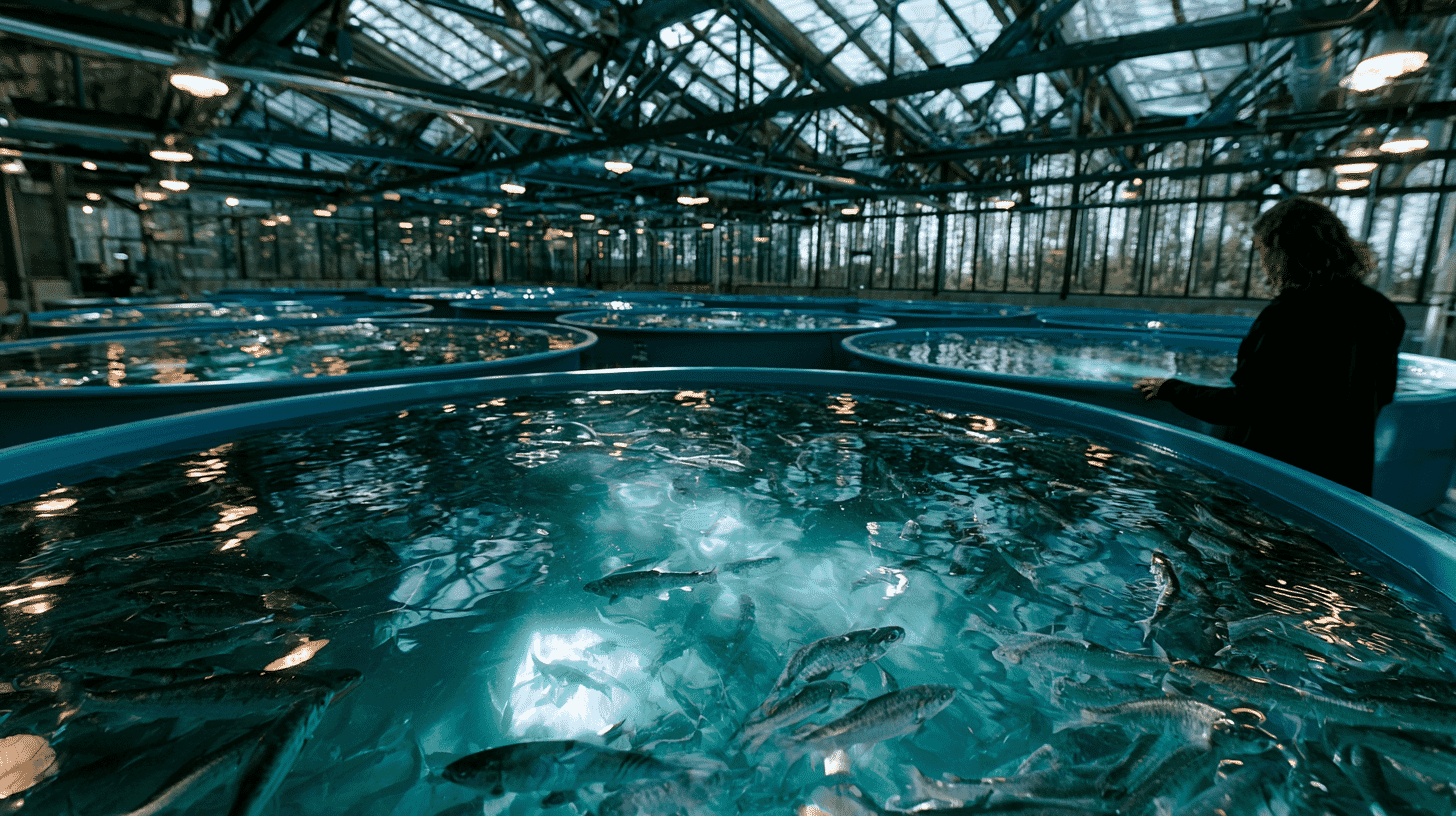
🐟 In a lab on a hilltop in Okayama, nowhere near the ocean, about 2,000 young salmon are swimming in tanks of water that is neither seawater nor fresh. The team raising them isn't just farming fish. They're trying to close a loop no one has ever closed: raising salmon through their whole life, egg to egg, entirely on land. The university says that, if it works, it would be a world first. The bigger story is why anyone would attempt it now, and how a 250-year-old salmon town in northern Japan ended up commissioning the work.
The water that pretends to be the sea
The strange part isn't the fish. It's the water.
Most farmed fish need either freshwater or seawater, and switching a fish between the two is stressful, sometimes fatal. A team at Okayama University of Science spent years getting around that problem. In 2006, associate professor Toshimasa Yamamoto developed what he calls kouteki kankyousui, roughly "ideal environment water." Seawater contains dozens of dissolved substances, but a fish really only needs a few of them to manage the salt balance inside its body. Yamamoto stripped the recipe down to three (sodium, potassium and calcium) at a low concentration. The result is a liquid that both freshwater fish and saltwater fish can live in comfortably.
That sounds like a parlor trick until you see what it unlocks. Because the water is so simple and runs through a closed filtration loop, it barely has to be replaced. According to the university, some tanks have gone well over a year, in some cases years, on the same water, with microbes doing the work of breaking down waste. No ocean pumping. No tides. No pathogens or parasites hitchhiking in from the sea.
The track record is what makes the claim hard to wave off. Using this water, the Okayama group has raised and sent to market tiger pufferfish (sold under the cheeky name "Ridai Fugu"), Japanese eel, flounder, black tiger shrimp, and even bluefin tuna, branded memorably as "Forest Tuna," because it was grown far inland. The technique has traveled, too: in landlocked Mongolia, where there is no coastline at all, a partner project has grown saltwater grouper to seven kilograms in the middle of the steppe. For a method that began, in Yamamoto's telling, because his hillside campus simply didn't have enough seawater to work with, that is a long way to come.
Why salmon is the boss level
So why is salmon the hard one?
Because salmon don't stay put. A chum salmon, the species at the center of this work and the familiar shake of Japanese kitchens, is born in a river, swims to the sea as a juvenile, ranges thousands of kilometers across the cold North Pacific toward the Bering Sea over several years, then navigates back to the exact river where it hatched to spawn and die. To recreate that on land, you have to satisfy a fish that is biologically programmed to move between freshwater and saltwater at different stages of its life. This is precisely the wall that "ideal environment water" is built to remove: a single tank chemistry the fish can stay in from start to finish.
It's worth being precise about the "world first" claim, because salmon is hardly an exotic dish. Atlantic salmon, a different species, is farmed at enormous scale in Norway and Chile, increasingly in land-based systems. So farmed salmon itself is old news. What the Okayama researchers are claiming is narrower and harder: completing the entire life cycle of this Pacific salmon on land, raising fry into adults, taking eggs from those adults and hatching the next generation, without ever borrowing from the wild. That full circle, they say, has not been closed for this fish before.
The current cohort is early but encouraging. The roughly 2,000 fry are kept at around 14°C, and since early April they have grown to about 17 centimeters and 40 grams, nearly doubling in length and quadrupling in weight in a matter of weeks. Crucially, the team reports that the salt-handling cells in the young fish's gills have already shifted into a seawater-ready state, a sign the water is doing its job across the developmental switch that normally requires a trip to the ocean. This isn't the group's first attempt with salmon, either: back in 2015 they grew chum salmon to about 1.2 kilograms in the same water, and the food-industry people who tasted it came away talking about how rich and fatty it was. The goal this time is to close the loop within two years. The contract with Murakami runs for two years from April 2026, and the university expects the fish to reach about a kilogram in year one and 1.5 to 3 kilograms by year two.
Update: By early July 2026, local broadcasters reported the young salmon had reached roughly 20 centimeters. The team plans to grow this cohort to 2–3 kilograms before moving on to stripping eggs and hatching the next generation.
A salmon town with a 250-year head start
The experiment is being run as commissioned research for Murakami, a small castle town on the coast of Niigata Prefecture, and that detail is the heart of the story.
Murakami doesn't just eat salmon; it is organized around it. Locals call the fish iyoboya, a dialect word built from two older words that both mean "fish": salmon as the fish of fishes. The town claims more than a hundred distinct salmon dishes and wastes almost nothing, cooking the head, the organs, the bones and the skin. Salmon from the local Miomote River were sent as tribute to the imperial court in Kyoto over a thousand years ago.
Murakami also happens to be where humans first learned to manage a salmon run on purpose. In the 18th century the domain's salmon were collapsing from overfishing. A low-ranking samurai named Buheiji Aoto grasped something his contemporaries hadn't: salmon return to the river where they were born. Around 1763 he engineered a protected side channel of the Miomote where the fish could spawn undisturbed, a system called tanegawa, the "breeding river." It is often described as the world's first deliberate use of natural salmon propagation, and it worked spectacularly; the catch multiplied, and the domain's finances recovered. A century later, in 1884, Murakami's river recorded over 737,000 returning salmon, still a single-river record in Japan.
Here's the irony that makes this article worth writing. Aoto's genius was to send the fish out and trust them to come back. Today that bargain is breaking down: across northern Japan, fewer and fewer released salmon are returning, and Murakami feels it. Japan's Fisheries Research and Education Agency put the 2025 return rate at 0.66% nationwide, the lowest since 1989, and at 0.06% in Niigata; warming seas have pushed yellowtail and Spanish mackerel north, and they eat the released fry. The town's quiet fear is that its defining fish is slipping away. Which is why it turned to a lab on an Okayama hillside with a radical proposition: stop relying on the round trip altogether. As Yamamoto puts it, completing the whole cycle on land could be the decisive move to carry this salmon culture into the 21st and 22nd centuries. A 250-year-old release-and-return tradition is now placing a bet on never releasing the fish at all.
Behind it all, a hungrier planet
Step back and there's a market reason this is happening now.
Salmon has quietly become one of the world's favorite fish. Sushi, sashimi, grilled, smoked, in a stew, it goes everywhere, and demand has climbed across Asia, Europe and the Americas on the back of health-conscious eating. Japan illustrates the dependence neatly: salmon and trout make up roughly a tenth of the fresh seafood Japanese households buy, and about 80% of it is imported, much of it flown in from Norway and Chile. As global demand, shipping costs and a weak yen stacked up, the price of imported salmon ran up by roughly half between 2019 and 2023. (At roughly ¥160 to the dollar as of July 2026, the weak yen alone makes every imported fillet noticeably more expensive than it was.)
That math has set off a domestic land-farming race that "ideal environment water" now slots into. Maruha Nichiro and Mitsubishi have a joint venture, Atland, building one of Japan's largest land-based salmon operations in Nyuzen, Toyama: 2,500 tonnes a year, cleverly using cold deep-sea water from Toyama Bay to chill the tanks, with first shipments targeted for fiscal 2027. Fishing giant Nissui is constructing a facility aiming for 10,000 tonnes. These are about scale and supply security. Okayama's project is a different bet, not the biggest tanks but the deepest control: a fish that never touches the sea, in water you can stand up almost anywhere, even where there is no coast.
Whether the loop closes in two years, nobody can promise yet: the salmon still have to grow up, pair off and produce a viable next generation in captivity. But the direction is hard to miss: the cutting edge of fish farming is moving indoors, inland, into water humans design from scratch.
In Japan, a samurai once saved the salmon by letting them go. Three centuries later, the plan is to keep them home. Where you live, is the seafood on your plate still coming out of the wild, and would you eat a salmon that had never seen the ocean?
References
- https://news.yahoo.co.jp/articles/b5862b8d1959936db74c4067e9c45f9f95c7c900
- https://www.rikelab.jp/post/10959.html
- https://www.minato-yamaguchi.co.jp/minato/e-minato/articles/76492
- https://www.life.ous.ac.jp/staff/staff-779/
- https://www.city.murakami.lg.jp/site/kanko/aoto-buheiji.html
- https://ja.wikipedia.org/wiki/%E9%9D%92%E7%A0%A5%E6%AD%A6%E5%B9%B3%E6%B2%BB
- https://www.maruha-nichiro.co.jp/corporate/news_center/news_topics/2022/06/30_2.html
- https://www.mizuhobank.co.jp/corporate/industry/pdf/msif_231.pdf






Global Discussion
4 comments