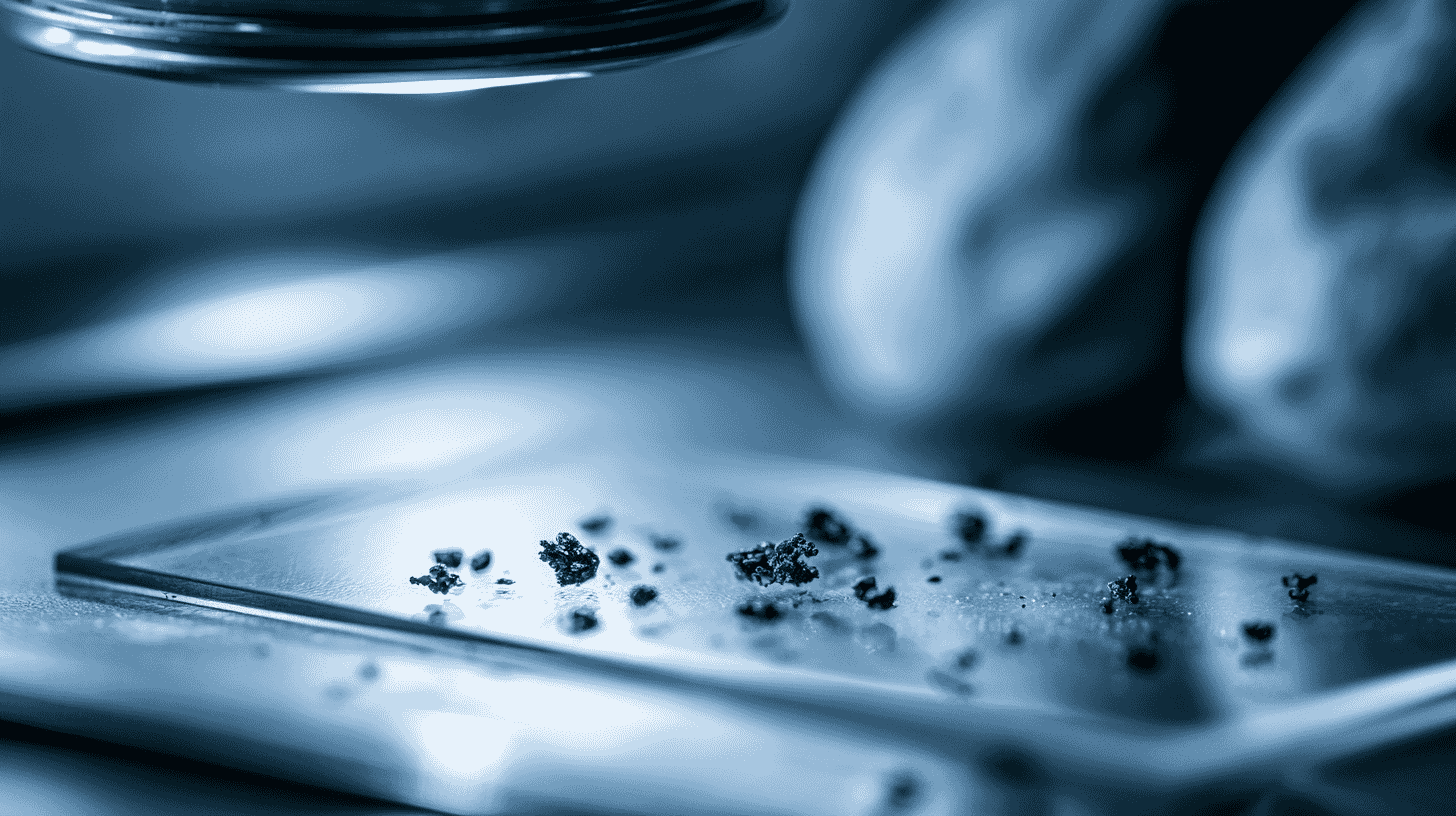
🔬 Hayabusa2 brought about 5.4 grams of asteroid Ryugu back to Earth, and a few of its grains contain tiny crystals of salt. A team led by the University of Tokyo has now asked where the rest of Ryugu's sodium and chlorine is. Nearly all the sodium sits between the layers of a clay mineral, and about 90% of the chlorine is built into the crystals of another mineral. At most about a tenth of either is salt. From that, the team estimates that the water which once soaked Ryugu's parent body was roughly a hundred times less salty than the sea.
That puts the paper at odds with research we covered in September, which read the same kind of grains as the record of a concentrated brine.
Where the salt went
The paper appeared in Nature Communications on October 16, 2026. It comes from Yoshio Takahashi's group at the University of Tokyo's Graduate School of Science. The first author, Takahiro Kawai, did the work as a doctoral student there and is now a researcher at the Japan Synchrotron Radiation Research Institute (JASRI). JAMSTEC, Japan's marine science agency, also announced the result, but it is one of several partner institutions rather than the lead.
The method is called X-ray absorption near-edge structure, or XANES. Tune an X-ray beam through the energy at which an element absorbs, and the shape of the absorption curve shifts depending on what that element is bonded to. Compare it with curves from known reference minerals, and you can estimate what share of the element sits in each form.
Sodium came out simply. Nearly all of it sits between the layers of saponite, a clay mineral, held by ion exchange, much as the resin in a water softener holds sodium. Less than 10% is present as sodium chloride.
Chlorine was a different story. About 90% of it matched lizardite, a member of the serpentine family, with chlorine sitting inside the crystal in place of a hydroxyl group. The rest, about 10%, is most likely sodium chloride.
So the Japanese headline on both press releases, "not salt but adsorbed," fits the sodium but not quite the chlorine. The chlorine is not stuck to a surface. It is part of the crystal.
The fitting method cannot reliably resolve a component below about 5 to 10% of the total, so both figures for salt sit at the edge of what it can see.
A thin, alkaline water
From where the elements ended up, chemical equilibrium calculations reconstruct the water that left them there. Dissolved ions came to about 7 milliequivalents per kilogram, roughly one-hundredth of seawater (about 0.6 eq/kg). The water was strongly alkaline, at pH 10.3 to 11.5, and highly reducing. Hydrogen gas may have exceeded 1 bar, which the team takes as a sign that the alteration happened under a frozen surface layer that kept the gas in.
That is 10 to 100 times less salty than earlier estimates for CI-type meteorites, the kind Ryugu most resembles, at similar water-to-rock ratios. Those models, the paper says, often assumed water rich in sodium and chlorine. This one subtracts what the clay and the serpentine were holding.
The estimate rests on an assumption: only about a tenth of the chlorine, the share found as sodium chloride, was dissolved. If all of it is treated as soluble, the paper reports, the estimated pH falls below 9.8. The authors say their X-ray data rule that out, but the whole reconstruction turns on it.

Source: University of Tokyo, Graduate School of Science
Same sand, two readings
In September we covered a study led by Toru Matsumoto of Kyoto University's Hakubi Center that found nitrogen beside Ryugu's salt veins, including ammonium in the saponite next to sodium carbonate. Behind it stood a paper his team published in Nature Astronomy in November 2024, which read the sodium-bearing carbonates, sulfates and chlorides it found in Ryugu grains as signs that very salty water once flowed far out in the solar system.
The new paper cites the 2024 work directly and accepts part of it, including sodium chloride crystals smaller than 200 nanometers inside sodium carbonate. Its argument is about quantity. In that sodium carbonate region there are about 2 chlorine atoms per 1,000 sodium. Ryugu as a whole has about 8 per 100. The veins cannot account for the bulk chlorine, so most of it must be elsewhere, and Kawai's team places it in the serpentine.
The paper even proposes a bridge. As the water froze and shrank, chloride could have been taken up into lizardite, releasing hydroxide ions that made the remaining water more alkaline and helped sodium carbonate settle out. In that picture, the veins and the dilute water belong to the same history.
The disagreement is about how salty the water was and how it disappeared. Matsumoto's 2024 paper describes a concentrated brine left as the liquid water evaporated or froze in the final stages of alteration. Kawai's describes low-salinity water lost mainly as ice sublimated straight into space. It goes further, stating that chlorides did not form, at least in the altered rock, and that Ryugu does not contain evaporites such as chlorides. That sits squarely against a paper that reported chlorides.
One way to see how both sets of observations can stand is scale. Kawai's bulk measurements used a beam about 1 millimeter across, so each spectrum averages over mineral grains mostly smaller than 50 micrometers. A press release on Matsumoto's August paper says the salt veins turn up only rarely, and a vein making up a few percent of the rock would sink below the detection limit. Matsumoto's team pointed electron microscopes at the veins themselves. One approach asks what most of the rock holds; the other asks what the last drops of water left behind.
The two papers have not yet engaged each other. Kawai's was submitted in November 2025 and does not cite Matsumoto's August 27, 2026 paper. It even states that ammonium-bearing saponite has not yet been identified in Ryugu samples, which is exactly what the August paper reported. Nor are these rival camps: three of the new paper's 23 authors, Mizuho Koike (Hiroshima University), Yoko Kebukawa (Institute of Science Tokyo) and Hiroki Suga (JASRI), also appear on the August paper.
Bennu gets a different explanation too
NASA's OSIRIS-REx brought back samples from asteroid Bennu, and in January 2025 Tim McCoy and colleagues reported a range of sodium-bearing salts in them, including carbonates, sulfates and chlorides, formed as a brine evaporated. Our September article read the two asteroids as different stages of the same drying process.
Kawai's paper offers a simpler split: Ryugu lost its water mainly through sublimating ice, Bennu through evaporating liquid. Ice that turns directly to vapor leaves no shrinking puddle to concentrate salts. Evaporating liquid does.
For ammonia, the paper turns to pH. NASA's Daniel Glavin and colleagues reported in 2025 that Bennu samples hold far more ammonia than Ryugu's. Our September article put part of that gap down to measurement: the hot-water extraction behind the figure misses ammonium tucked between clay layers. Kawai's team gives a chemical reason. Above a pH of roughly 10, ammonium mostly becomes ammonia, so water above pH 10.3 would hold little of it, while Bennu's water may have been less alkaline. The paper adds a caveat: if ammonium locked in phosphate minerals dominates, the conclusion may need revisiting.
The two explanations can both be partly right, and neither has been tested against the other.
Life's ingredients and Earth's water
The authors see two consequences. One concerns chemistry before biology: strongly alkaline, reducing water favors the non-biological synthesis of nucleobases, sugars through formose-type reactions, and amino acids, the molecules at the center of our October story on life's left-handed chemistry. Uracil and other nucleobases have already been found in both Ryugu and Bennu.
The other concerns Earth's oceans. If sublimation loses water more slowly than evaporation, which the paper treats as an assumption, a Ryugu-type parent body could have delivered more water to the early Earth than Bennu's. The authors note that this fits a recent lutetium-hafnium dating study suggesting water ice survived in Ryugu for more than a billion years.
What would settle it
No one has yet tied the rare veins seen under the microscope to the averages measured in bulk. Until someone does, the same 5.4 grams of sand supports two histories: a briny puddle drying out in its final days, or thin, alkaline water under an ice lid that slowly vanished into space. Where you live, when research teams read the same evidence differently, is it reported as a fight someone has to win, or as a sign that the science is working?
References
- https://www.jamstec.go.jp/j/about/press_release/20261016/
- https://www.s.u-tokyo.ac.jp/ja/press/11258/
- https://doi.org/10.1038/s41467-026-78348-5
- https://doi.org/10.1038/s41550-024-02418-1
- https://doi.org/10.1038/s41550-026-02962-y
- https://www.ehime-u.ac.jp/wp-content/uploads/2026/09/pr_20260903_sci.pdf
- https://www.nature.com/articles/s41586-024-08495-6
- https://doi.org/10.1038/s41550-024-02472-9
- https://curation.isas.jaxa.jp/sample-curation/ryugu/




Global Discussion
4 comments