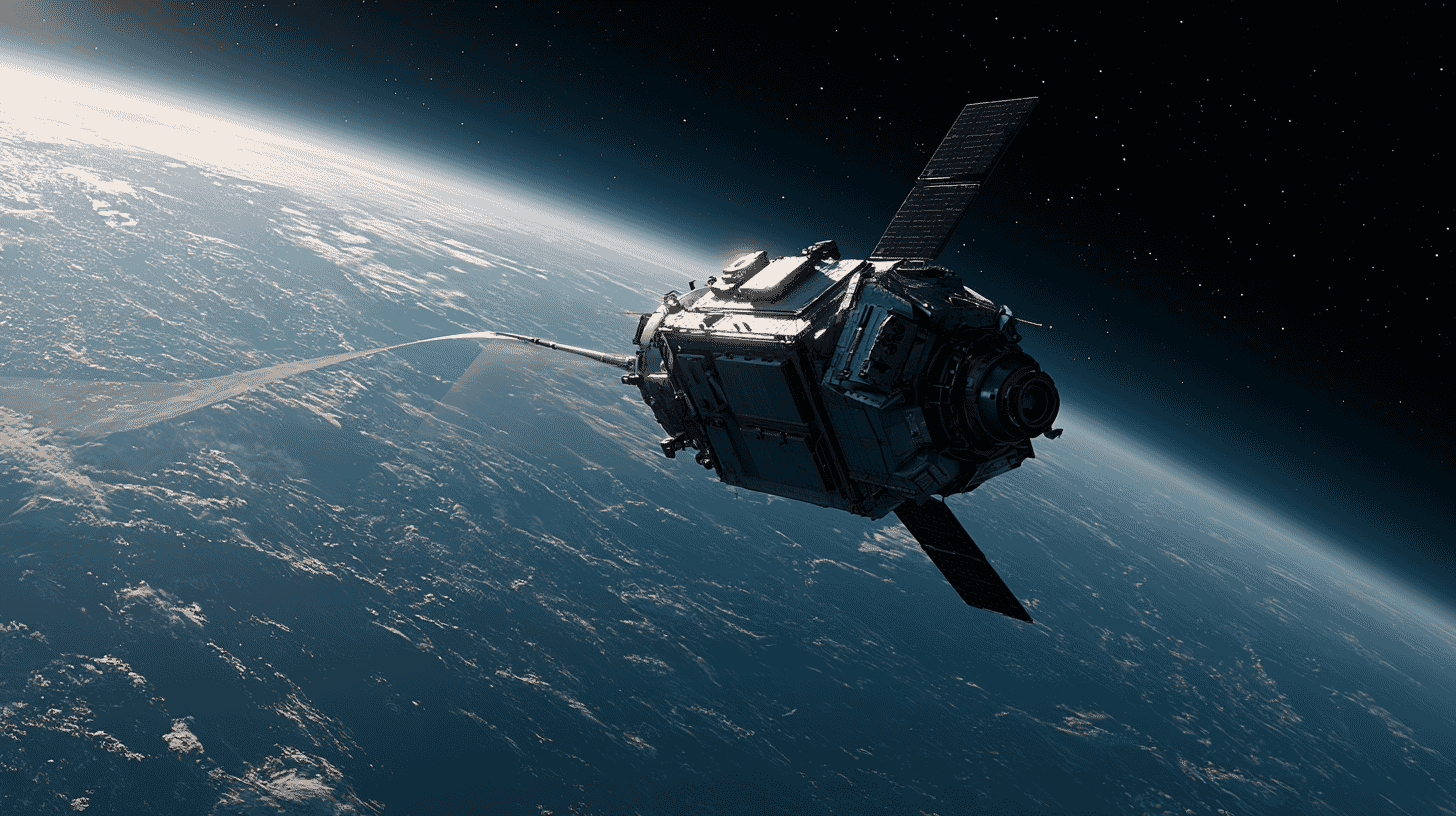
🛰️ On June 10, a Japanese flagship rocket was set to lift off without a single solid booster, a first for the country's heavy launchers. The weather said no.
Setting the delay aside, the more interesting story is bolted inside the nose cone: a kilometer-long tether that rehearses snaring space junk in a net, a sail designed to drag dead satellites to a fiery end, a telescope that studies the universe by night and fishing grounds by day, and a French satellite built to find ships that have made themselves invisible. Six small satellites in all, and a more mismatched set is hard to imagine.
Here is what is waiting to fly.
Why this launch looks different
JAXA had planned to send H3 Rocket No. 6 up from the Tanegashima Space Center on June 10. On June 8 the agency called it off, pointing to forecasts of deteriorating weather on launch day, and said a new date would follow once decided. A backup window runs to the end of June.
The rocket is itself the experiment. Until now, every H3 has lifted off with solid rocket boosters bolted to its sides. No. 6 is the first "Type 30," which drops the boosters entirely and flies on three of the main LE-9 engines alone, the first time a large Japanese rocket would leave the pad on liquid propulsion only.
Because the change reaches deep into the vehicle's design, JAXA is not risking a real flagship satellite on it. The rocket instead carries VEP-5, an instrumented dummy payload that measures how the new setup actually performs, and which it will drop into a sun-synchronous orbit. The flight also comes after the loss of H3 No. 8 last December, traced to delamination in the adapter that holds the satellite to the rocket; No. 6 carries a fix for that part and will gather extra data to confirm it holds.
All of that left space in the fairing. The six passengers riding along are where it gets interesting.
Cleaning up low orbit
Two of the satellites exist to chip away at the same problem: the growing pile of dead hardware circling Earth.
The pair built by BULL, a startup in Utsunomiya north of Tokyo, are called HORN-L and HORN-R, each a 6U craft of about 10.6 kg. HORN stands for "Hurtling Orbit Normalizer," and its method is almost disarmingly simple. A boom unfurls a thin resin membrane; the membrane catches the faint wisps of atmosphere that still linger a few hundred kilometers up; the drag bleeds off speed until the satellite spirals down and burns on re-entry. The two craft carry membranes of roughly 20 and 10 square meters, sized and folded differently so the team can compare them. An early plan called for a 50-square-meter sail, but at that size the satellite would have dropped out of orbit in about three days, too fast to learn much from.
The second junk-fighter works from the other direction. STARS-X, from Shizuoka University and nicknamed "Shiraito," is a 50 kg-class satellite that separates into two pieces after release and reels out a tether one kilometer long between them, the longest Japan has attempted. A small robot then crawls along the line, and the satellite rehearses catching a chunk of dummy debris in a net. It reads like a stunt; it is really a dress rehearsal. The same tether-and-net handling points toward future debris removal, and far down the road, the long-imagined space elevator. The nickname, picked from 485 public submissions, nods to Shizuoka's Shiraito Falls, whose threads of water resemble a tether stretched taut.
Eyes turned outward, and down
Two more passengers are built to watch rather than clean.
PETREL, whose Japanese name "Umitsubame" refers to the seabird, comes from the Institute of Science Tokyo and weighs around 65 kg. Its party trick is doing two unrelated jobs with one body, something its team calls "satellite sharing." On the night side of each orbit it aims an ultraviolet telescope at the sky, watching for sudden flares: the UV glow of merging neutron stars that also throw off gravitational waves, or the first light of a nearby supernova. On the day side it swings its multispectral and hyperspectral cameras downward, collecting data for fisheries, agriculture, and environmental monitoring: the commercial half of the mission, aimed at the unglamorous business of feeding people.
VERTECS, a 6U CubeSat led by the Kyushu Institute of Technology alongside a long roster of university and corporate partners, is after a quieter puzzle. Infrared surveys have found the sky's faint background glow to be two to three times brighter than the combined light of every galaxy we can actually count, a hint of uncatalogued sources out there. VERTECS pushes that hunt into visible light, where the hard part is subtracting the zodiacal light, the soft haze of sunlight bouncing off interplanetary dust. Whatever is left is a clue to how galaxies and stars piled up over cosmic time.
The hunter of dark ships
The final passenger is the only foreigner aboard, and it carries the most pointed mission of the bunch.
BRO-22 belongs to Unseenlabs, a company out of Rennes in the French region of Brittany. It is an 8U nanosatellite in a constellation that now runs to around twenty, each one built to pick up the radio-frequency signals a vessel leaks simply by running its electronics. Conventional tracking leans on AIS, the transponder signal ships broadcast voluntarily, which means a ship that wants to vanish just switches it off. Unseenlabs listens instead for the emissions a crew cannot easily mask, and can pin down a "dark" vessel from a single satellite. That data feeds work against illegal fishing, covert ship-to-ship transfers, and suspicious movement near undersea cables and pipelines.
BRO-22 stands out for a second reason. It is the first satellite from a foreign private company to fly on the H3, and part of the rocket's first commercial rideshare, brokered by the Tokyo firm Space BD. BULL's HORN is the launch's first paying customer, the debut of Japan's flagship rocket as a shared ride for hire, not only a national launcher.
Now they wait
For the teams behind these six satellites, several of whom have been building toward this flight for years, the weather delay is one more pause in an already long wait. A fresh date will arrive when the skies over Tanegashima settle.
[Update] JAXA reset the launch for June 12 and lifted off from the Tanegashima Space Center at 9:53:59 a.m. that day. The 30 configuration, flying without solid boosters, succeeded on its first attempt, and the second stage carrying VEP-5 reached the planned sun-synchronous orbit. All six small satellites separated as scheduled. The flight also marks the return to flight after the loss of Flight 8 in December 2025. (Added June 12, 2026)
It is a modest rocket-load carrying an outsized spread of ambitions: keeping orbit usable, reading the deep sky, helping grow food, and watching the sea. Space is getting more crowded and more contested, and these little craft are part of how one country is answering that. Whether the question is who clears the junk overhead or who keeps an eye on the ships off your coast, how is that conversation going where you live?
References
- https://www.jaxa.jp/press/2026/06/20260608-1_j.html
- https://www.jaxa.jp/press/2026/04/20260424-1_j.html
- https://sorae.info/space/20260608-stars-x-shiraitoo.html
- https://www.kenkai.jaxa.jp/kakushin/interview/03/interview03_11.html
- https://vertecs-project.com/ja/home-jp/
- https://prtimes.jp/main/html/rd/p/000000027.000113020.html
- https://aeromorning.com/en/unseenlabs-bro-22-to-launch-on-jaxas-h3-rocket/







Global Discussion
4 comments