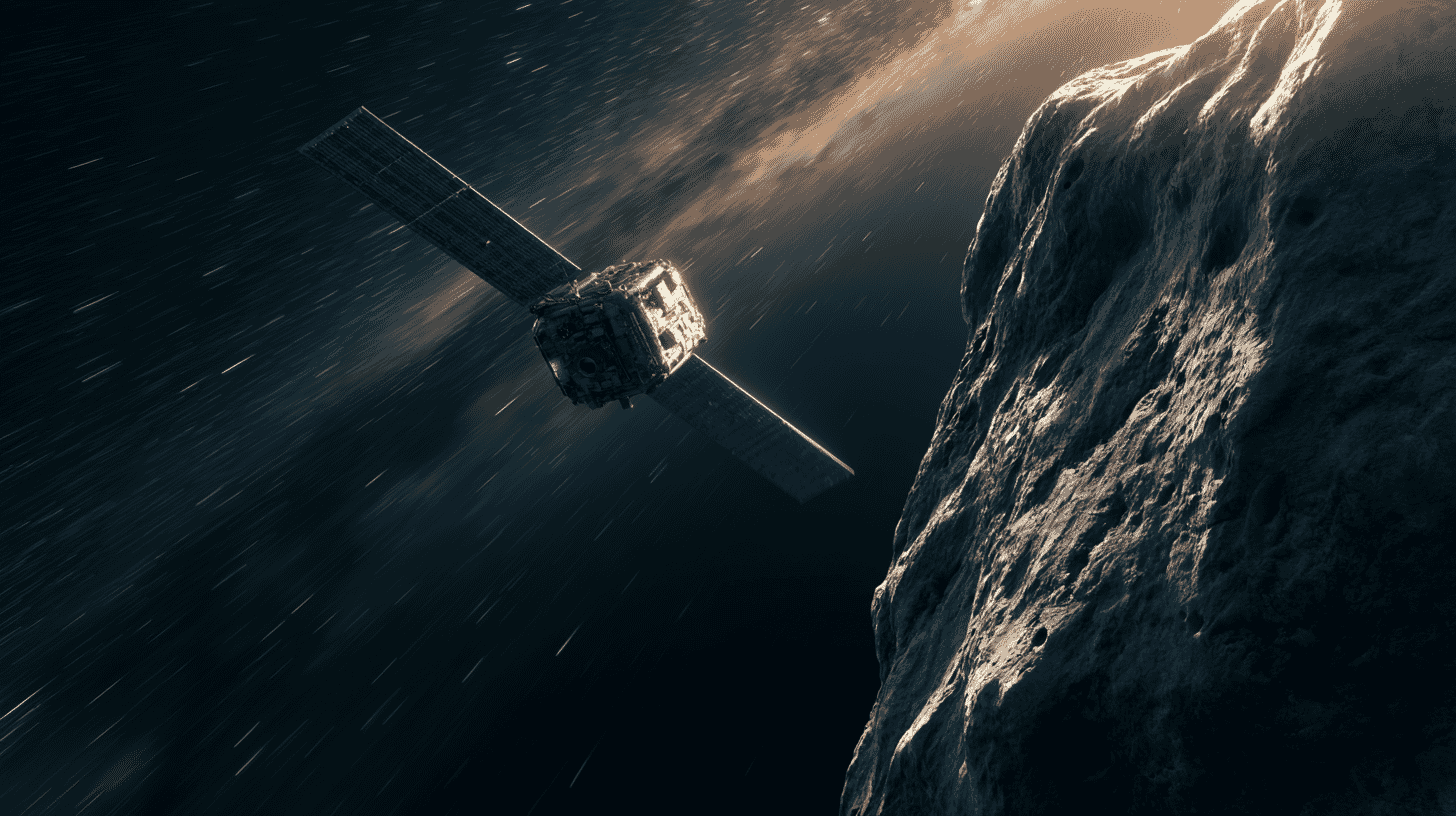
🛰 It was over in a third of the blink of an eye.
At 6:30 p.m. Japan time on July 5, 2026, JAXA's Hayabusa2 spacecraft streaked past asteroid Torifune at roughly 5 kilometers per second, threading a path less than a kilometer from the asteroid's center. At that speed, crossing the 500-meter body takes a mere 0.1 seconds. Five and a half years after delivering samples from asteroid Ryugu, Japan's veteran probe had taken on an entirely new kind of challenge: photographing an asteroid in passing.
A journey that didn't end at Ryugu
Hayabusa2 launched in December 2014 aboard an H-IIA rocket. It reached asteroid Ryugu in June 2018, racked up a series of world firsts, including blasting an artificial crater into a small body's surface, and returned about 5.4 grams of samples to Earth in December 2020. That was the end of its original mission. But the spacecraft still had fuel, so JAXA sent it back into deep space on a decade-long extended mission called Hayabusa2# (pronounced "sharp"). The "#" stands for SHARP: Small Hazardous Asteroid Reconnaissance Probe.
The final goal is a rendezvous with asteroid 1998 KY26 in July 2031. Flying in formation with this tiny, rapidly spinning object would be a world first. The route there includes Earth swing-bys in December 2027 and June 2028. But before any of that comes the extended mission's first asteroid encounter: the Torifune flyby, the first milestone on the road to the final destination.
A date with Torifune: July 5, 6:30 p.m.
On June 9, 2026, JAXA announced the timing for the flyby. Closest approach will come at around 6:30 p.m. Japan time on Sunday, July 5 (about 9:30 a.m. UTC) at a distance of roughly 1 kilometer from Torifune's center and a relative speed of about 5 km/s. The agency notes the timing may shift depending on operational conditions.
The date itself had been public since December 2025. But Torifune rotates once roughly every five hours, so shifting the pass time even slightly changes which side of the asteroid comes into view. Choosing which face to image, on top of the spacecraft's operational status and the selection of ground stations, is why the exact hour was announced only about a month before the encounter.

Source: JAXA (©Akihiro Ikeshita)
Torifune (asteroid number 98943, formerly designated 2001 CC21) is a near-Earth asteroid discovered in 2001 by the US-based LINEAR survey. Its name comes from Ame-no-torifune, a deity in Japanese mythology that is also the name of a divine ship said to travel as fast as a bird and as steady as a rock. JAXA ran a public naming campaign starting in late 2023, and a selection committee of nine Japanese schoolchildren debated the entries and chose the winner, which the International Astronomical Union formally approved in September 2024. The name carries a wish: that this high-speed encounter goes safely.
Why a 0.1-second window is so hard
Five kilometers per second is fast enough to cover the 400 km between Tokyo and Osaka in about 80 seconds. At that pace, Hayabusa2 will skim past a small body estimated at about 500 meters across. The crossing lasts just 0.1 seconds.
And that "about 500 meters" is only an estimate. Past ground-based observations suggest Torifune may be elongated rather than round. The team has to plan a closest-approach distance for an object whose exact size and shape remain unknown: close enough for good data, but not so close that an unexpectedly long asteroid becomes a collision hazard. It's a tightrope walk built on incomplete information.
There's a deeper complication: Hayabusa2 was never designed for this. At Ryugu, the spacecraft arrived first and observed at leisure, hovering alongside its target for over a year. To get meaningful data from a single high-speed pass, the probe has no choice but to get as close to Torifune as it safely can.
The closer you fly, the less you have to turn
Counterintuitively, flying closer also makes the observation easier in one key respect. Hayabusa2's cameras are fixed to the spacecraft body; there's no swiveling camera platform. To keep a passing asteroid in view, the entire spacecraft must rotate. On a distant pass, the target starts drifting across the field of view early, forcing large, continuous attitude changes. On a very close pass, the target stays in nearly the same spot in the frame until just before closest approach, so only small adjustments are needed.
Think of passing someone in a long corridor. To follow a person crossing a hallway far ahead of you, you have to keep turning your head, and the distance blurs their face anyway. Someone walking straight at you, though, stays in almost the same direction until the instant you pass, their features sharpening with every step. That second situation is what Hayabusa2 is after. The moment of the pass itself will be far too fast to track, so the observation wraps up just short of closest approach.
After DART: Japan's contribution to "hitting the target"
The ultra-close Torifune flyby is science, but it's also a stepping stone for planetary defense: the international effort to detect Earth-approaching asteroids early, track them, and act to prevent or reduce damage if a collision threat emerges.
The field's biggest demonstration so far came from NASA. In September 2022, the DART mission deliberately crashed a spacecraft into Dimorphos, a small moon of asteroid Didymos, and measurably shortened its orbital period. It was the first proof that humanity can change an asteroid's path.
But slamming a probe into a small celestial body demands extremely precise guidance. JAXA says one goal of the Torifune flyby is to gather fundamental data for exactly that technology: accurately steering a spacecraft to impact a small body. Hayabusa2 itself will be operated to avoid hitting Torifune, but deliberately threading a 1-kilometer gap past a 500-meter-class asteroid is a direct rehearsal of the navigation a future deflection mission would need.
The 2031 encounter with 1998 KY26 sits on the same continuum. JAXA has long estimated the asteroid at about 30 meters in diameter, but observations published by a European-led research team in September 2025 suggest it may be only around 11 meters wide, not much bigger than the spacecraft itself. Objects this small can survive the trip through Earth's atmosphere, so learning whether they are solid monoliths or loose piles of rubble is crucial input for designing any impact-avoidance strategy.
With Ryugu, Japan showed the world how to bring an asteroid home. Now it's working on how to approach one with pinpoint precision. On the evening of July 5, that 0.1-second moment played out deep in space, far from Earth.
Update: At a briefing on July 6, 2026, JAXA confirmed the flyby succeeded. Closest approach came on schedule at 6:30:00 p.m. Japan time (give or take a second) at a relative speed of about 5.3 km/s, and controllers verified the spacecraft was healthy five minutes later. The telephoto optical navigation camera ONC-T shot Torifune from June 20 until one second before closest approach, at 6:29:59 p.m., and all four instruments returned data, including the mid-infrared camera TIR, the near-infrared spectrometer NIRS3 and the laser altimeter LIDAR. The final plan called for a pass 800 meters from the asteroid's center; the actual distance could not be estimated in real time and will come out of post-flight analysis. The images show an elongated body resembling Itokawa, the asteroid visited by the first Hayabusa, with a deeper waist, marking it as a contact binary. The remaining data will be downlinked by the end of the year, and the next operational event is an Earth swing-by in December 2027. (As of July 2026)
In Japan, the idea of a spacecraft chasing an asteroid named by schoolchildren after a mythological ship has drawn interest across generations. How much attention do asteroid missions and planetary defense get in your country?







Global Discussion
3 comments