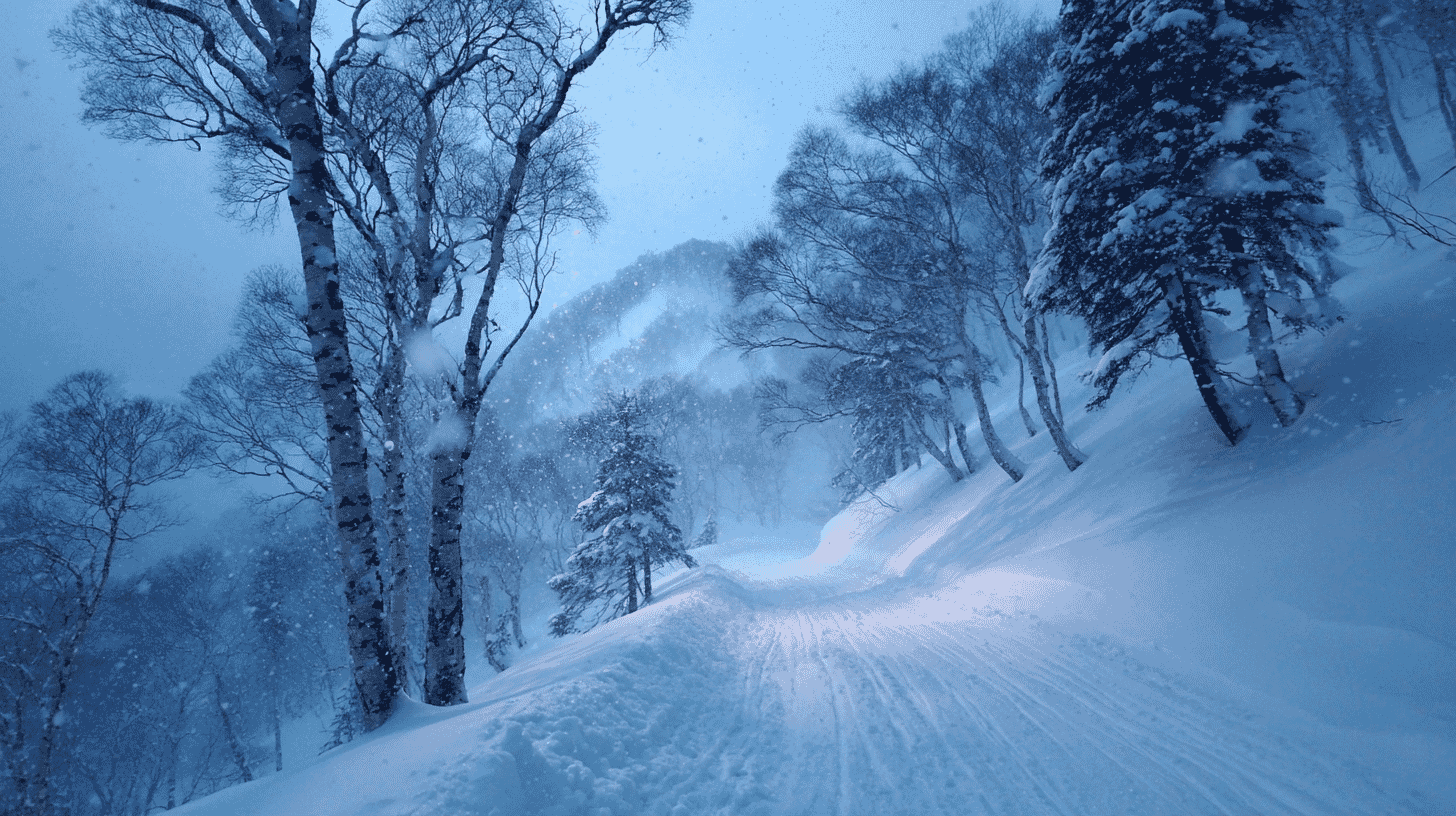
For two decades Japan has sold the world one product. Snow that falls dry, deep and often. In August, researchers at Hokkaido University and Japan's national forestry institute ran that snow through a climate model and came back with a number that has been circulating in Japanese ski circles ever since.
Seven.
Seven, out of 349
The work was announced on August 3, 2026, two days after it appeared online in Seppyo, the journal of the Japanese Society of Snow and Ice. Its authors are Nao Yoshizawa, a lecturer at Hokkaido University who studies ski tourism, and Yuta Katsuyama, a snow researcher at the Forestry and Forest Products Research Institute's Tohkamachi station in Niigata.
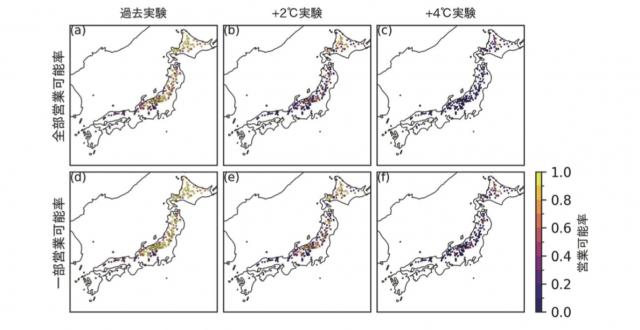
They took all 349 Japanese ski areas that run a lift or a gondola and pushed each one through a snowpack model called SNOWPACK, driven by a large climate dataset known as d4PDF at five-kilometre resolution. Three runs: a historical baseline covering 1951 to 2011, a world 2°C warmer than pre-industrial levels, and a world 4°C warmer. On the model's timeline those correspond roughly to 2030–2091 and 2050–2111.
The test itself was simple. Could a resort stay open at least 100 days a year on natural snow alone?
At 2°C, 53 areas clear that bar across their whole terrain and another 108 manage it on part of it. At 4°C, full operation survives at seven. Partial operation survives at 26. The team does not name the seven, but says the places most likely to hold on are the higher ground of Hokkaido and Nagano.
The other finding lands harder on anyone who books a flight for snow quality. In the historical run, stretches of the Sea of Japan coast, the hills west of Sapporo, the Ou mountains and the Niigata-Nagano-Gunma border averaged more than twenty fresh-snow days a year. At 4°C most areas fall to ten or fewer. A resort can be open and still not be the thing people came for.
Source: Forestry and Forest Products Research Institute / Hokkaido University
Why the study stops at 2°C and 4°C
Those two brackets are not arbitrary. Two degrees is the outer edge of what the Paris Agreement treats as acceptable. Four is roughly where the world lands if it stops trying.
On September 2, 2026, the UN Environment Programme published Limiting Overshoot, its first report written on the assumption that 1.5°C is already gone. Long-term warming currently sits near 1.4°C. Even if every country delivers on every pledge, UNEP puts peak warming around 1.8°C. On current policies the median lands near 2.6°C by 2100, inside a range of 1.9 to 3.6.
Set against the ski paper, that puts Japan past the 53-resort scenario and short of the seven-resort one, with the upper end of the range reaching all the way there.
Japan also warms faster than the planet does. The Japan Meteorological Agency puts the long-term rise in Japan's annual mean temperature at 1.44°C per century, against 0.79°C globally. The winter that just ended, December 2025 through February 2026, came in 0.90°C above the 1991–2020 baseline, the fifth warmest since records began in 1898.
The agency's own snow projections point the same way as the ski paper. Under its 4°C scenario, annual maximum snow depth falls by roughly 60% nationwide by the end of this century compared with the end of the last. Under 2°C the decline is about 30% and concentrated on Honshu and further south, while Hokkaido's future stays small and hard to pin down. For Hokkaido's Sea of Japan side specifically, the figures are about 38% at 4°C and about 11% at 2°C.
The map was already shrinking
This is not landing on a healthy industry.
Japan had 698 ski areas operating in 1999. In 2025 the count was 417, an all-time low and about 40% below that peak, according to the Japan Funicular Transport Association. The study worked from its own list of 349 areas it could model, so the two numbers are not counting the same set of places, but the direction is not in dispute.
The cause so far has been mostly domestic. Ski and snowboard participation peaked in 1998 at around 18 million people, by the Japan Productivity Center's Leisure White Paper count, then fell away with the economy and with the generation that had made it fashionable. The association lists warming and ageing facilities among the causes too, but across these three decades the dominant pressure has been the missing customers.
Climate is now arriving on top of that. The meteorological agency has recorded a downward trend in annual maximum snow depth on the Sea of Japan side since 1962, along with fewer days of 20-centimetre snowfalls in eastern and western Japan.
Powder is the product
And yet the marquee resorts keep pushing their numbers higher, because the demand stopped being Japanese.
In Hokkaido's Niseko area, the three towns of Kutchan, Niseko and Rankoshi logged 2.135 million visits over the 2025-26 winter, up 8.4%. Foreign guest-nights reached 973,798, up 32.9%, while the headcount behind them rose only 9.4%. People are staying longer. The Niseko Promotion Board's visitor survey put average spend at about ¥580,000 for an international visitor, roughly $3,700 at the ¥156-to-the-dollar rate of early September 2026, against about ¥125,000, roughly $800, for a Japanese overnight guest. Australia is still the largest market.
Hakuba Valley in Nagano tells the same story at a different scale. Its ten ski areas drew 1.925 million visitors in 2025-26, the best figure in ten seasons according to the DMO that runs the valley. Of those, 925,000 were foreign. That is 48% of everyone who showed up, and 17% more than the year before.
The snow itself, meanwhile, is already behaving unevenly. Niseko's 2025-26 season total was 751 cm against a ten-year average of 851. November and December came in thin enough to push full openings back by one to two weeks, and the season only really turned in January.
A handful of valleys now earn most of their year inside roughly a hundred winter days, from people who booked international flights specifically for snow quality.
Japan is not the only place doing this arithmetic
Europe ran the same test first. A 2023 study in Nature Climate Change assessed 2,234 ski resorts across 28 European countries and found that without snowmaking, 53% face very high snow-supply risk at 2°C of warming and 98% at 4°C. With artificial snow covering half of each resort's pistes, those shares drop to 27% and 71%, at the cost of more water and more electricity.
A global analysis published in PLOS ONE in 2024 sorted the damage by mountain range. Under a high-emissions pathway, annual snow cover days between 2071 and 2100 decline by about 50% in the Japanese Alps, 42% in the European Alps and 23% in the Rocky Mountains.
The Japanese Alps lose roughly twice what the Rockies do. In the models, the powder pulling Australians and Americans across the Pacific is more fragile than the snow they flew away from.
What the model left out on purpose
The seven-resort figure comes with a large asterisk, and the researchers put it there themselves. Snowmaking was excluded. This was a first pass on natural snow, and the European numbers suggest what machines actually buy: at 4°C they take the at-risk share from 98% down to 71%. That helps without saving anyone, and it costs water and power in exactly the decades when both get harder to spare.
The model also leaves out individual run layouts, local operating economics, and how skiers would respond to a thinner map. Yoshizawa and Katsuyama list all of it as the next job.
Their closing point is about concentration. If Japanese ski tourism collapses into a handful of high northern valleys, those places get more crowded and more expensive than they already are, while the low-elevation local hills that taught most Japanese people to ski disappear entirely. The question they leave open is whether an ordinary child in a snowy prefecture still learns to ski at all.
Japan is now counting its winters resort by resort. Has anyone run that arithmetic where you live, and does the winter you grew up with still turn up?
References
- https://www.ffpri.go.jp/press/2026/20260803/index.html
- https://www.jstage.jst.go.jp/article/seppyo/88/4/88_295/_article/-char/ja/
- https://www.data.jma.go.jp/cpdinfo/ccj/2025/html_honpen/cc2025_honpen_6.html
- https://www.data.jma.go.jp/cpdinfo/temp/an_jpn.html
- https://www.data.jma.go.jp/cpdinfo/temp/an_wld.html
- https://www.data.jma.go.jp/cpdinfo/temp/win_jpn.html
- https://www.sakigake.jp/news/article/20260103CO0057/
- https://www.mext.go.jp/sports/content/20200217-spt_stiiki-000004998_7.pdf
- https://prtimes.jp/main/html/rd/p/000000013.000063156.html
- https://newscast.jp/smart/news/5199865
- https://www.nature.com/articles/s41558-023-01759-5
- https://journals.plos.org/plosone/article?id=10.1371/journal.pone.0299735
- https://www.unep.org/news-and-stories/press-release/unep-world-set-cross-15degc-global-warming-can-still-limit-adapt-and








Global Discussion
4 comments