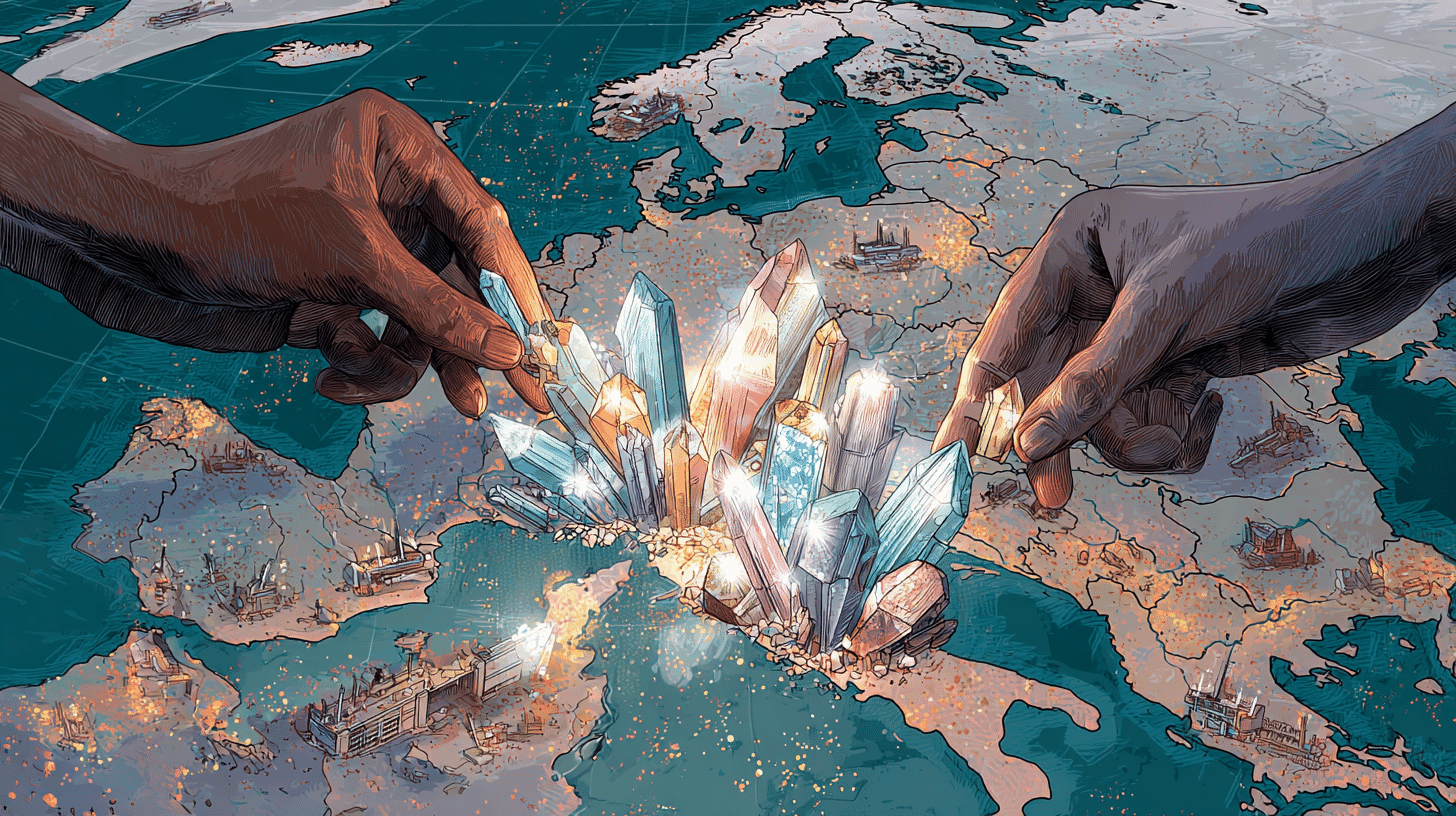
In July 2025, Japanese and European business leaders called for a joint rare earth strategy. Nine months later, the question isn't whether anyone listened, it's whether they're moving fast enough. A 55-nation summit, minimum pricing agreements, an EU agency modeled on Japan, and China's new "extraterritorial" controls that could freeze global supply chains: here's a timeline of everything that happened, and what comes next.
The Timeline: 9 Months That Reshaped the Rare Earth Map
Starting Point: July 2025|The BRT Proposal and "Competitiveness Alliance"
On July 23, 2025, the Japan-EU Business Round Table (BRT), a forum of roughly 50 top executives from major Japanese and European companies, formally submitted its policy recommendations to Prime Minister Shigeru Ishiba. The core message: Japan and the EU must jointly invest in rare earth refining, coordinate strategic stockpiles, and build semiconductor supply chains that don't depend on any single country.
That same day, Ishiba and European Commission President Ursula von der Leyen launched the "Japan-EU Competitiveness Alliance." Their joint declaration described the concentration of permanent magnet and solar panel supply chains in "specific countries" as an economic security risk, a thinly veiled reference to China, which controls roughly 70% of global rare earth mining and over 90% of refining.
The proposal was ambitious. But proposals are easy. What happened next?
October 2025: China's Countermove|Extraterritorial Controls
On October 9, China announced export controls on five additional rare earth materials. But the real shock was something else entirely: a simultaneous regulation extending Chinese export licensing to products manufactured outside China using Chinese rare earth materials or Chinese refining technology.
In plain language: if a Japanese or European company refines rare earths in its own country but the raw material originated in China, that company could need Beijing's permission to export the finished product to a third country. This "extraterritorial application" was widely interpreted as a direct strike at the West's efforts to build China-free supply chains.
Following US-China summit talks on October 30, this regulation was suspended until November 10, 2026. The clock is now ticking.
October 28: Japan-US Rare Earth Agreement
In the same month, a Japan-US summit produced an agreement on rare earth supply chain cooperation, including plans around the Mountain Pass mine in California and joint development frameworks.
November 2025: G7 Standards-Based Market Roadmap
At the G7 Energy Ministers' meeting in Toronto, Canada, ministers adopted a "roadmap for promoting a standards-based market for critical minerals." Rather than competing on price alone, a battle the West cannot win against China's subsidized production, the roadmap envisions differentiation through traceability, environmental standards, and human rights-compliant sourcing.
December 3: EU's "RESource EU"|A JOGMEC for Europe
The European Commission unveiled its "RESource EU" action plan, headlined by the creation of a "European Critical Raw Materials Center" modeled explicitly on Japan's JOGMEC. Senior Vice President Stéphane Séjourné stated plainly that Japan's system "is a model not just for Europe but for the world."
The plan committed approximately $3.4 billion through a CRM Funding Hub over 12 months, announced a rare earth joint purchasing matchmaking program for March 2026, and outlined a cross-member-state strategic stockpiling coordination system. Export restrictions on permanent magnet scrap were also put on the table, a move to prevent recycling resources from flowing out of Europe.
January 2026: Acceleration From Three Directions
G7 Finance Ministers (Jan. 12), US Treasury Secretary Bessent hosted G7 counterparts in Washington to map out concrete steps for addressing critical mineral supply chain vulnerabilities. Australia, India, South Korea, and Mexico participated as observers.
China's Dual-Use Controls on Japan (Jan. 6), China's Ministry of Commerce announced strengthened export controls on all dual-use items destined for Japan, explicitly targeting military users and any end-use that could enhance Japan's military capabilities. Rare earths are understood to fall within scope.
US CHIPS Act Funding for Rare Earths (Jan. 27), The US Commerce Department committed up to $1.3 billion in loans to USA Rare Earth (USAR) under the CHIPS Act for "mine-to-magnet" production facilities in Texas and Oklahoma. The federal government also took an approximately 10% equity stake, an extraordinary step.
February 4, 2026: 55 Nations Agree on Minimum Pricing
The Trump administration convened a 55-nation ministerial meeting on critical minerals. Japan, the EU, and Mexico formally agreed with the US to develop minimum pricing mechanisms for critical minerals. Vice President Vance proposed a "critical minerals trade zone protected from outside forces", a market designed to shield Western producers from Chinese price undercutting while domestic capacity scales up.
Where We Stand: April 2026
Nine months after the BRT proposal, the velocity of change is striking. What began as a business recommendation has evolved into 55-nation agreements, billions of dollars in committed funding, new institutional infrastructure, and concrete pricing mechanisms.
But will the "Western trade bloc" actually work? The picture is mixed.
Reasons for Optimism
The money is real. The EU's $3.4 billion funding hub, America's $1.3 billion USAR deal, Australia's AU$1.25 billion strategic reserve fund, and Japan's cumulative JOGMEC investments in Lynas and Caremag collectively represent an unprecedented public commitment to non-Chinese supply chains.
The institutions are materializing. The EU's Critical Raw Materials Center is scheduled to begin operations this quarter (Q2 2026), with legislation to expand its authority coming simultaneously. The G7 standards-based market roadmap is moving from concept to implementation.
Three Walls
Wall 1: Time, China built its refining dominance over 30 years. Estonia's new rare earth magnet plant plans for 5,000 tons of capacity, but the EU's projected demand by 2030 is approximately 45,000 tons. The math doesn't yet add up.
Wall 2: Cost, Minimum pricing means consumers ultimately pay more. The impact on EV component costs, wind turbine pricing, and electronics manufacturing will ripple through global supply chains. How much are voters and consumers willing to pay for supply security?
Wall 3: The November 2026 Deadline, China's extraterritorial export controls are suspended, not withdrawn. If activated, they could constrain the international trade of any product containing even trace amounts of Chinese-origin rare earths. If Western supply chains aren't ready, the disruption could be severe.
What to Watch Next
Three developments will determine whether the "Western trade bloc" becomes reality. First, whether the EU's new Critical Raw Materials Center can convert its mandate into actual investment deals. Second, whether the G7's standards-based market produces procurement criteria that buyers actually adopt. And third, the biggest variable, how the world responds when China's extraterritorial controls come off suspension in November.
The BRT's proposal dropped a stone into the water nine months ago. The ripples have traveled farther than anyone expected. But the shore is still distant, and the current is strong.
How is your country responding to the idea of a "Western rare earth trade bloc"? Would you support paying higher prices for supply security? Share your thoughts in the comments!
References
- https://www.eu-japan.eu/ja/brt
- https://www.bloomberg.com/jp/news/articles/2026-02-04/T9XWO7T96OSN00
- https://www.bloomberg.com/jp/news/articles/2026-01-13/T8RYFHKJH6VF00
- https://www.jetro.go.jp/biznews/2025/12/2262497fdfbe0b5d.html
- https://www.jetro.go.jp/biznews/2026/01/556c919dce41e141.html
- https://mric.jogmec.go.jp/reports/current/20260113/187778/
- https://www.meti.go.jp/shingikai/sankoshin/seizo_sangyo/pdf/019_02_00.pdf







Global Discussion
14 comments