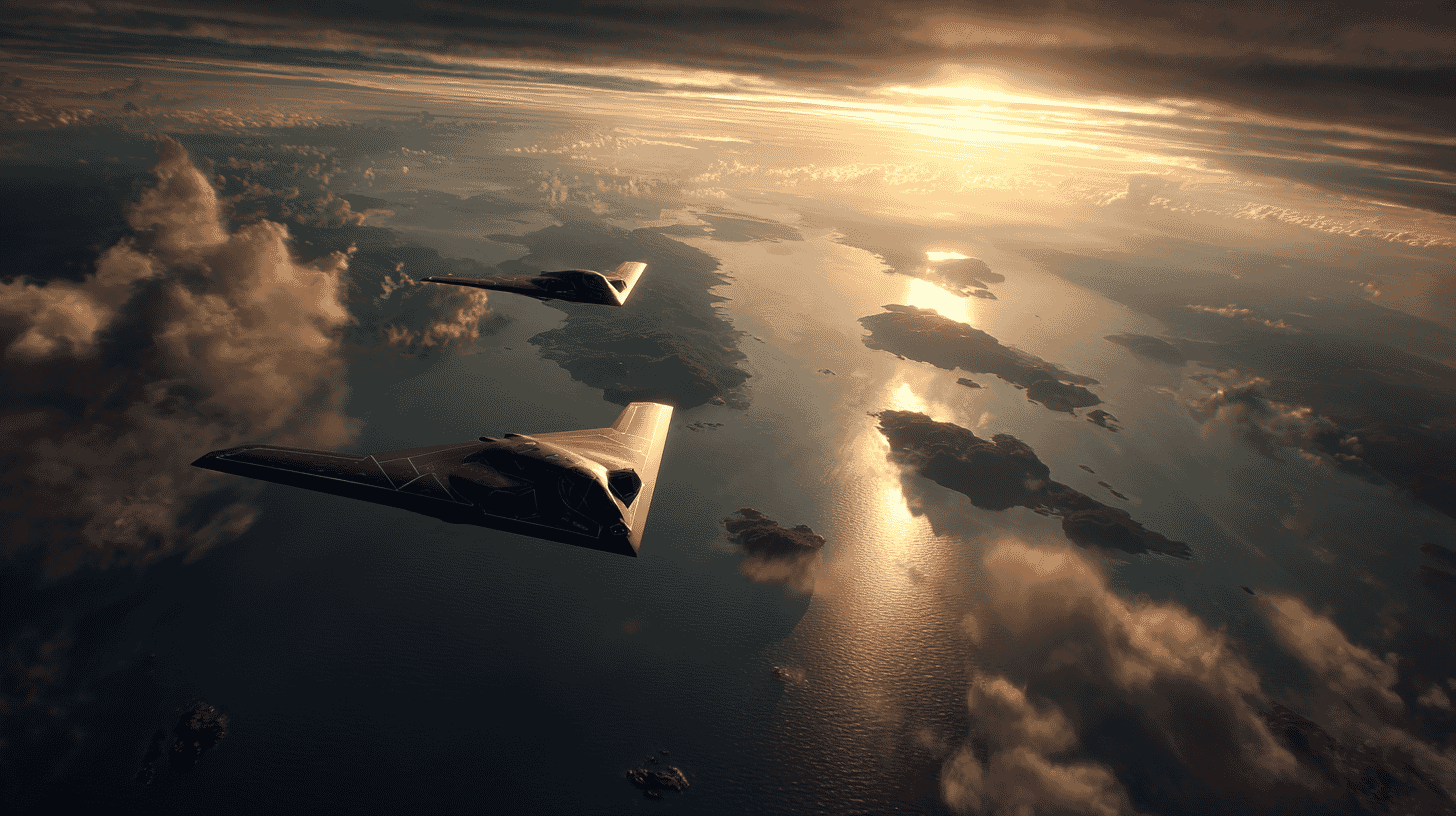
The race to build AI-powered "wingman" drones is reshaping military aviation. The US has already flown two CCA prototypes, China unveiled four new stealth drone designs at a single parade, and Japan planned its first AI drone test flight for late 2025. But how far behind has it fallen, and what structural challenges does its defense industry face?
What Is a "Loyal Wingman"? The Future of Air Combat
One of the most closely watched concepts in modern military aviation is the "loyal wingman", an AI-powered unmanned aircraft that flies in formation with manned fighters, autonomously performing reconnaissance, electronic warfare, and attack missions. The US calls them Collaborative Combat Aircraft (CCA), while Japan uses the term "combat support unmanned aircraft."
Why does this technology matter so much? First, drones can be sent into dangerous missions without risking pilots' lives. Second, they cost far less than manned fighters, enabling a "mass over exquisite" strategy. Third, AI-driven autonomous decision-making can coordinate multiple aircraft simultaneously while reducing pilot workload.
The Ukraine conflict demonstrated that inexpensive drones can destroy tanks and warships costing millions. That lesson has sent shockwaves through military doctrines worldwide, accelerating investment in manned-unmanned teaming technology.
United States: Over 1,000 CCAs to Escort 6th-Gen Fighters
The US leads the unmanned combat aircraft race by a significant margin. Under its Next Generation Air Dominance (NGAD) program, the US Air Force is developing CCA drones to operate alongside Boeing's sixth-generation F-47 fighter.
In 2024, the USAF awarded development contracts to five companies (Anduril, Boeing, General Atomics, Lockheed Martin, and Northrop Grumman), then selected Anduril and General Atomics for Increment 1 production. General Atomics' YFQ-42A "Gambit 2" completed its maiden flight in August 2025, followed by Anduril's YFQ-44A "Fury" in October 2025.
The scale is staggering. Increment 1 envisions 100–150 aircraft, while Increment 2 could add up to 2,350 more. The USAF has stated plans to field at least 1,000 CCAs. The FY2026 budget allocates over $4 billion for the F-47 and CCA programs combined, with approximately $800 million for CCA alone. Initial operational capability is targeted before 2030.
In December 2025, the Air Force selected nine vendors for Increment 2, expanding the program to cover air-to-air combat, ground attack, electronic warfare, and ISR missions with multiple CCA types.
China: Four New Stealth Drones Unveiled in a Single Day
China is widely regarded as neck-and-neck with, or in some areas ahead of, the United States.
The Zhuhai Airshow in November 2024 showcased the Feihong-97A, a loyal wingman drone designed to fly alongside manned fighters. Even more dramatic was China's September 2025 military parade, where four entirely new stealth drone designs debuted alongside the established GJ-11 attack drone.
Two of the new designs are smaller CCA-class aircraft, one resembling the US XQ-58. The other two are significantly larger, roughly the size of a J-10 fighter, powered by what analysts believe are derivatives of the WS-10 or WS-15 turbofan engines. This suggests China is building a tiered unmanned force: affordable mass-production drones alongside high-performance platforms.
China has also developed the J-20S, the world's first twin-seat fifth-generation stealth fighter, specifically designed so the rear-seat pilot can manage a swarm of companion drones. In November 2025, the PLA Air Force released footage of a J-20 flying in formation with GJ-11 drones and J-16D electronic warfare aircraft.
Europe, Australia, and South Korea Join the Race
The competition extends far beyond the US and China.
The United Kingdom introduced its "StormShroud" loyal wingman demonstrator in May 2025, with an initial order for 24 platforms. Developed as an Autonomous Collaborative Platform (ACP) separate from the GCAP fighter program, StormShroud is designed to team with existing 4th and 5th-generation fighters as well as future aircraft.
Australia has been a CCA pioneer through its MQ-28 Ghost Bat program with Boeing. The Ghost Bat features a modular nose section that can be swapped to reconfigure the drone for reconnaissance, electronic warfare, or attack missions. An AIM-120 missile firing test was planned for late 2025 or early 2026.
South Korea is developing multiple loyal wingman types in parallel with its KF-21 fighter program, with Korean Air having unveiled a UCAV model for the Korean Air Force.
Japan's Current Position: The Road to GCAP-Linked Drones
Japan's unmanned combat aircraft development centers on the GCAP (Global Combat Air Programme) next-generation fighter being jointly developed with the UK and Italy.
Mitsubishi Heavy Industries (MHI) unveiled two combat support drone concepts at the 2024 International Aerospace Exhibition in Tokyo, a medium-sized CCA airframe and a missile-shaped expendable drone designated "ARMDC-20X." MHI has been working on AI-equipped drone technology since 2022 under contracts from Japan's Acquisition, Technology and Logistics Agency (ATLA).
Kawasaki Heavy Industries (KHI) debuted its own AI-powered combat support drone concept at DSEI Japan 2025, emphasizing electronic warfare capability and power generation from its proprietary KJ300 compact engine. KHI envisions its drones supporting not only the GCAP fighter but also the P-1 maritime patrol aircraft.
SUBARU's aerospace division is also involved, having manufactured test drones displayed at ATLA's Technology Symposium 2025. Flight testing in Hokkaido successfully demonstrated five-drone formation flying using GPS navigation with voice commands from a helicopter-mounted control system.
ATLA planned the first flight of an AI-equipped unmanned demonstrator for November 2025. In December 2025, it also issued a tender for a study on "risks and challenges in introducing drones that cooperate with the next-generation fighter", directly addressing how much autonomy AI systems should be granted in combat situations.
The FY2026 defense budget includes ¥4.8 billion ($32 million) for conceptual design of GCAP-linked drones, and ¥100.1 billion ($670 million) across all unmanned asset programs, with a target of establishing a "multi-layered coastal defense system using unmanned assets" by FY2027.
Structural Challenges Facing Japan's Defense Industry
Despite steady progress, Japan's defense industry faces several deep-rooted challenges compared to its US and Chinese competitors.
First, the budget gap is enormous. The US plans to spend $8.9 billion on CCA programs from FY2025–2029. Japan's linked-drone budget stands at ¥4.8 billion ($32 million), less than one-hundredth of the US figure. MHI's entire aerospace, defense, and space division generates roughly ¥1 trillion in annual revenue, less than one-tenth of Lockheed Martin's $71 billion.
Second, there is no combat data for AI training. AI performance depends on the quality and quantity of training data. Japan has no recent combat experience, making it reliant on simulations. The US, by contrast, has already tested AI-flown fighter aircraft (the X-62A, a modified F-16) in simulated dogfights against human pilots.
Third, the industrial base is narrow. Japan's defense companies have historically depended entirely on domestic demand due to strict export controls. While restrictions have been gradually relaxed (the 2014 defense equipment transfer principles and the 2024 authorization of third-country exports), overseas sales remain limited. Few new entrants are joining the defense sector, constraining innovation.
Fourth, there is ethical and legal uncertainty over AI autonomy. How much autonomous decision-making should combat AI be allowed? ATLA's December 2025 tender explicitly seeks answers to this question. The debate over "how much should humans remain in the loop" is not merely technical, it is a policy and philosophical challenge that will shape procurement decisions.
Japan's Strengths and Future Outlook
Japan does possess genuine advantages, however. International collaboration through GCAP with the UK and Italy offers both technology sharing and cost distribution. The competitive dynamic between MHI and KHI produces diverse concepts. Japan's dual-use technology ecosystem (AI, sensors, semiconductors) creates opportunities for startups and cross-industry entrants.
Japan is also pragmatically evaluating foreign unmanned systems, including Turkey's Bayraktar TB2S and Israel's Heron Mk II, for potential adoption alongside domestic development. This realistic approach of combining proven foreign technology with indigenous R&D could help narrow the gap.
The unmanned combat aircraft race is no longer a distant future scenario. The US and China are in flight-test stages, targeting operational deployment before the end of this decade. Whether Japan can establish its presence depends on sustained budget commitment, AI technology investment, industrial base reinforcement, and deeper international cooperation.
In Japan, debate swirls between those who see unmanned combat aircraft as essential for national security and those who question whether AI should ever be trusted with lethal decisions. How is your country approaching the development of unmanned combat aircraft and the military use of AI? We'd love to hear your perspective.
References
- https://trafficnews.jp/post/617947
- https://j-defense.ikaros.jp/docs/mod/004199.html
- https://j-defense.ikaros.jp/docs/commentary/004463.html
- https://newswitch.jp/p/39402
- https://instituteofgeoeconomics.org/research/2025052801/
- https://www.airforce-technology.com/projects/collaborative-combat-aircraft-cca-usa/
- https://euro-sd.com/2025/11/articles/technology/47629/ccas-rcs-loyal-wingmen-and-effectors-developing-unmanned-systems-for-the-future-air-superiority-team/








Global Discussion
16 comments