NEC plans several hundred laser-linked satellites, the Yomiuri reports. Japan's Kirari made a two-way laser link in 2005, but Starlink now has about 11,100. Why Japan still wants its own.
Meta's 7,000 km US-France cable Petal targets 1 petabit per second in 2029, built by NEC and Sumitomo. Labs reach 19 cores, so why two? Repeater power.
Underwater, only sound carries far, so the ocean is still read by a handful of specialists. NEC has a Japanese defence contract to build a self-supervised underwater acoustic foundation model by fiscal 2027.
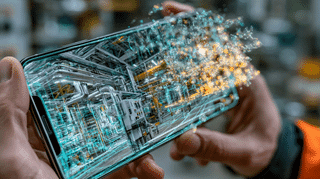
NEC and Keio AI Center have developed a technique that turns ordinary smartphone video into a high-fidelity 3D model in as little as one minute. By pairing Gaussian splatting with its own AI, NEC cut generation time to one-tenth and taught the system to erase workers caught on camera. Commercial launch is targeted within fiscal 2027.
NEC and New York University estimate that flood defenses on the Rockaway Peninsula could avoid up to $800 million in losses, pricing everything from transit disruption to residents' mental health in a bid to pull private money into climate adaptation.
Free-space optics sends data on beams of light without cable. The idea dates back to Bell's 1880 photophone. Here is why a 140-year niche technology is now moving toward disaster recovery and remote connectivity, from Taara to Japan's NEC and NICT.
On May 27, Fujitsu announced partnerships with two US AI labs at once, Anthropic and OpenAI. We unpack what this dual strategy means versus NEC's single bet, the Forward Deployed Engineer model, and how Japanese IT giants differ from Microsoft-OpenAI and SoftBank.
NEC has completed the East Micronesia Cable System (EMCS), a 2,250-kilometer optical submarine cable that gives three Pacific island nations their first-ever fiber connectivity. For Tarawa, Nauru, and Kosrae, roughly 100,000 people who had only known the 600-millisecond delay of satellite internet, the upgrade is transformative. The backstory is equally striking: in 2018, China's HMN Tech (formerly Huawei Marine) underbid NEC and Alcatel Submarine Networks by more than 20%. A 2020 US diplomatic warning to Micronesia, the World Bank's withdrawal, and a 2021 Japan-US-Australia rescue plan rewrote the project. Five years later, the cable is in the water.
Submarine cables carry 99% of international data traffic, and roughly 90% of new construction is controlled by just three companies: SubCom (US), Alcatel Submarine Networks (France), and NEC (Japan). Japan now wants 35% of that market by 2030, and NEC's CEO is targeting 40%. We unpack the AI-era infrastructure race, the Taiwan Strait cable cuts, the exclusion of China's HMN, and why undersea cables have become the new front line of geopolitics.
NEC has begun a strategic partnership with Anthropic, becoming the first Japanese company named as a global partner. The deal embeds Claude Opus 4.7 and Claude Cowork into NEC's BluStellar DX platform for banks, manufacturers, and local governments, and deploys Claude across roughly 30,000 employees. We break down NEC's three-layered AI strategy spanning its own cotomi LLM, the national Physical AI initiative, and now Anthropic, and examine why Tokyo's IT giants are hedging toward Claude over ChatGPT.
Nine months after the Japan-EU BRT proposal, the rare earth landscape has transformed: 55-nation pricing agreements, an EU center modeled on Japan's JOGMEC, and $1.3B US funding. But can the West truly break China's grip?
SoftBank, NEC, Honda, and Sony have established a new company to develop Japan's own AI foundation model, backed by $6.3 billion in government support over five years. Instead of competing head-on with US and Chinese tech giants in general-purpose AI, Japan is betting on 'Physical AI', AI that controls robots and factory equipment using the country's deep manufacturing expertise.