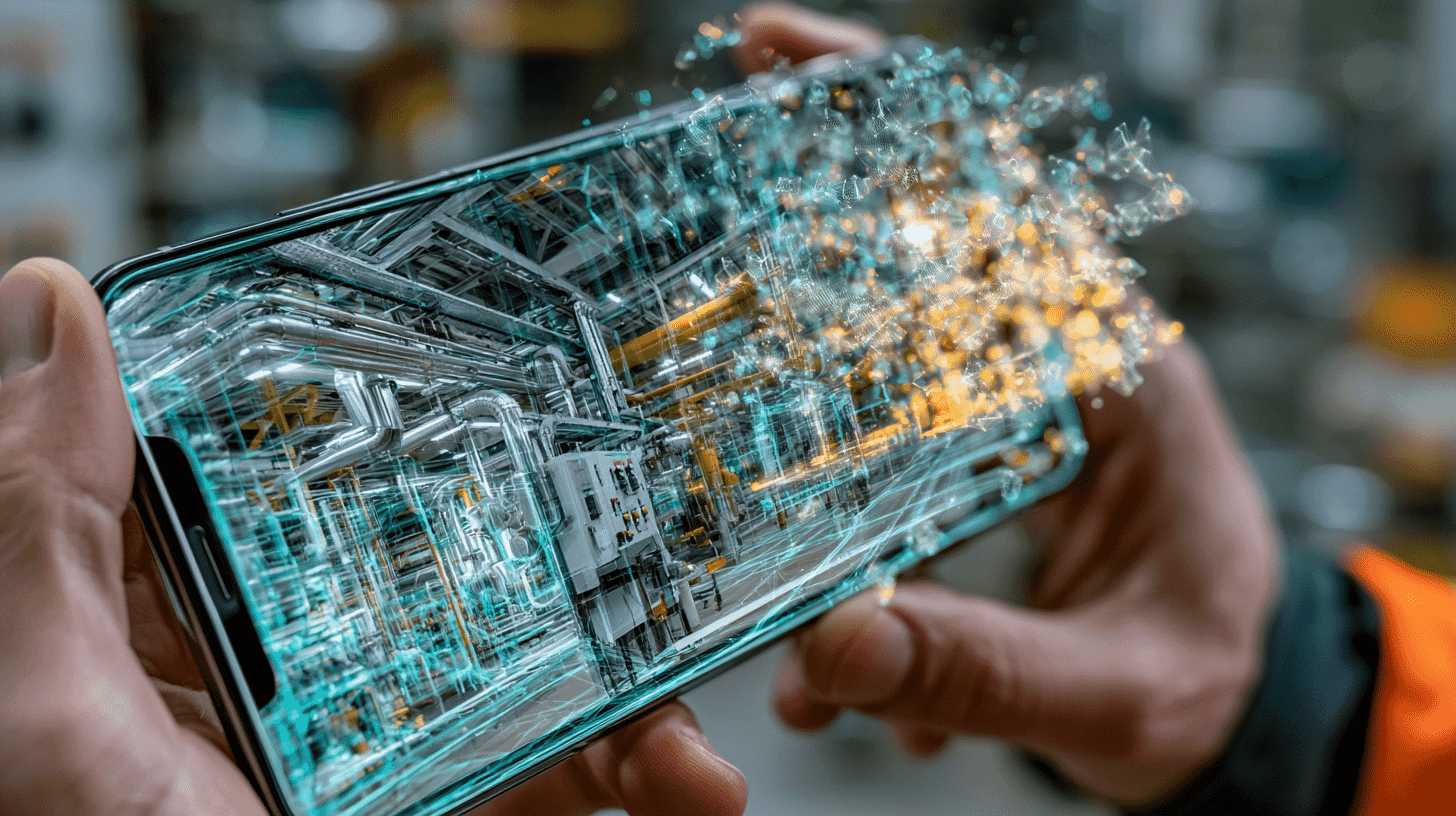
📱 Walk through a factory filming with your phone, wait about a minute, and you get a detailed 3D model of the entire site, with every worker who wandered into frame neatly erased. That's the technology NEC announced on July 14, 2026, developed jointly with Keio AI Center, and the company says nobody has pulled off this particular combination before.
What NEC actually announced
The work came out of NEC's Cyber-Physical Intelligence Research Laboratories, jointly with Keio AI Center, and NEC credits the result to its collaboration with Professor Hideo Saito, one of Japan's leading figures in visual computing. The target users are not gamers or filmmakers but people who run power plants, factories, and construction sites. A site manager films the floor with a phone, and a minute later a supervisor hundreds of kilometers away can spin the model around on a regular laptop or tablet, zoom in on a pipe joint or a pressure gauge, and decide whether someone needs to be dispatched. No lidar scanner, no camera rig, no halting operations for a capture session. NEC aims to commercialize the technology by the end of fiscal 2027, which runs through March 2028.
The problem with turning reality into 3D
Digitizing a real place has always involved an awkward trade-off between quality, speed, and cost.
The classic approach is photogrammetry: take hundreds of overlapping photos, let software find matching points between them, and reconstruct the geometry. It works, and it powers tools like Apple's Object Capture, but it is computationally heavy and tends to struggle with shiny, transparent, or featureless surfaces, exactly the kind of thing industrial sites are full of.
In 2020, NeRF (Neural Radiance Fields) changed the conversation by having a neural network learn a scene and render photorealistic views from any angle. Beautiful results, but training and rendering were slow, which kept it largely in research labs.
Then came 3D Gaussian Splatting, presented at SIGGRAPH 2023. Instead of meshes or neural networks, it represents a scene as a cloud of soft, blurry blobs, each carrying position, shape, color, and transparency. Pile up enough of them and you get a scene that looks startlingly real, renders fast, and stays lightweight compared with traditional 3D models. Within two years it spread into film backgrounds, VR capture, and mapping apps.
But conventional Gaussian splatting still had two weaknesses for industrial use. Generation took time. And it faithfully reconstructed everything the camera saw, including the forklift driver who happened to pass by. On a working site, "everything the camera saw" is precisely the problem.
Two tricks: smarter blobs, and making people disappear
NEC's contribution is a pair of AI techniques layered on top of Gaussian splatting.
The first attacks speed through selective effort. NEC's AI analyzes how visually complex each part of the footage is, then allocates the Gaussian blobs accordingly: dense clusters on intricate areas like valve assemblies and instrument panels, sparse coverage on plain walls and floors. By not wasting computation where detail doesn't matter, the system cuts generation time to one-tenth of conventional Gaussian splatting, according to NEC's figures, which is how it reaches the one-minute mark.
The second trick handles the messiness of a live site. During model generation, the AI detects people and temporary objects caught in the footage and removes them, then fills in the gap using background information from surrounding frames. The result is a clean model of the facility as it actually is, minus the clutter, captured without shutting anything down. There's a privacy benefit tucked in here too: workers don't end up permanently embedded in a 3D archive.
This announcement isn't a one-off. In May 2026, NEC unveiled a related technique, also built around Gaussian splatting, that converts bulky 3D point-cloud data into high-fidelity 3D data roughly 90 percent lighter. Both target commercialization in fiscal 2027, and together they sketch NEC's bet: that Gaussian splatting is the format industrial digital twins have been waiting for.
Where this sits next to Meta, Apple, and China
Gaussian splatting is a crowded field, so the comparison is worth making.
Meta released Horizon Hyperscape Capture in September 2025, letting Quest 3 owners scan a room and revisit it in VR with near-photorealistic quality. It uses the same underlying technique, but reviewers report that cloud reconstruction typically takes hours, and the product is aimed at consumer VR experiences. Apple has taken the photogrammetry route, building Object Capture into its developer tools so iPhone users can scan objects for AR. Both are oriented toward capturing things to look at.
China, meanwhile, has poured resources into city-scale digital twins as part of its smart-city programs, and Chinese universities and tech firms are highly active in 3D reconstruction research. The emphasis there tends toward large-scale urban modeling rather than individual work sites.
NEC's angle is narrower and more industrial: not scanning your living room or an entire city, but the unglamorous middle ground of substations, plant floors, and half-finished buildings, where speed matters because conditions change daily, and where erasing bystanders is a feature, not an afterthought. If the demos hold up in the field, that focus could matter more than raw novelty. Japan's chronic shortage of maintenance engineers means fewer experts covering more sites, and a one-minute 3D snapshot is a plausible way to stretch them further.
The caveats, and what to watch
A few things deserve honest flags. The "world first" is NEC's own determination, and the tenfold speedup is the company's published figure; neither has been independently benchmarked. The demonstrations so far use footage from a training facility, not a rain-soaked construction site with poor lighting. And NEC has not yet disclosed pricing, product form, or exactly what hardware runs the generation step. Fiscal 2027 leaves time for those answers, and for competitors to close the gap.
Still, the direction is hard to argue with. If a phone in a worker's pocket becomes a good-enough 3D scanner, digital twins stop being a capital investment and start being a habit. Beyond factories, it's easy to imagine the same pipeline feeding XR content, disaster damage assessment, or heritage documentation.
Japan is betting on technologies like this to compensate for a shrinking skilled workforce. How about where you live: are job sites and factories in your country going digital this way, or does inspection still mean someone driving out with a clipboard?









Global Discussion
0 comments