
🪟 Picture a museum case where a 3D model floats over the real artifact behind it. Or a shop window where the product sits behind clear glass, but a full-color, three-dimensional cutaway hangs in front of it. No goggles. No bulky displays. Just glass. On May 19, NHK's broadcasting research lab said it has built exactly that, and the way it solved the underlying physics is what makes the story interesting.
What NHK actually built
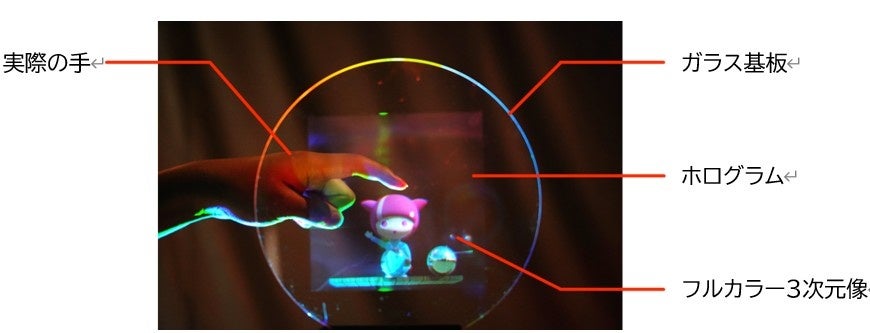
NHK Science & Technology Research Laboratories (STRL), the engineering lab behind decades of Japanese broadcasting firsts, from analog HDTV to 8K, announced a transparent hologram that displays full-color 3D images on a clear glass substrate. The work was done jointly with Institute of Science Tokyo (Science Tokyo), the new national university formed in October 2024 when Tokyo Tech and Tokyo Medical and Dental University merged.
NHK calls it a world first. The press release frames the headline simply: a glass plate that lets you see what's behind it, with a sharp color 3D image floating in front. The paper has been accepted as a journal paper at SIGGRAPH 2026, the field's premier computer-graphics conference, which ran in Los Angeles from 19 to 23 July 2026, where the work was presented.
Source: NHK STRL
The two walls that made "transparent + color" so hard
Holography isn't new: every credit card has a small foil hologram on it. But the kind of hologram that displays a large, walk-around-it 3D image has been stuck on two specific problems for a long time, both of them tied to a method called the surface-relief hologram.
A surface-relief hologram is, physically, a sheet of glass with microscopic bumps etched into its surface. Light passing through those bumps bends in a precisely calculated way and reassembles, on the other side, into a 3D image. The technique can produce relatively large still images with a wide viewing area, which is why researchers like it.
The catch, until now, was twofold.
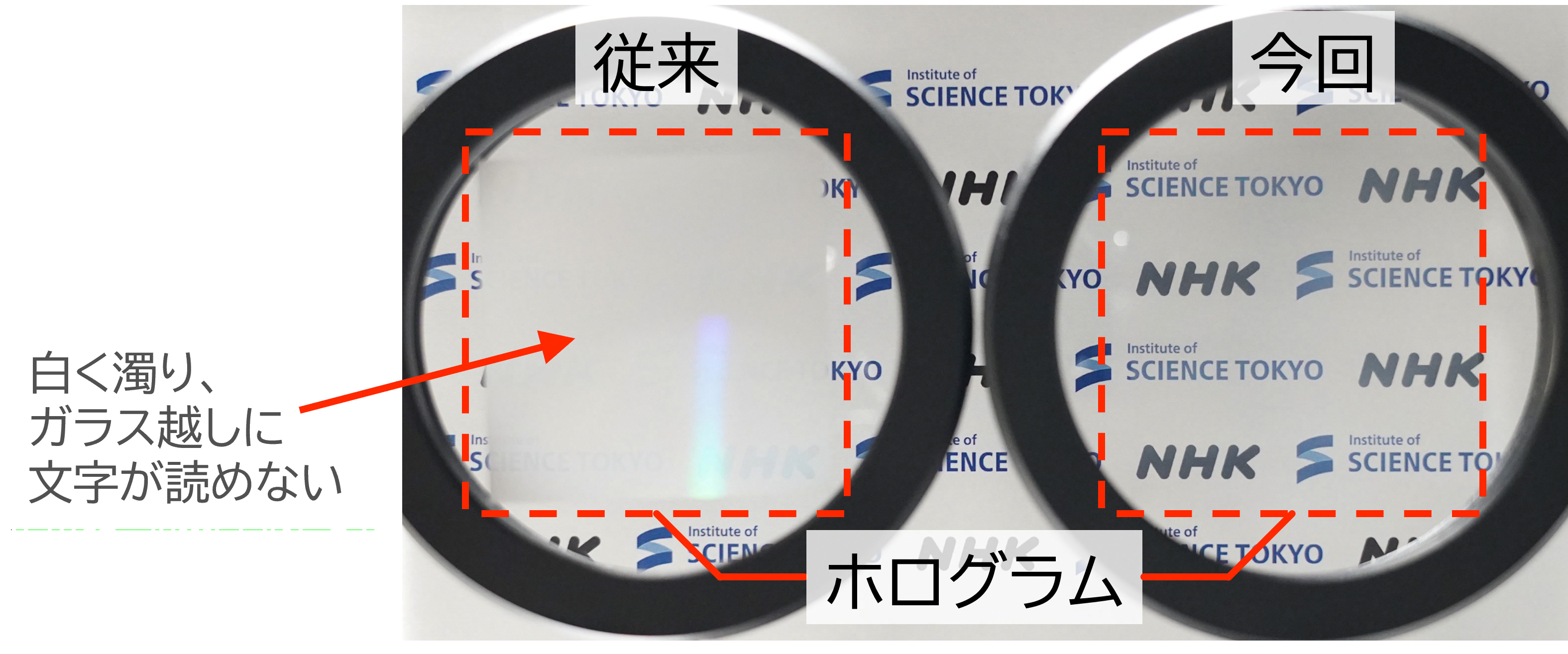
Cloudiness. The bumps had to be deep and sharp, roughly 1 micrometer tall with steep edges. That depth was needed to bend light enough to form a clean image, but it also scattered light in random directions. Look through a piece of glass like that and the background goes milky-white. The hologram worked, but the "window" stopped being a window.
Color complexity. To get full color, designers traditionally stacked separate panels for red, green, and blue, or layered color filters. Each extra layer cut transparency further. The result was a hologram that was either crisp and color but opaque, or transparent and monochrome. Both, in one piece of glass, kept being out of reach.
Source: NHK STRL
The trick: stop ignoring the amplitude
Traditional surface-relief design treats light as a wave and controls only its phase, how the wave is shifted in time as it passes through each bump. The amplitude, or wave height, was treated as a fixed quantity you couldn't really play with.
The NHK-Science Tokyo team's core idea was: use both.
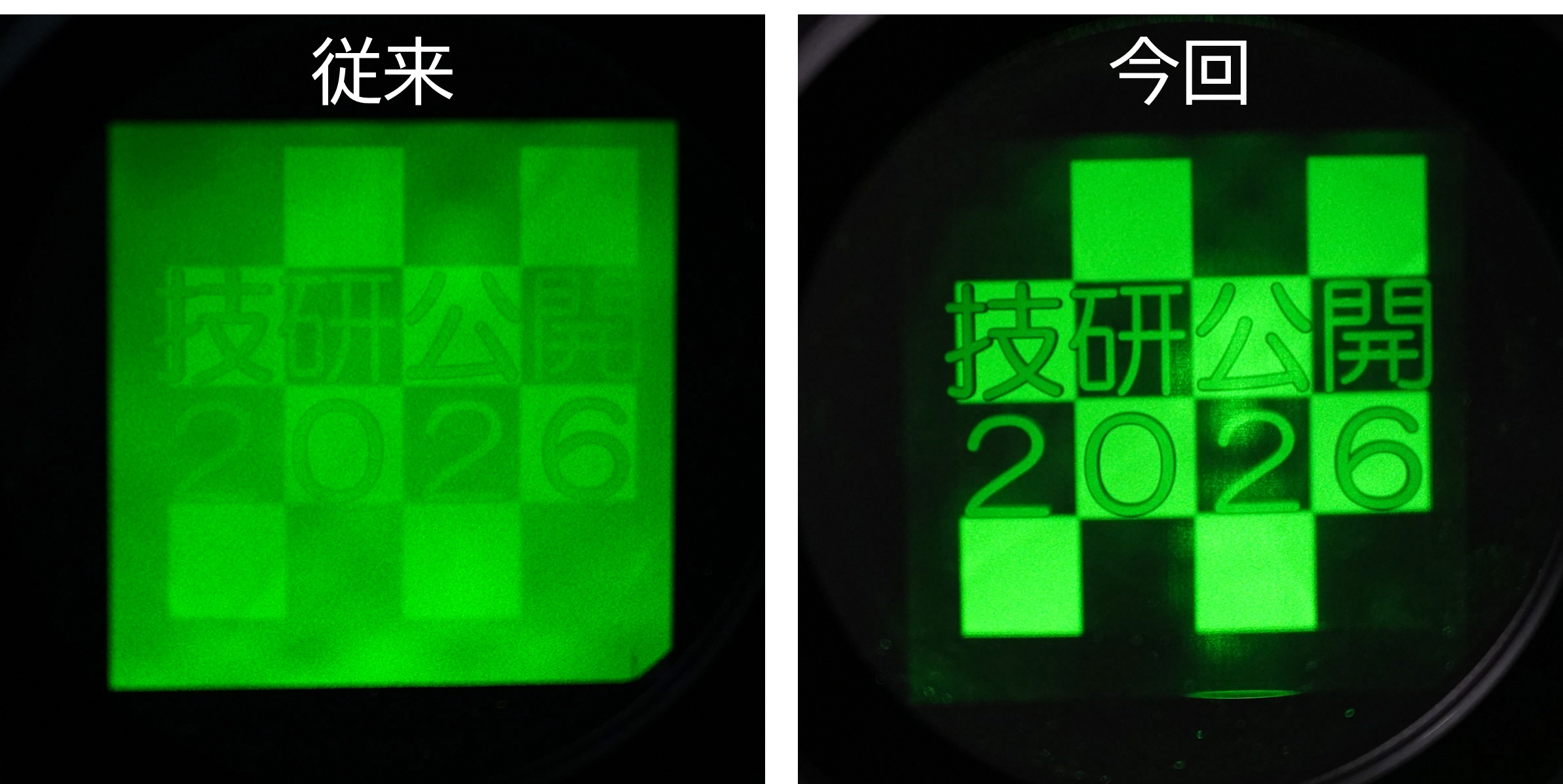
By bringing amplitude into the design, letting the bump pattern adjust how much light goes where as well as when it arrives, the team found they no longer needed deep, sharp peaks to shape the image. The bumps dropped to about 0.5 micrometers, roughly half the previous depth, and the profile became smooth and continuous rather than jagged. Less depth and smoother slopes mean far less scattering, which is why the glass stays glass-clear.
The same amplitude trick handled the color problem in an unexpectedly clean way. Instead of stacking R/G/B layers, a single hologram is illuminated by red, green, and blue light coming in from three slightly different angles. Each color reconstructs its own 3D image at the same point in space, and the three overlap into one full-color picture. One thin engraved surface, three colors, no filters.
NHK adds that, somewhat counterintuitively, the new design didn't cost extra compute. The same algorithms that calculated the old phase-only pattern now calculate phase plus amplitude, with the amplitude information actually improving image quality by giving the math more degrees of freedom to work with.
What the prototype looks like
The numbers are the kind that make display engineers raise an eyebrow.
The test piece is about 12 centimeters square, small enough to hold in two hands. Onto that surface the team packed roughly 60 billion pixels, in a grid of 245,760 by 245,760. Each pixel sits 0.5 micrometers from the next, which is one two-thousandth of a millimeter. The bump heights at each pixel can be set to one of 32 discrete levels, smoothing the steps between heights and letting the surface encode light information with more precision than earlier prototypes.
The trade-off is the viewing zone. Squeezing both transparency and color into one engraved surface narrows the angles from which the 3D image looks right. But within that zone, the image shifts naturally as you move your head: the parallax you'd see on a real object, which is the part of holography no flat screen can fake.
Source: NHK STRL
Why this matters outside the lab
NHK is upfront about where it sees this going. Two scenarios show up in the press release, and they're worth thinking about because they're concrete rather than vaporware.
The first is the shop window. Right now, retailers who want digital signage in a glass storefront have to choose: paste a screen onto the window (and lose the view in), use a projection trick like Pepper's Ghost (which only works at certain angles), or settle for a static decal. A transparent hologram embedded in the glass itself could float a 3D explainer next to a real product behind the window: say, a 3D cutaway of a watch movement hovering beside the actual watch.
The second is the museum case. Museums struggle with the same compromise: how to overlay information onto an exhibit without putting a screen between the visitor and the object. A glass case that is genuinely transparent, but can also show a 3D label, a reconstruction of a broken piece, or an animated diagram suspended over the artifact, opens up a different kind of exhibit design altogether.
There are limits worth being honest about. The viewing angle is narrow. The image is currently a still, not motion; NHK puts moving pictures at around 2030. Twelve centimeters square is a long way from a department-store window. And nothing in the announcement says when, or whether, any of this becomes a product you can buy. But the specific technical wall NHK and Science Tokyo broke through, high transparency and full color in a single surface-relief hologram, is exactly the wall that has kept the technology in the lab for years.
The bigger picture at NHK STRL
It's easy to forget that NHK STRL is one of the longest-running corporate research labs in broadcasting anywhere in the world. They championed HDTV when HDTV was an obscure idea, drove 8K through a decade when nobody wanted it, and have quietly held a position in 3D-without-glasses research that doesn't make headlines until it does.
The lab's stated long-range plan, "Future Vision 2030–2040," puts immersive media at the center. Holography fits there: it's the most physically honest way to reproduce a 3D scene because it actually reconstructs the light field, not just two stereo images. The transparent hologram work is one piece of that bigger bet, alongside curved image sensors, ultra-thin silicon imagers, and the next-generation terrestrial transmission standard the lab helped push through ARIB.
The technology was shown publicly for the first time at the lab's annual open house, NHK STRL Open House 2026, held 28–31 May in Tokyo's Setagaya ward, free and without registration. NHK TECH EXPO 2026 ran alongside it at the same venue for the first time. The booth put an older, milky-looking hologram next to the new one so visitors could compare the transparency directly.
If transparent 3D displays do become real, what would you most want to use one for? A shop window, a museum, your living room?



Global Discussion
4 comments