
🦵 You probably know someone who has had knee surgery, and maybe you have had one yourself. For decades, a torn meniscus often meant cutting the damaged piece away. It works in the short term, but it quietly sets the knee up for arthritis years down the line. Japan has now approved something different: a treatment that uses a patient's own stem cells to help the meniscus heal instead of removing it.
On May 8, 2026, Fujifilm Toyama Chemical announced that its product Seibiscus had received manufacturing and marketing approval in Japan, the country's first regenerative medicine product aimed specifically at meniscus injury. The technology behind it came out of a university lab, and its journey from research bench to approved treatment says a lot about where Japan sits in the regenerative medicine race.
A cushion you only miss once it's gone
The meniscus is a pair of crescent-shaped pads of cartilage that sit between the thigh bone and the shin bone in each knee. They act as shock absorbers and help keep the joint stable. Tear one, through a sudden twist on a soccer pitch or simply through years of wear, and you get pain, swelling, and that unsettling sensation of the knee catching or locking.
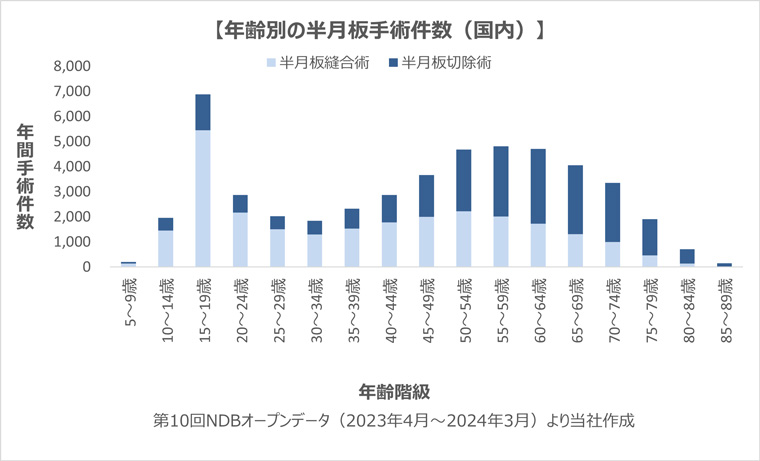
Meniscus tears are among the most common knee injuries in the world. In the United States, studies put the incidence at roughly 61 cases per 100,000 people each year, and the risk climbs after age 40. In Japan, surgeons perform around 50,000 meniscus operations annually.
Here is the uncomfortable part. Roughly half of those Japanese operations are meniscectomies: procedures that trim away or remove the torn tissue. Among patients over 40, the share rises to about 60 percent. Removing the damaged tissue relieves the immediate pain, but it also removes the cushion. With less padding, the cartilage underneath takes a heavier load, and the knee becomes more likely to develop osteoarthritis later. Stitching the meniscus back together preserves it, but sutures only work for certain tear shapes and locations, and re-tears are common. Orthopedic surgeons have rallied around an international slogan, "Save the Meniscus", but until now they have not had many tools to do it.
Source: Fujifilm news release
How Seibiscus works: borrowing cells from inside your own knee
The treatment was developed by Professor Ichiro Sekiya, who heads the Center for Regenerative Medicine Research at the Institute of Science Tokyo (the university formed in 2024 from the merger of Tokyo Medical and Dental University and the Tokyo Institute of Technology).
His approach is built around a tissue most people have never heard of: the synovium, a thin membrane that lines the inside of the joint and produces the fluid that keeps it moving smoothly. The synovium is also a rich source of mesenchymal stem cells: versatile cells that can mature into bone, cartilage, or fat, and that play a natural role in tissue repair.
Seibiscus uses the patient's own synovial stem cells. During an arthroscopic procedure, keyhole surgery through a few small incisions, surgeons take a sample of synovium from inside the patient's knee. Those cells are then isolated and grown in culture until there are enough of them, and the resulting cell suspension is delivered back into the joint. Once there, the cells settle onto the damaged meniscus, begin maturing into cartilage cells that produce cartilage matrix, and help draw the patient's own synovial tissue toward the injury. The goal is not to install a synthetic patch but to coax the meniscus into knitting itself back together.
One detail matters for understanding why this is a big deal: the cells come from the patient, so there is no donor and no risk of immune rejection. And because everything happens through an arthroscope, the physical burden on the patient is relatively light.
What the trial actually showed
The product's path to approval ran through an investigator-initiated trial led by Professor Sekiya, followed by a company-run Phase III trial that began in January 2023.
The Phase III study enrolled 19 patients whose meniscus tears were the kind that would normally lead to a meniscectomy, and whose symptoms had not improved after 12 weeks of conservative treatment. Many had flap tears, a particularly stubborn type where a piece of the meniscus peels up like a loose flap.
The main measurement was the Lysholm score, a standard knee questionnaire that rates pain, stability, and function. Among the 15 patients with confirmed flap tears, the average score climbed from 38.1 before treatment to 91.6 one year afterward, a jump that was both statistically significant and large enough to be clinically meaningful. At the two-year mark, the improvement was still holding.
Imaging backed up the questionnaires. MRI scans showed signs of repair at the damaged area in 73.7 percent of patients (14 of 19). When independent specialists reviewed arthroscopic images, they found complete healing in the central, blood-starved part of the meniscus, a zone that essentially never heals on its own, in 35.7 percent of flap-tear patients. Crucially, no patient needed a second operation for a re-tear within two years, and the trial reported no adverse events that could be clearly traced to the treatment.
Why this happened in Japan first
It is tempting to file this under "Japan and iPS cells", the famous stem cells that earned Kyoto University's Shinya Yamanaka a Nobel Prize. But Seibiscus does not use iPS cells. It uses adult stem cells taken straight from the patient's body, a simpler and older category of cell. The real story is less about one celebrity technology and more about an ecosystem.
In 2014, Japan overhauled its laws to create a dedicated regulatory category for "regenerative medicine products," separate from ordinary drugs and devices. That framework gave companies a clearer, faster route to market for cell-based treatments. Approvals under that framework have accumulated steadily since, and Seibiscus is the second one aimed at the knee joint, after an autologous cultured cartilage product. On March 6, 2026, Japan also granted conditional, time-limited approval to two iPS-derived products: the RiHEART cardiomyocyte sheet from Cuorips for severe heart failure, and Sumitomo Pharma's AMCHEPRY for Parkinson's disease. They were the first iPS-derived approvals anywhere, though both use donor cells rather than the patient's own. Two iPS-cell products were also cleared earlier in 2026, for heart failure and Parkinson's disease.
Seibiscus is also notable for its origin story. A university professor's research moved through an investigator-initiated trial and then into a commercial product, a hand-off from academia to industry that Japan has long talked about wanting and has not always managed to pull off. The government's research funding agency, AMED, supported the project at multiple stages.
Korea, the US, and a crowded global race
Japan is not alone. Knee cartilage and meniscus repair has become one of the most competitive arenas in regenerative medicine, and it is worth seeing where the neighbors stand.
South Korea, in particular, has a head start in one respect. The Seoul-based company Medipost won approval back in 2012 for Cartistem, a stem cell therapy for knee cartilage defects. Cartistem uses allogeneic cells, mesenchymal stem cells derived from donated umbilical cord blood, which means it can be produced as an off-the-shelf product rather than custom-made for each patient. It has since been used in more than 32,000 people in Korea, and Medipost has cleared US regulators to begin a Phase III trial in North America. But Cartistem treats worn cartilage, not the meniscus itself: a related problem, not the same one.
The United States, despite its enormous research base, has no approved cell therapy aimed specifically at regenerating the meniscus. American work in this space is mostly at the trial stage, including studies using a patient's own micro-fragmented fat tissue. In China, a Beijing team has run an early-phase trial using cells derived from embryonic stem cells for meniscus injury. Each country is taking a slightly different route, with different cell sources and different regulatory systems, and no single approach has clearly won.
That is what makes Japan's approval significant: not that it ends the race, but that it is the first time a treatment built specifically to repair the meniscus, using the patient's own cells, has crossed the finish line of national approval.
The honest caveats
Enthusiasm should come with footnotes. The Phase III trial was small, 19 patients, and it had no control group, so there is no direct comparison with patients who received standard care. The strongest healing result, complete repair of the avascular central zone, was seen in roughly one in three flap-tear patients, not a sweeping majority. Long-term durability beyond two years is still unknown.
There are practical unknowns too. Approval is not the same as availability: the price has not been announced, and it is not yet clear when or whether the treatment will be covered by Japan's public health insurance, which will largely determine how many patients can actually reach it. The therapy is also indicated for a specific situation, tears serious enough that a meniscectomy would otherwise be the plan, not for every sore knee.
Still, for a condition this common, a tool that lets surgeons preserve the meniscus instead of trimming it away is a genuine shift. If it holds up, the people who benefit most may be patients in their 40s and 50s: old enough that their tissue no longer heals well on its own, young enough that they have decades of walking, working, and playing ahead of them.
In Japan, the conversation around knees is slowly moving from "remove the damage" to "help it repair." How are torn menisci and knee injuries usually treated where you live, and would you trust your own cells to do the mending?









Global Discussion
4 comments