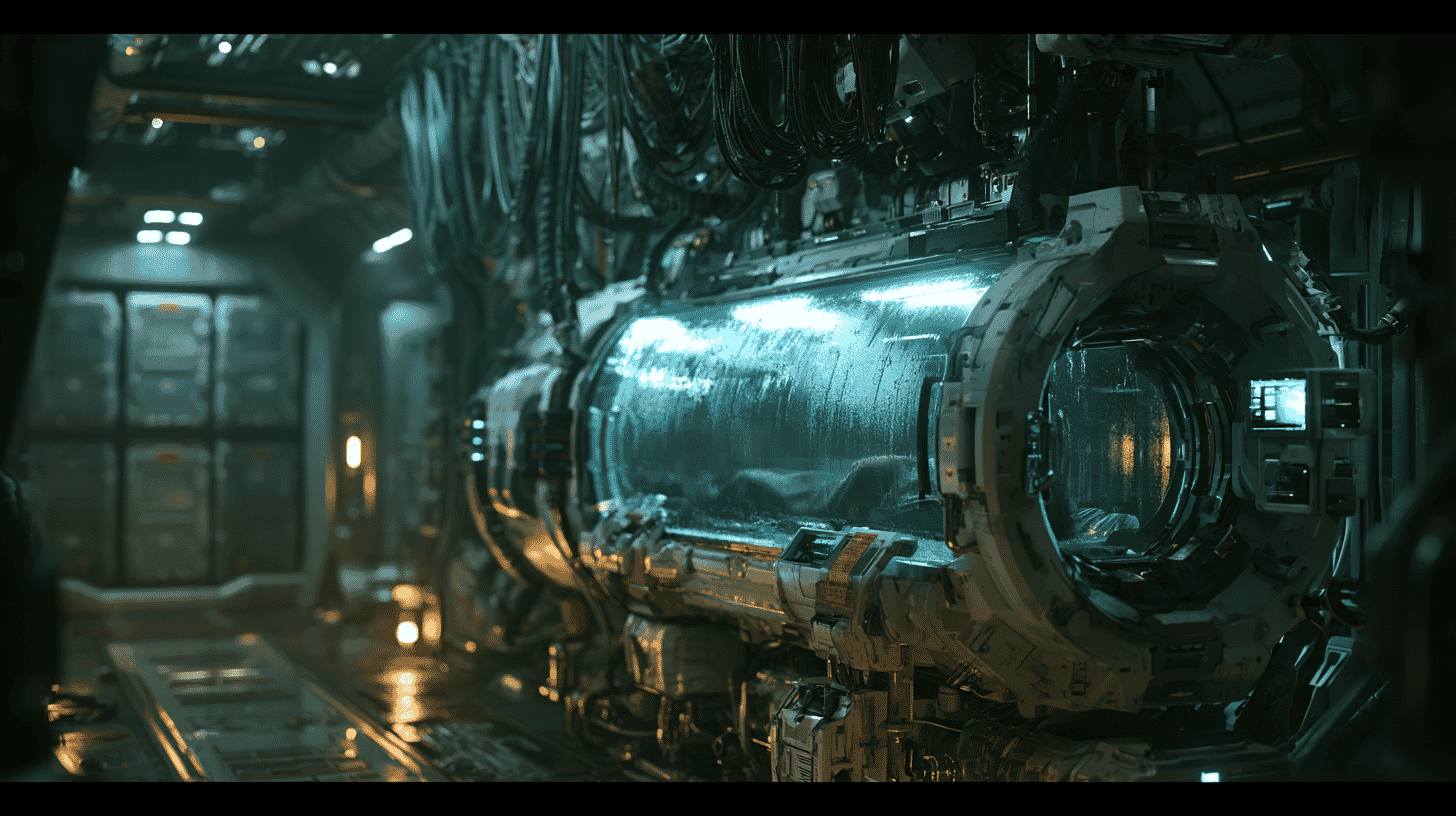
Every spaceship in the movies has them: a row of frosted pods where the crew sleeps through the empty part of the trip. For most of a century that was purely a prop. In the last few years it has stopped being one. Two space agencies have run real design studies on hibernating crews, a Japanese lab found the brain switch that drops non-hibernating animals into something close to hibernation, and NASA has put money into hardware meant to test the idea on the space station. What nobody has done is put a human through it.
A Way to Make the Spacecraft a Third Lighter
A round trip to Mars is measured in years. Everything the crew eats, drinks and breathes has to be launched from Earth first, and that is the heaviest single part of a crewed Mars mission. It is also the reason hibernation keeps coming back as a serious question rather than a joke.
In 2019, the European Space Agency took an existing Mars mission concept, six people over a five-year timescale, and asked its Concurrent Design Facility what would change if the crew slept through the cruise. Removing the crew quarters cut the spacecraft's mass by roughly a third, with a comparable cut in consumables. The crew would ride in small individual pods that double as their cabins while awake. The cruise runs 180 days, followed by a 21-day recovery period after arrival. If everyone is parked in the same place for months, shielding like water tanks can be concentrated around them instead of spread thin.
NASA files the idea differently. The agency groups the hazards of deep space under the acronym RIDGE: radiation, isolation and confinement, distance from Earth, gravity, and hostile closed environments. What makes hibernation unusual is that it could plausibly act on all five at once. Very little else does.
In 2020, Someone Found the Switch
Hibernation is not the same thing as being cold. Hospitals already cool patients on purpose. That procedure works by suppressing the body's temperature control with drugs and then chilling it from the outside, while the body spends the whole time trying to warm itself back up. Animal hibernation runs the other way around. The animal turns its own metabolism down, and the drop in body temperature follows from that. The second version is the one you would want on a spacecraft, and for a long time nobody knew how to produce it on demand.
Then in 2020, Takeshi Sakurai's group at the University of Tsukuba, working with Genshiro Sunagawa of RIKEN, reported in Nature that stimulating a small population of neurons in the hypothalamus put mice into a hibernation-like state lasting days. They called the cells Q neurons. Mice do not hibernate. The group went on to report that they could induce a comparable state in rats, which neither hibernate nor use daily torpor.
If it works in an animal that never hibernates, the underlying machinery may be sitting in mammals generally, unused by most of them. Humans included.
Around the same time, an old observation came back into circulation. Animals in torpor tolerate radiation better than the same animals awake. This had been noted in the early 1960s and then shelved, since there was no way to put a person into torpor and therefore no way to use it. More recent work in rats, using the kind of heavy particles found in cosmic rays, points the same direction. The American company Fauna Bio and Colorado State University now run a long-term study, backed by NASA, the Italian Space Agency and the Canadian Space Agency, exposing ground squirrels to radiation designed to imitate what a Mars crew would absorb.
With Humans, It Is Still a Matter of Hours
What has been tried in people, with lowering metabolism as the actual goal, is a mild reduction produced by a sedative plus cooling and held for a matter of hours. Researchers in the field describe that shallow reduction as the realistic first step, and write that producing the deep kind seen in animals in a human being, let alone aboard a spacecraft, is not currently possible.
The primate results are instructive. According to a 2025 review in Nature Metabolism, when the brain region that worked in mice was stimulated in monkeys, body temperature barely moved, heart rate climbed, and the animals shivered. The body read the situation as cold and fought it. A switch found in rodents does not automatically press in a primate.
The freezing that "cold sleep" implies cannot be done to a living person. Water expands as it turns to ice and wrecks cells on the way. What researchers are actually chasing is not a frozen body but a regulated one, held stably at low temperature and low metabolism.
Even ESA's design study rested on an assumption: that an astronaut's basal metabolic rate could be brought down by 75 percent, the sort of figure large hibernators like bears manage. No one currently knows how to meet that assumption in a person.
Who Flies the Ship?
The walls are not all biological.
If the whole crew is asleep, the vehicle has to fly itself. ESA's study noted that such a mission would need largely autonomous operation, leaning on AI for fault detection, isolation and recovery, holding the ship together until someone could be revived. That is a spacecraft problem rather than a physiology problem, and it is not solved either.
Then there is the body itself. How do you deliver food and water across months. What happens during the waking-up procedure. Hibernating animals emerge from a season of near-total stillness without the muscle and bone loss you would expect, which is the single biggest reason space medicine wants a closer look. Yet nobody has ever watched an animal hibernate in weightlessness.
Filling that gap is the entire point of STASH. In 2024, NASA's Innovative Advanced Concepts program selected a proposal from Ryan Sprenger of Fauna Bio, built with the University of Colorado Boulder outfit BioServe Space Technologies: a small refrigerated animal laboratory sized to fit inside an incubator already flying on the ISS. It now runs under the name Project ADAPT.
NIAC funds early-stage concepts with small grants; it does not fund missions. As of August 2026, no space agency has a program to hibernate astronauts. Jennifer Ngo-Anh, who coordinates human exploration research at ESA, told Space.com in 2023 that if the funding appears, the first trials in people could begin as early as the mid-2030s.
And the largest question is still open. Why don't humans hibernate? Do we carry the machinery and simply never switch it on, or did we lose it somewhere? The rat result hints at the first answer. A hint is all it is.
Why Japan Sits at the Center of This
Hibernation researchers are a small population worldwide, and a disproportionate share of them work in Japan.
In 2021, a project led by Masashi Yanagisawa, who directs the University of Tsukuba's International Institute for Integrative Sleep Medicine, was selected under Japan's national Moonshot research program, Goal 7, administered by AMED. Its title translates roughly as sleep and hibernation: understanding and controlling two kinds of dormancy for next-generation medicine. Not many countries have a national program aimed at human hibernation.
Goal 7 is about healthcare and elder care by 2040, not spaceflight. When researchers name the first practical uses, they talk about keeping critically ill patients alive during transport, or protecting organs during surgery.
That may turn out to be the realistic sequence. An intensive-care specialist at Ludwig Maximilians University in Munich who sits on ESA's hibernation team has said much the same thing: the first person put into this state will most likely be an ICU patient. If human hibernation ever arrives, it probably comes out of a hospital rather than a Mars vehicle, and spaceflight borrows the finished technique afterward.
In Japan, the money behind this is medical money. If your country were funding it, what would you want it aimed at first?
References
- https://www.esa.int/Enabling_Support/Space_Engineering_Technology/Hibernating_astronauts_would_need_smaller_spacecraft
- https://www.nasa.gov/general/studying-torpor-in-animals-for-space-health-in-humans/
- https://www.faunabio.com/
- https://www.nature.com/articles/s41586-020-2163-6
- https://www.tsukuba.ac.jp/en/research-news/20200612090000.html
- https://www.nature.com/articles/s42255-025-01345-3
- https://www.nature.com/articles/s41598-022-20382-6
- https://wpi-iiis.tsukuba.ac.jp/japanese/about/moonshot/
- https://pmc.ncbi.nlm.nih.gov/articles/PMC12011254/
- https://pmc.ncbi.nlm.nih.gov/articles/PMC7099441/
- https://www.space.com/astronaut-hibernation-trials-possible-in-decade









Global Discussion
3 comments