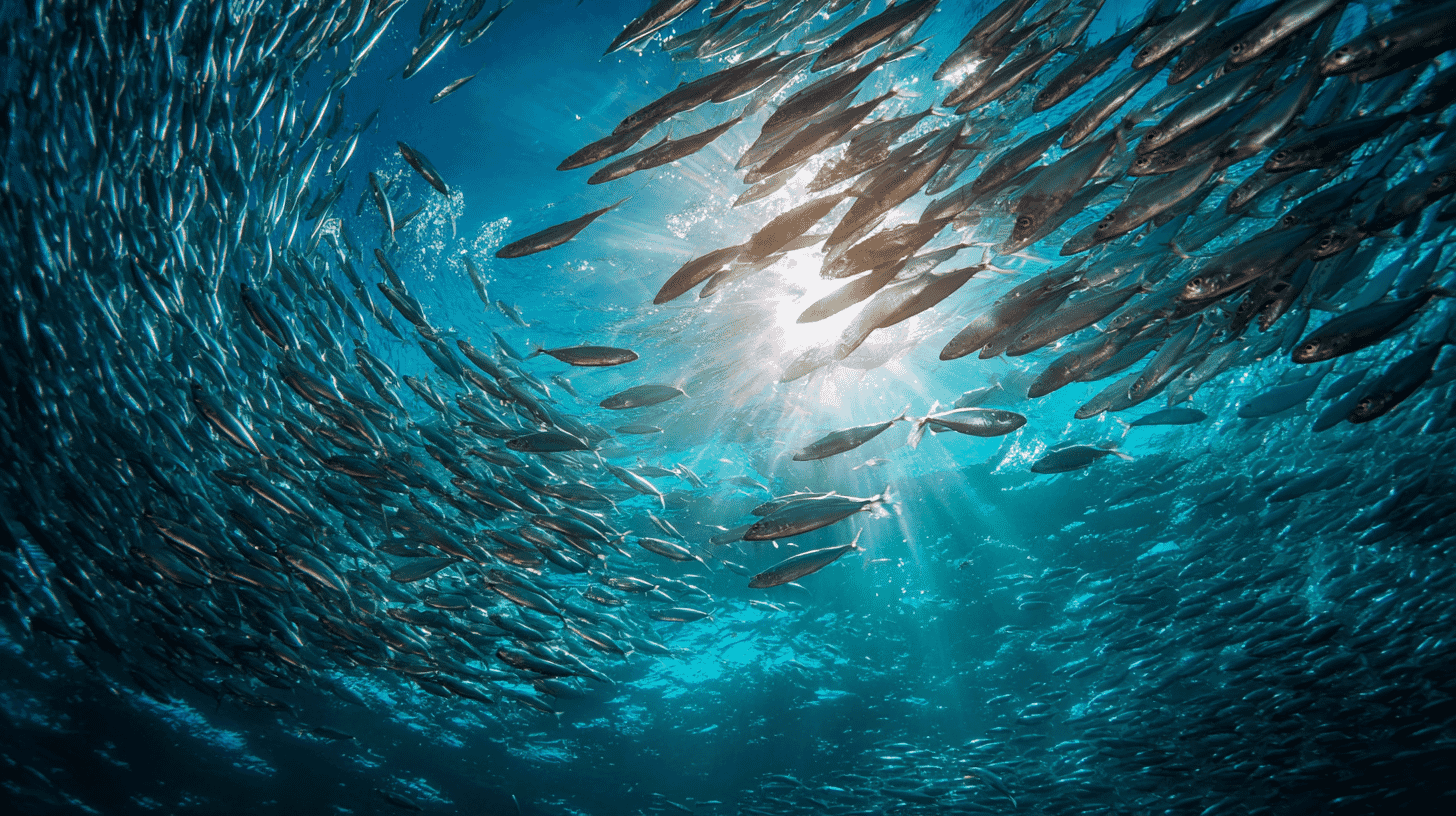
🐟 Mackerel and sardines are packed with DHA, an omega-3 fat. Yet most marine fish can't make enough of it on their own. So where does it actually come from? A team led by Konan University in Japan spent a year counting microbes in the cold Oyashio waters off northeastern Japan, and their numbers suggest a tiny algae-eating protist plays a bigger part than the textbook picture allows.
The DHA paradox: the numbers don't add up
In the textbook version, phytoplankton make DHA, tiny animals called zooplankton eat the phytoplankton, and fish eat the zooplankton. The DHA in a fish fillet has simply climbed the food chain.
The trouble is the math. Diatoms, the glassy algae behind roughly half of the planet's primary production, do make some DHA, but their fats lean heavily toward EPA, a closely related omega-3. Across phytoplankton as a whole, EPA outweighs DHA about five or six to one. Fish, meanwhile, store the two in roughly equal amounts. Researchers call this mismatch the "DHA paradox."
Some fish can make their own, at least partly. Salmon and trout are relatively good at converting alpha-linolenic acid, the omega-3 found in plants, into EPA and DHA. A 2020 study found that three flatfish species in the family Achiridae that moved into fresh water each evolved their own complete route to DHA. Humans make a little, too, but not efficiently. Most marine fish, though, have to get it from their food.
An unseen protist that eats algae
Daisuke Honda, a biology professor at Konan University, has spent years studying a group of single-celled organisms called Labyrinthulea. They live throughout the ocean, but they have no chloroplasts and don't photosynthesize. What they do is make DHA themselves and pack it into their cells at high concentrations.
One branch of the group, the aplanochytrids, eats living diatoms. Honda's lab showed this in culture experiments published in 2019. A year earlier, a study with Japan's national fisheries research agency looked inside copepods from subtropical coastal waters. These crustaceans, a few millimeters long, are a staple food for fish, and aplanochytrid DNA turned up in their guts at higher shares than in the surrounding seawater.
That pointed to a possible relay runner: something that eats EPA-heavy diatoms, holds onto DHA, and then gets eaten by copepods. What nobody really knew was how many of these protists were actually out there.
A year of counting in the Oyashio
The team joined five survey cruises a year run by the Japan Fisheries Research and Education Agency. The route covers waters from the Sanriku coast to southern Hokkaido, where the cold, nutrient-rich Oyashio current flows in. They sampled six stations stretching about 600 kilometers (about 370 miles) offshore, at five depths from the surface down to about 3,000 meters (about 9,800 feet), from July 2021 to May 2022.

Source: Konan University
To count something you can't see, they used environmental DNA. They collected the fragments of genetic material that organisms leave in seawater, measured them with quantitative PCR, and converted the results into cell counts and carbon. (For how environmental DNA works, see our story on how a single glass of water revealed a bear upstream.)
Near the surface, where the Oyashio brought in nutrients, they found from several thousand to about 50,000 aplanochytrid cells per liter. The stations with the most aplanochytrids were also the ones with the most phytoplankton, a hint that the protists were grazing on diatoms out in the open ocean, not just in a lab dish.
But in absolute terms, there weren't many. Even at their peak, aplanochytrids made up only about 2% of the biomass of the main producers, and about 13% in terms of DHA. The team's own release concedes these were not numbers that would solve the paradox.
Scarce in the water, big on the menu
So the researchers turned to what copepods actually eat. Using gut-content DNA data from earlier studies, they estimated how much DHA each of three prey groups hands over. The press release puts the shares at 56% for aplanochytrids, 34% for diatoms and 10% for dinoflagellates. Few in number, aplanochytrids get eaten so readily that they may end up as the copepods' biggest DHA source. In the paper itself, the figure depends on which gut data is used: 63% with data from subtropical coastal waters, and about 40% with data from the East China Sea and the Kuroshio region.
Adding that contribution brings the DHA to EPA ratio in copepod guts to 1 to 2.4. That is still not one to one, but it is far closer to what fish carry than the five- or six-fold gap in phytoplankton. The team named this route, from phytoplankton to aplanochytrids to copepods, the "aplanochytrid pathway."
What was measured in the Oyashio was how many aplanochytrids were there. The gut-content data came from earlier studies in subtropical coastal waters and the Kuroshio region. This is a model estimate, not a direct trace of where Oyashio fish get their DHA. The paper itself says the paradox has not been completely resolved. Labyrinthulea as a whole have been tracked through the seasons off Japan, China and the United States. But according to the team, this is the first survey of aplanochytrids specifically across a fairly wide area over a full year.
In environmental DNA data gathered in other seas, Labyrinthulea made up about 0.1% of DNA reads in coastal samples from the Mediterranean, the Red Sea and the Atlantic, but about 2% to 4% in upwelling zones off Spain and Chile, where deep, nutrient-rich water rises to the surface. The share tends to be higher in heavily fished waters, the team notes, while stressing that these are relative values, not cell counts.
The same family as your algal DHA capsule
Labyrinthulea are already grown in factories to make DHA, which also goes into fish-farm feed. DHA from one member, Schizochytrium, has been sold as supplements and used in feed for farmed fish larvae. It doesn't photosynthesize, so it isn't strictly an alga, but it is one of the sources behind the "algal DHA" on store shelves.
Fish farming has long relied on fish oil to supply omega-3s in feed, but supply is limited and the industry is hunting for other sources. Honda's team suggests that growing aplanochytrids together with diatoms could produce farm feed with a tuned balance of EPA and DHA.
Will a warmer ocean mean less DHA?
In separate research, a 2016 study projected that 2.5°C (4.5°F) of warming would cut global phytoplankton DHA production by 27.8%. Another study, published in 2020, estimated that globally available DHA could fall by about 10% to 58% by 2100. Where in that range it lands varies by warming pathway and region, and inland waters such as lakes and rivers would be hit hardest.
Both projections are built on how phytoplankton respond to heat. How the aplanochytrid pathway would respond is outside the scope of the new study. If part of the ocean's DHA flow runs through organisms the models leave out, the assumptions behind such forecasts may deserve a second look.
DHA also matters for newly hatched fish larvae, affecting how many survive and how fast they grow. The team says monitoring aplanochytrids could one day help forecast catches and protect fish stocks.
Back on land, Japan is eating less fish. At its peak in fiscal 2001, the average person ate 40.2 kilograms (about 89 pounds) of seafood a year. By fiscal 2024 that had dropped to 21.3 kilograms (about 47 pounds), close to half, according to preliminary government figures.
Where you live, do people mostly get their omega-3s from fish, or from a capsule?
References
- https://www.konan-u.ac.jp/news/archives/58299
- https://www.riken.jp/press/2026/20261027_3/index.html
- https://doi.org/10.1093/ismeco/ycag178
- https://journals.plos.org/plosone/article?id=10.1371/journal.pone.0208941
- https://doi.org/10.3800/pbr.13.75
- https://doi.org/10.1038/s41598-021-02083-8
- https://doi.org/10.1038/s42003-020-01242-3
- https://www.frontiersin.org/journals/animal-science/articles/10.3389/fanim.2023.1147081/full
- https://doi.org/10.1007/s10126-008-9135-4
- https://doi.org/10.1111/gcb.13295
- https://doi.org/10.1007/s13280-019-01234-6
- https://www.frontiersin.org/journals/microbiology/articles/10.3389/fmicb.2022.906864/full
- https://www.jfa.maff.go.jp/j/kikaku/wpaper/R7/attach/pdf/260605_1-6.pdf







Global Discussion
4 comments