
In 27 of the 50 countries and territories with cancer registries good enough to measure it, colorectal cancer is rising among adults under 50. The reasons have never been established. A Japanese team has now named a suspect, and put a date on when it went to work: long before these patients were adults.
The first damage was done before the age of ten
On August 10, a group led by Tatsuhiro Shibata of the Institute of Medical Science at the University of Tokyo and Shinichi Yachida of Osaka University published a whole-genome analysis of 200 colorectal cancer patients from Tokyo and Osaka in Nature Genetics.
What they were reading was forensic evidence. Anything that damages DNA leaves behind a recognisable pattern of mutations, and researchers call these patterns mutational signatures. Ultraviolet light leaves one mark, tobacco another. Sequence a tumour, sort the damage by pattern, and you can work backwards to what did it. More than fifty such patterns have been catalogued in human cancers, and for roughly a third the culprit is still unidentified.
Two of those patterns, labelled SBS88 and ID18, were traced in 2020 to colibactin, a genotoxin that binds directly to human DNA and breaks it. Only the minority of Escherichia coli strains that happen to carry the right cluster of genes can make it.
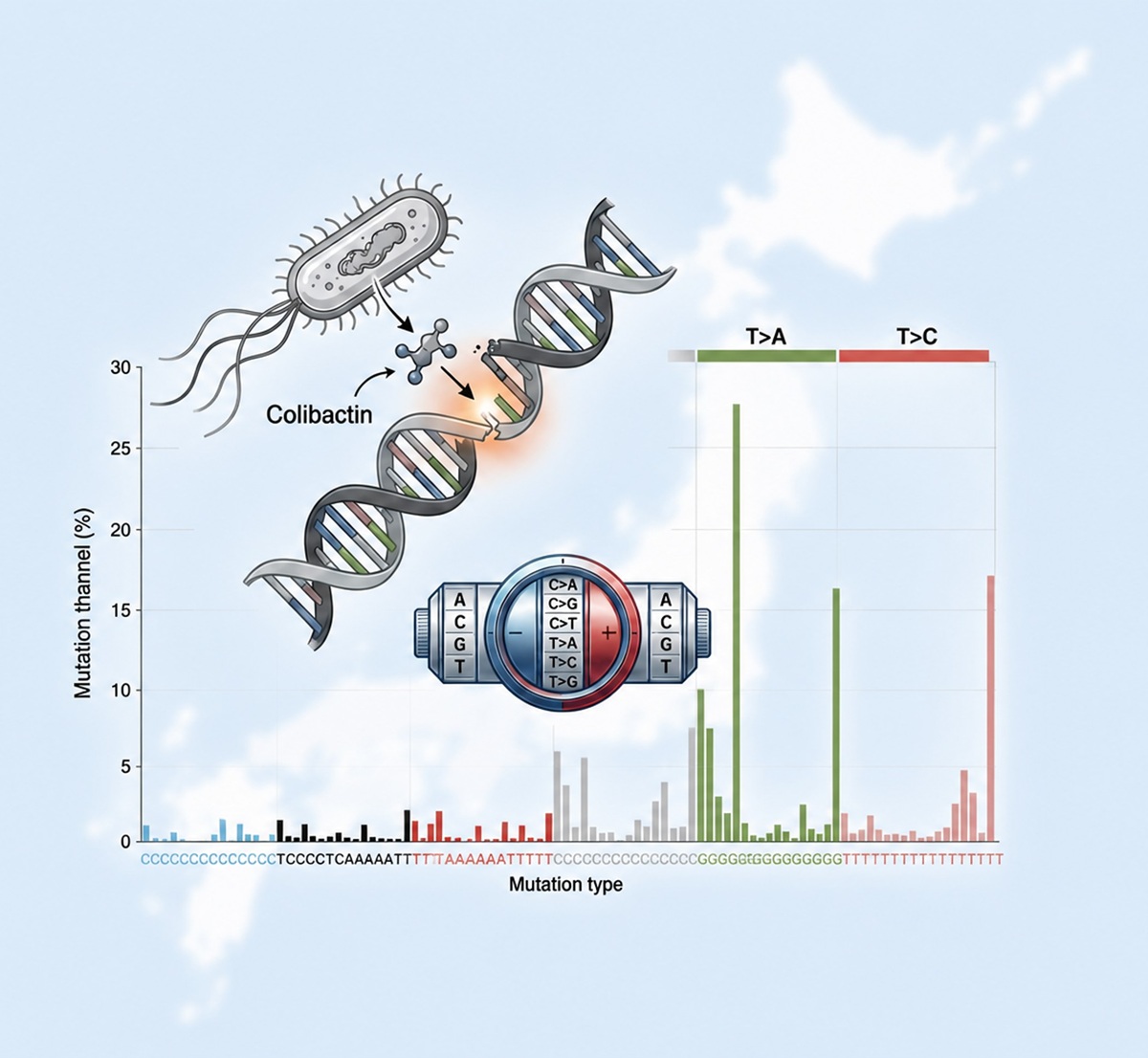
Source: Institute of Medical Science, the University of Tokyo, press release (Figure 1)
In the 200 Japanese tumours, 44.8 percent carried the colibactin signature. That figure needs care: it is a share of people who already had colorectal cancer, not a share of the Japanese population. Among the patients who developed the disease before turning 40, though, the proportion reached roughly 70 percent, and it broadly fell as age at diagnosis rose.
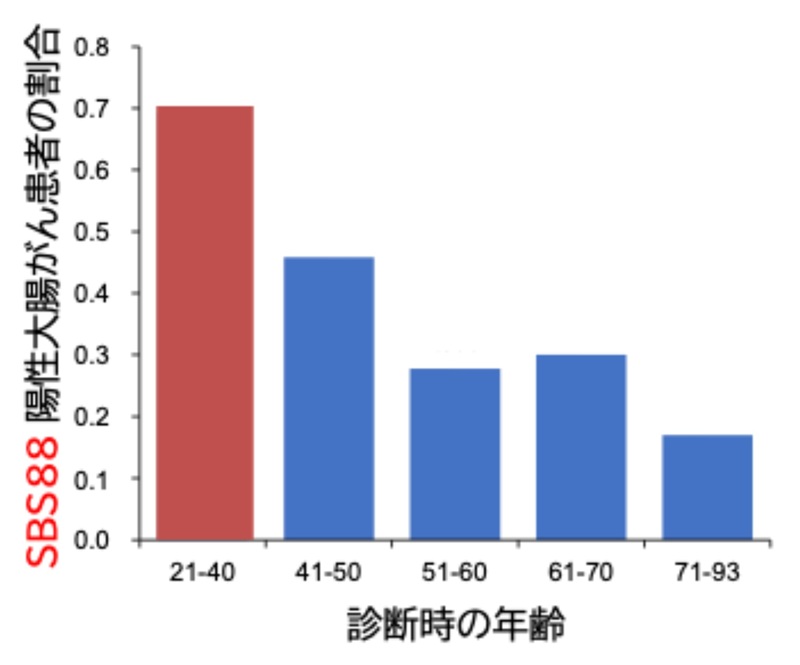
Source: Institute of Medical Science, the University of Tokyo, press release (Figure 5; axis labels in Japanese)
The damage was not incidental. Colibactin mutations turned up in APC, BRAF and TP53, the genes that actually drive the disease. APC in particular is the gene most often broken at the very beginning of a colorectal tumour's life. And when the team reconstructed the chronology of those tumours, the APC hit appeared to have landed before the patient was ten years old.
Why it took Japanese data to see this
The signature was not discovered in Japan. In April 2025, an international team published in Nature the genomes of 981 colorectal cancers drawn from 11 countries, looking for reasons some populations get this cancer far more than others. Across most of those countries, the colibactin signature showed up in somewhere between 5 and 20 percent of tumours. In the Japanese samples it appeared in about half. The same study found the signature roughly 3.3 times more common in patients diagnosed before 40 than in those over 70 at diagnosis.
The problem was that only 28 of those 981 cases were Japanese. An outlier built on 28 samples is a lead, not a finding.
That is what the new paper closes. Two hundred cases, sequenced end to end, and the anomaly held. Japan was not the subject of the investigation so much as the instrument: the place where the signal was loud enough to read the mechanism off it.
The people born after 1965
Sorting the Japanese patients by birth year rather than by age at diagnosis produced the result that is hardest to explain away. The colibactin signature clusters in people born from 1965 onward.
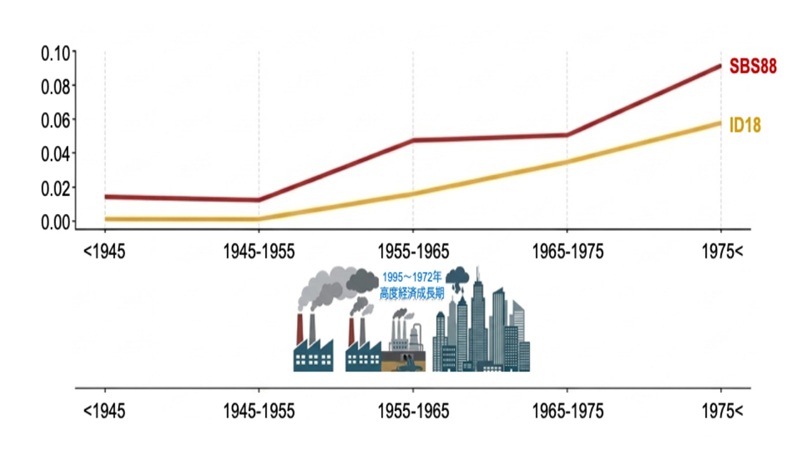
Source: Institute of Medical Science, the University of Tokyo, press release (Figure 6; axis labels in Japanese)
That date lines up with work done nowhere near Japan. In August 2025, researchers at the International Agency for Research on Cancer ran an age-period-cohort analysis of long-term registry data from Australia, Canada, the United Kingdom and the United States, and found that the rise in early-onset colorectal cancer begins with birth cohorts from roughly 1955 to 1960 in all four countries, in men and women alike. Their conclusion was that something people meet in childhood or the first years of adulthood changed around then. If the current trend holds, they estimated, early-onset incidence in those four countries will double about every 15 years.
Two entirely separate lines of evidence, one genomic and one epidemiological, have converged on the same window: children growing up from the late 1950s and 1960s onward were meeting something their parents had not.
The study explains a mechanism. It does not explain why that mechanism is running so much harder in Japan than in Britain or Brazil. Shibata put it plainly in the announcement: why it is so common in Japanese people is a question for future work. What has arrived is not a solved case. It is a much better-specified unsolved one.
Doing to E. coli what Japan once did to H. pylori
There is an obvious precedent here, and the researchers reached for it themselves. Japan is the country that decided to treat stomach cancer as an infectious disease. Helicobacter pylori is treated as the main cause, and eradication therapy is standard practice. The announcement raises the possibility of doing something comparable for colorectal cancer: controlling how these bacteria spread, or clearing them. The obstacles are considerable, and the paper is candid about them.
The first is timing. If the initiating mutation is already in place before a child's tenth birthday, removing the bacterium at 45 does not undo it. Whatever eradication could achieve, it would have to be aimed at children, and nobody has shown that it works.
The second is detection. The bacterium is not exotic: a study of 224 healthy Japanese adults found 26.8 percent of them carrying it. But it sits in stool at very low abundance, which makes it hard to catch there. The team's metagenomic survey of gut flora, which sorted these cancers into four microbial subtypes, could not pick the bacteria out at all. The 2025 international study ran into the same wall from the other direction, finding no link between a tumour carrying the signature and the presence of these bacteria in the patient at diagnosis. That absence is consistent with the whole premise: by the time the cancer appears, the exposure is decades in the past.
The subtype analysis turned up something else. Tumours carrying the colibactin signature concentrated in one group, subtype 3, and that group was notably low in Fusobacterium nucleatum, the bacterium that has dominated research on the gut microbiome and colorectal cancer since 2012. If that holds up, the field has been watching one road while a second one carried a large share of the traffic.
How the bacteria get into the body in the first place is also unknown. Yachida told the news agency Jiji that mapping the route of transmission is part of what the team wants to do next. As of August 2026, there is no established way to prevent colorectal cancer by targeting these bacteria. Yachida's stated goal is a society with zero colorectal cancer. That is an ambition, not a protocol.
Screening from 40, and it still is not enough
Japan added colorectal cancer to its national screening programme in April 1992, offering an annual stool test to everyone aged 40 and over. Compared with most of the world, that is early. The United States only lowered its recommended starting age from 50 to 45 in May 2021. Britain's NHS invites people aged 50 to 74, every two years.
And Japan's own guidance says the early start has not been enough. When the National Cancer Center revised its colorectal screening guideline in November 2024, it recommended the 40-to-74 range while noting the reason for keeping 40: despite screening from that age, incidence among Japanese people in their 40s and 50s remains internationally high. The same document allows starting at 45 or 50 instead, because screening young people who are unlikely to have the disease carries costs of its own. The national programme itself was revised in March 2026, when a health ministry panel agreed to cut the number of stool samples from two to one, a change due to take effect in fiscal 2027. The starting age was not on the agenda.
Meanwhile the American numbers arrived early. Colorectal cancer was the fifth leading cause of cancer death among Americans under 50 in 1990. By 2023 it was the first, according to an American Cancer Society analysis published in JAMA in January 2026. Earlier projections had put that crossover around 2030.
Screening age is one lever countries can actually pull today, and they are pulling it, slowly and at different speeds. What it works on is detection, the stage where tumours and polyps get found earlier. What the Japanese data has just done is put a number on how far upstream the damage begins. If the first mutation lands before a child turns ten, no starting age any country could realistically set would reach it.
At what age does bowel cancer screening begin where you live? And when was that number set, by whom, and on what evidence?
References
- https://www.ims.u-tokyo.ac.jp/imsut/jp/about/press/page_00411.html
- https://doi.org/10.1038/s41588-026-02692-x
- https://www.nature.com/articles/s41586-025-09025-8
- https://today.ucsd.edu/story/childhood-exposure-to-bacterial-toxin-may-be-triggering-colorectal-cancer-epidemic-among-the-young
- https://www.iarc.who.int/news-events/increase-of-early-onset-colorectal-cancer-a-cohort-effect
- https://doi.org/10.1016/S1470-2045(24)00600-4
- https://pubmed.ncbi.nlm.nih.gov/41569583/
- https://www.ncc.go.jp/jp/information/pr_release/2024/1127/index.html
- https://www.mhlw.go.jp/content/10901000/000342252.pdf
- https://www.uspreventiveservicestaskforce.org/uspstf/recommendation/colorectal-cancer-screening
- https://www.nhs.uk/tests-and-treatments/bowel-cancer-screening/
- https://www.mhlw.go.jp/stf/shingi/other-kenkou_128563.html
- https://www.jiji.com/jc/article?k=2026081000476&g=soc
- https://www.ncbi.nlm.nih.gov/pmc/articles/PMC8240356/







Global Discussion
4 comments