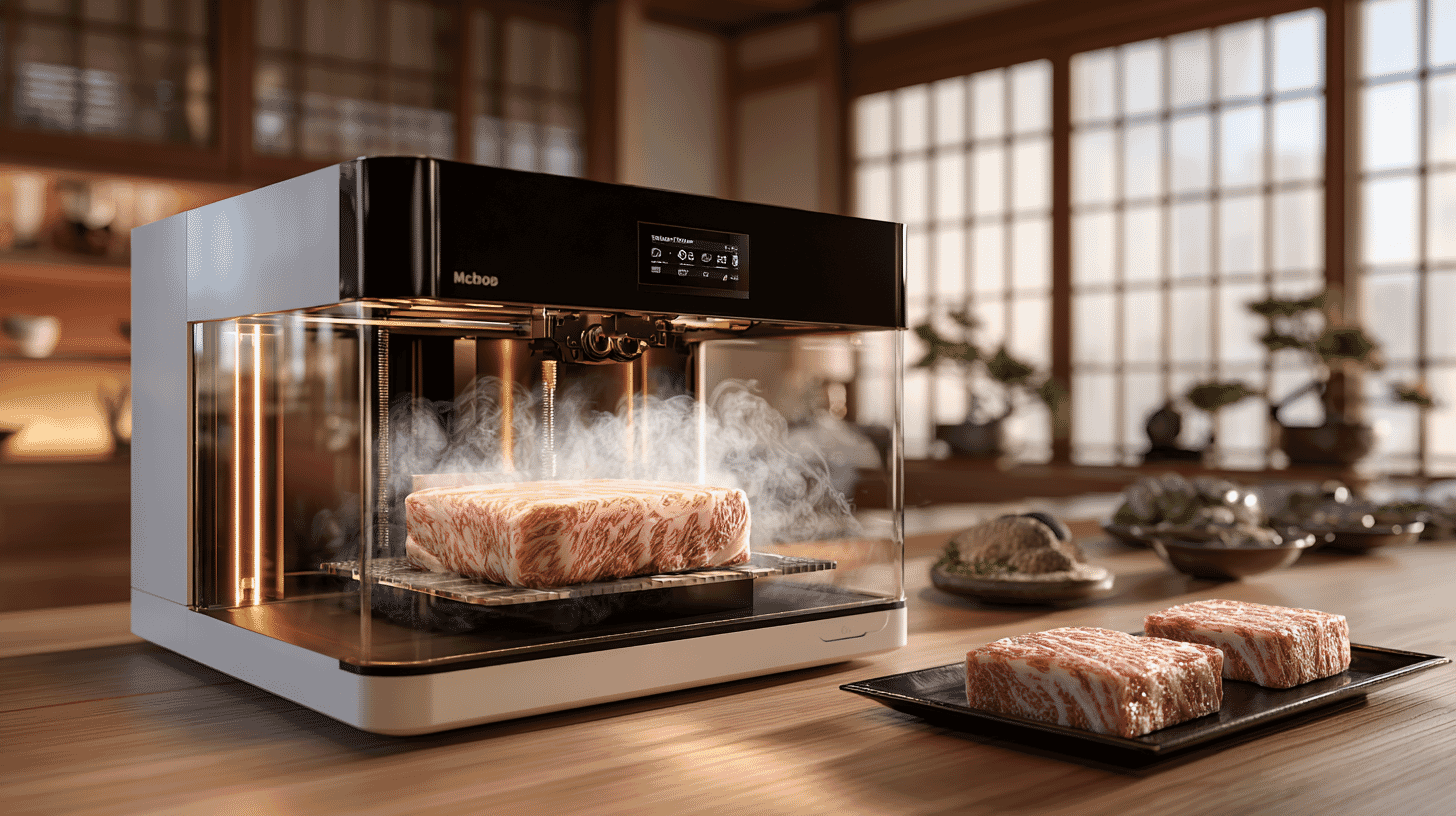
Press a button on your kitchen counter and a slab of marbled wagyu prints out, fat content adjusted to your cholesterol levels, texture tuned to your taste. That is the vision driving TOPPAN Holdings, a 120-year-old Japanese printing giant, as it formally launches its 3D-printed cultured meat business with commercialization targeted for 2031 and beyond. Printing presses and cell biology make an odd pairing, so here is how it works, who else is building this in Japan, and what regulation and cost still stand in the way.
Why a printing company is building meat
According to a Nikkei interview reported by The Nikkei, TOPPAN Holdings President Satoshi Oya describes the company's 3D cell culture business this way: replication and microfabrication techniques cultivated through printing are now being used to replicate cells themselves. The same technology that once etched fine dot patterns on packaging and circuit boards is being repurposed to layer biological tissue.
Since 2017, TOPPAN has worked with Professor Michiya Matsusaki of Osaka University's Graduate School of Engineering to develop "invivoid®," a proprietary 3D cell culture technology. Their approach builds wagyu-like meat by 3D-printing thin individual fibers, about 0.5 mm in diameter, of muscle, fat, and blood vessel tissue, then bundling them together. The team named this approach the "3D-printed Kintaro-ame technique," after a traditional Japanese candy that displays the same image on every cross-section, no matter where you slice the stick. Slice the bundled fibers anywhere and you get the same marbled pattern.
The trick is two-fold: TOPPAN's expertise in "ink formulation and dispersion," and its experience layering ultra-thin films for semiconductors and printed circuit boards. Both translated surprisingly well to formulating "bio-inks" loaded with living cells and printing them in three dimensions.
The 2031 roadmap: Japan's national biomanufacturing strategy in action
TOPPAN's cultured meat work is not an isolated lab experiment. It anchors a major national project funded under NEDO (Japan's New Energy and Industrial Technology Development Organization) "Bio-Manufacturing Revolution Promotion Project," officially titled "Research and Development for Social Implementation of Cellular Wagyu Beef." The consortium includes:
- TOPPAN Holdings, bio-inks and tissue fabrication
- Shimadzu Corporation, the 3D bioprinter "Meat Maker" and edible culture media
- Itoham Yonekyu Holdings, food-safety standards and product development
- ZACROS (formerly Fujimori Kogyo), packaging and biomaterial films
- Sigmaxyz, project management and consortium coordination
- Research partners: Osaka University, University of Tokyo, Tokyo Women's Medical University
The five-year R&D phase runs from FY2023 through FY2027, with the consortium targeting business launch in 2029 and revenue generation in 2031. Each participant contributes core competence from its existing business, a textbook example of Japan's keiretsu-style innovation ecosystem applied to a frontier technology.
What "Meat Maker" actually means
At Expo 2025 Osaka-Kansai (which opened in April 2025), the consortium displayed actual cultured meat samples and a concept model of the home "Meat Maker" inside the Osaka Healthcare Pavilion's "Future City" area. Per NHK's reporting, Professor Matsusaki's team has produced approximately 9 cm × 15 cm slabs of cultured wagyu and conducted sensory evaluations. Tasters reportedly found the chew and fiber separation "close to real meat."
The team has also boosted oleic acid content, a key marker of premium wagyu's signature buttery flavor, to over 50% as of March 2026, using their proprietary cell culture method.
The "Meat Maker" concept goes further than a lab curiosity. The vision is a kitchen appliance that lets users adjust fat-to-muscle ratios on the fly: leaner cuts for someone managing diabetes or cholesterol, richer marbling for a special dinner. With the right data and recipe file, the same wagyu quality could be produced anywhere in the world, what TOPPAN calls "the ultimate local production for local consumption."
TOPPAN isn't alone: Integriculture's complementary approach
No discussion of Japanese cultured meat is complete without Integriculture, the Tokyo/Kanagawa-based startup founded in 2015 by CEO Yuki Hanyu (PhD, Oxford). The company has reached a post-money valuation of around 4.4 billion yen (roughly $28 million at ¥159/USD).
Integriculture's approach is fundamentally different. Its patented "CulNet® System" places liver and pancreas cells in a feeder culture layer, where they themselves produce the serum components, insulin, transferrin, EGF, FGF2, and other growth factors, that normally drive cultured meat costs through the roof. Public market prices for some of these components run as high as $50 million per kilogram. Producing them in-house, rather than buying them, sidesteps the largest cost driver in the industry.
In March 2026, Integriculture partnered with Oisix Ra Daichi to participate in the "Niigata Foodtech Town" initiative, developing region-specific cell-based foods. In August 2025, the company began test sales of cell-agriculture starter kits to four overseas universities, establishing itself as an "infrastructure provider" for the cell agriculture industry.
The two companies aren't really competitors. TOPPAN designs and shapes the meat; Integriculture provides the underlying cell-cultivation infrastructure. They occupy different layers of what's emerging as a complete domestic supply chain.
SusHi Tech Tokyo 2026: Japan's foodtech meets global capital
From April 27 to 29, 2026, Tokyo Big Sight hosted SusHi Tech Tokyo 2026, Asia's largest innovation conference. A record 798 startups from 60 countries and regions exhibited, up from 607 the previous year, drawing roughly 60,000 visitors against 43,000 last time and generating 25,140 business meetings. Integriculture was among the exhibitors, showing cellular food menus and cooking process videos to bring the technology closer to mainstream consumers. The next edition runs May 20 to 22, 2027 at the same venue.
The event sits at the intersection of two policy waves. In November 2025, the Takaichi administration designated foodtech as one of 17 national growth strategy fields. The Tokyo Metropolitan Government's 2022 startup strategy and its 2025 update ("Global Innovation Strategy 2.0") aim to scale Japan's startup ecosystem 10x. SusHi Tech Tokyo is the showcase venue where this state-backed foodtech meets global investors.
August in Osaka: the 2nd Cultivated Food Society conference
On August 28-29, 2026, the 2nd Annual Conference of the Japanese Society for Cultivated Food convenes at the Osaka International Convention Center (Grand Cube Osaka). The conference chair is Professor Matsusaki himself, TOPPAN's longtime research partner. The theme: "Innovation by Cell Based Food."
The Japanese Society for Cultivated Food was founded in April 2025, with Professor Tatsuya Shimizu of Tokyo Women's Medical University as Representative Director. The first conference (August 2025, University of Tokyo) saw a notable wave of presentations on flavor and aroma improvement, a sign that Japanese researchers are moving past the "can we even make it" question and into "can we make it taste good."
This second conference matters for three reasons. First, it lands in Osaka, walking distance from Osaka University, the consortium's intellectual home. Second, it brings TOPPAN, Shimadzu, Itoham Yonekyu, and other industry players face-to-face with academia at exactly the moment when commercial implementation is becoming the central question. Third, it gives the industry a coordinated voice as Japan's Consumer Affairs Agency, which began regulatory framework discussions in November 2024, works toward a domestic approval pathway.
Why "after 2031"
If this all sounds like easy optimism, the picture on the ground is harder. The global 3D-printed cultured meat market is forecast to reach about $4.36 billion by 2030 (CAGR around 36.1%), but Japan's cultured meat startups still trail US and Israeli competitors by orders of magnitude in cumulative investment.
The legal framework also lags. Cultured meat is approved for sale in Singapore (2020, the world's first), the United States (2023), Israel, Hong Kong, and Australia and New Zealand. In the Australian case, food regulator FSANZ approved cultured quail from Sydney startup Vow in June 2025 and created dedicated standards for cell-cultured foods rather than routing them through the existing novel food framework; the product has since been served in Australian restaurants. France's Gourmey has filed for cultivated duck with FSANZ, with assessment expected to finish in late August 2026. Japan still has no commercial approval framework. The Consumer Affairs Agency's New Food Investigation Subcommittee began deliberations in November 2024, and a structural outline is only starting to emerge.
Cost is the third wall. The world's first cultured meat hamburger (2013, Maastricht University, Netherlands) cost around 30 million yen. As recently as 2023, Integriculture's paste-form meat ran roughly 29,810 yen ($188) per 100g. The company aims to bring that down to 113 yen ($0.71) per 100g by 2028, but the path is steep.
TOPPAN's careful phrasing, "targeting commercialization beyond 2031," reflects all three walls. What keeps the company moving is a strategic philosophy that treats expansion into adjacent fields as a primary source of value creation.
From printing to medicine to food: TOPPAN's "expansion strategy"
What's most striking is that TOPPAN's 3D cell culture technology isn't only being aimed at meat. The same platform is moving into cancer therapy. At the TOPPAN Technical Research Institute in Sugito, Saitama, the company replicates a patient's tumor tissue ex vivo and tests different anti-cancer drugs against it, a personalized cancer treatment support technology. The Cancer Institute Hospital has been reported as preparing an application for advanced medical treatment status with the Ministry of Health, and TOPPAN is also targeting entry into clinical testing services in the United States during FY2026.
Medicine and food look like opposite worlds, but TOPPAN reaches both through the same root capability: 3D cell culture, descended from printing. President Oya acknowledges the puzzle directly, he says people often wonder why a printing company moves into "expansion zones" like medicine and food, but argues that broadening the scope of problem-solving reveals enormous potential for putting existing technology to work.
What's it like in your country?
In Japan, a printing company with a 120-year history is bringing together universities, food makers, instrument makers, and packaging companies to "print" wagyu beef in 3D. A home meat printer remains a 2031-or-later prospect, but the long-game collaboration is moving forward at a meaningful pace.
In your country, is cultured meat legally for sale? Have you ever spotted it in a supermarket? If a household "Meat Maker" arrived on the market, would you try it, or would you prefer that traditional livestock farming continues unchanged? Tell us in the comments.
References
- https://www.nikkei.com/article/DGXZQOUB1995Y0Z10C26A3000000/
- https://bizgate.nikkei.com/article/DGXZQOLM0660/
- https://www.holdings.toppan.com/ja/news/2023/10/newsrelease231019_3.html
- https://www.holdings.toppan.com/ja/invivoid/
- https://foodtech-japan.com/2025/04/13/banpaku/
- https://wired.jp/branded/2025/03/17/sigmaxyz-cultured-meat/
- https://resou.osaka-u.ac.jp/ja/story/2023/nl90_co_creation01
- https://www.cultivated-food.org/
- https://integriculture.com/
- https://sushitech-startup.metro.tokyo.lg.jp/






Global Discussion
14 comments