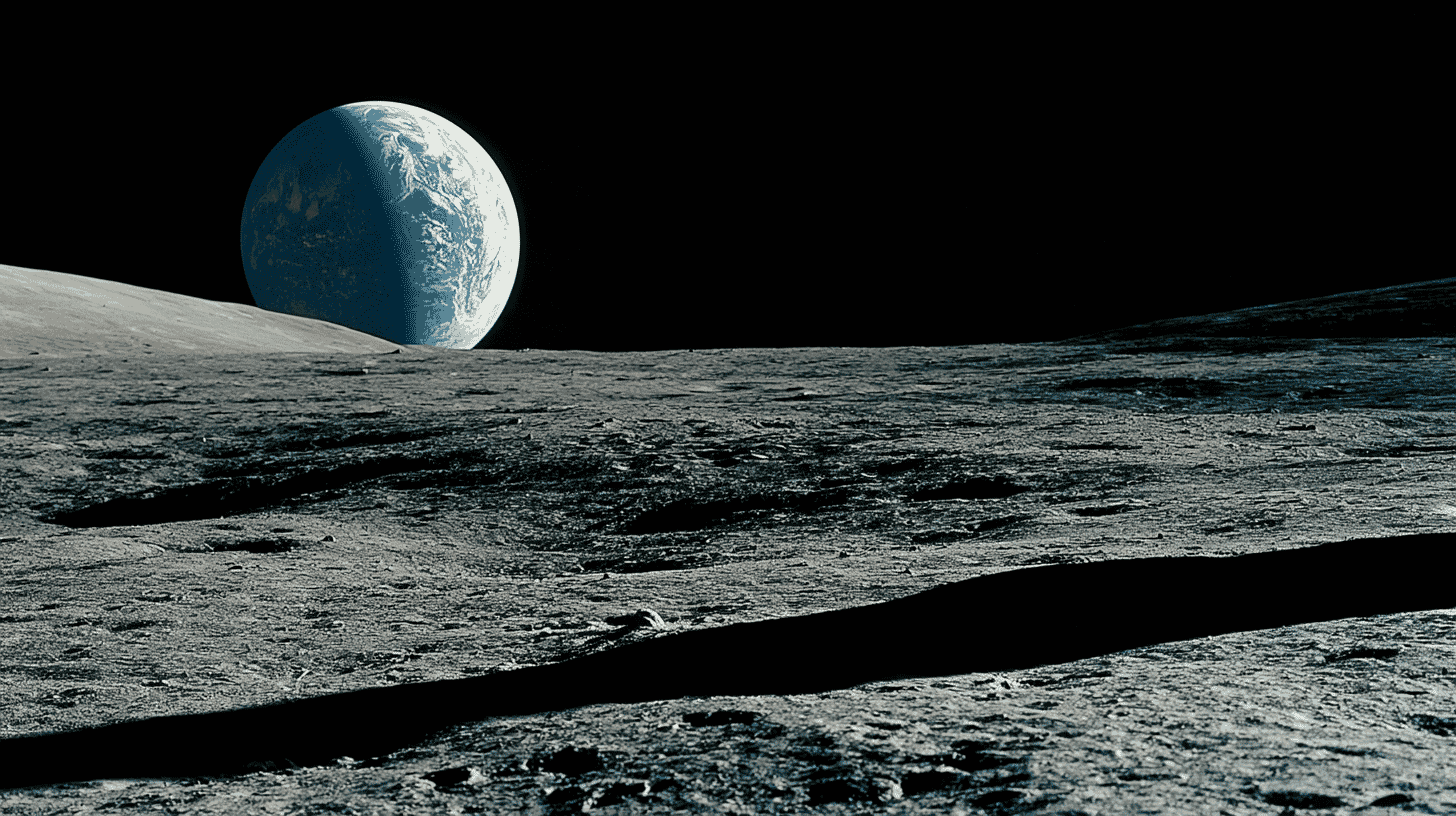
🌙 A perfect clock placed on the Moon would run ahead of an identical clock on Earth by about 56 microseconds every day. A radio signal covers about 17 kilometers in that time, which is why navigation on the Moon cannot ignore it. At a meeting in Versailles that opened on October 13, 2026, the treaty body that defines the second has a draft resolution on lunar time in front of it. A Japanese newspaper linked it to Japan's optical lattice clock. The draft itself says nothing about clock technology.
56 microseconds is 17 kilometers
Clocks tick faster where gravity is weaker, and they are also affected by how fast they move. The Moon's surface gravity is far weaker than Earth's, and the Moon is also moving relative to Earth. A paper published in Metrologia in January 2026 by researchers at the Paris Observatory, the Royal Observatory of Belgium and the time department of the International Bureau of Weights and Measures (BIPM) adds those effects up. For a clock sitting on the lunar surface compared with one sitting on Earth's surface, the difference comes to a relative frequency of about 6.58 × 10⁻¹⁰, or about 56 microseconds per day.
You will also see a second number: 58.7 microseconds. That is the figure in a White House memo from 2024, and the same paper lists it too. Both are correct. They compare different things. The 58.7 figure is the average rate between two coordinate time scales, Lunar Coordinate Time (TCL) and Terrestrial Time (TT), which are mathematical references rather than physical clocks. The 56 figure is what two real clocks on the two surfaces would show. On top of either steady drift, there is a periodic wobble that follows the lunar month.
Satellite navigation works by timing how long a signal takes to arrive and turning that delay into distance. Light and radio travel about 300 meters in a microsecond. So an uncorrected 56-microsecond offset would turn into roughly 17 kilometers of range error after a single day (that is simple arithmetic: the speed of light times 56 microseconds). The paper's authors put the requirement the other way around: positioning to within a meter on the Moon means keeping time to the nanosecond, so relativity cannot be ignored.
Right now, according to the tech site PC Watch's report on a July briefing by Japan's National Institute of Advanced Industrial Science and Technology (AIST), lunar time is set mission by mission. Once landers, rovers and relay satellites from several countries share signals, they will need a common reference. Japanese companies are already working on lunar communications and positioning, as we reported on ispace's Lunar Connect service and Japanese firms in the Artemis program.
What goes to the vote in Versailles
The General Conference on Weights and Measures (CGPM) is the top decision-making body under the Metre Convention, the 1875 treaty behind the metric system. Japan joined in 1885. Its 28th meeting runs from October 13 to 15, 2026, in Versailles.
Three of the drafts concern time:
- Draft Resolution B, on the future definition of the second
- Draft Resolution C, on the technical actions needed to ensure the continuity of UTC
- Draft Resolution D, on the definition of an international lunar reference time scale and its traceability to UTC
Draft D starts from TCL, which the International Astronomical Union defined at its 32nd General Assembly in 2024. The open question has been whether to use TCL as it is or a version scaled to the Moon's gravity. The draft says unscaled TCL would meet the scientific requirements for a lunar reference time scale.
The draft also says there must be a single lunar reference time scale, even if it has several realizations; that wording was clarified in a June 2026 revision. The BIPM and national metrology institutes are to work with space agencies to support realizations of the scale and their measurement against UTC.
The draft names no operator and no start date. It does not mention Coordinated Lunar Time, the name used in the US. And it does not mention any clock technology at all.
The BIPM's agenda schedules a single vote on Drafts B, C and D for 14:15 Paris time on October 15, 2026 (21:15 in Japan). As this article was prepared on October 15 Japan time, no result had been announced. Everything above describes the draft, not an adopted resolution.
Where optical lattice clocks come in
The headline that brought this topic to Japanese readers ran in the Nikkan Kogyo Shimbun on August 20, 2026, and was republished on its Newswitch site on October 13: "Will Japan's optical lattice clock be adopted? A step toward lunar standard time." The article body is more careful than the headline. It says Japan's focus at the CGPM is redefining the second using optical lattice clocks, and treats lunar time as a separate agenda item.
The drafts bear that out. Draft D does not mention optical clocks. Draft B, the one about the second, names no candidate atomic species and no optical lattice clock; it refers to optical frequency standards in general. It admits there is still no agreement despite active scientific debate, and asks the International Committee for Weights and Measures (CIPM) to work toward proposing a new definition and an implementation date at the 29th CGPM in 2030.
There is a link, but it is an idea rather than a decision. The same article asks what optical-lattice-level precision could do if it were achieved on the Moon, and floats resource management, such as monitoring losses of water and air. AIST's Masami Yasuda said only that if there is a need, his team would look at how large the effect is and how to confirm it.
The optical lattice clock was proposed in 2001 by Hidetoshi Katori at the University of Tokyo. According to AIST, such clocks have been demonstrated at the level of 18 digits, against 15 to 16 digits for the caesium fountain clocks that realize today's second. We covered the race to redefine the second in a separate article.
Japan's connection
The clearest Japanese connection to the lunar draft runs through a person. As of October 2026, Takashi Usuda, director general of AIST's National Metrology Institute of Japan, is secretary of the CIPM, the body that approved the draft texts in January, March and June 2026. Its 18 members serve as individuals, each of a different nationality, not as national delegates. AIST held a media briefing on July 22, 2026, to explain the drafts. There, Yasuda argued that lunar time, too, should be built as an international standard that everyone can use equally, not decided country by country.
The memorandum that the BIPM, RIKEN and Shimadzu signed in Kawasaki on May 12, 2026, concerns the second, not the Moon. It explores what portable optical frequency standards could do for comparisons ahead of redefining the second; the Moon and space are not mentioned.
What we could not find in primary sources was a Japanese program to build clocks for the Moon's time scale. Under Draft D, that kind of work would fall to national metrology institutes working with space agencies, Japan's included.
The leap second is on the same ballot
Since 1972, there have been 27 leap seconds, all of them added; the most recent came at the end of 2016 (January 1, 2017, Japan time). Earth's rotation has since sped up, raising the chance of a negative leap second, which has never been done. Nobody is sure how software would cope.
If adopted, Draft C makes continuous UTC take effect on May 20, 2027. The allowed gap between Earth-rotation time (UT1) and UTC would widen from 0.9 seconds to 3,600 seconds, one hour. That would keep UTC continuous for several centuries. Usuda told the Nikkan Kogyo Shimbun that the leap second would effectively be abolished and system failures avoided.
How the US plan fits
The US already has a policy. On April 2, 2024, the White House Office of Science and Technology Policy (OSTP) issued a memo naming Coordinated Lunar Time (LTC) as the standard for operations around the Moon. The memo gave NASA, with the Departments of Commerce, Defense, State and Transportation, until December 31, 2026, to deliver a finalized implementation strategy.
Our reading is that the draft's insistence on a single scale would make any national system, LTC included, one realization of a shared definition rather than a rival to it.
Even once the definition is settled, who runs the Moon's clock sits outside this draft. If people end up living there, should their day follow Earth's time, or a time of their own? We'd like to hear how it looks from where you are.
References
- https://newswitch.jp/p/50508
- https://www.bipm.org/documents/d/guest/cgpm-2026-draft-resolution-d-en
- https://www.bipm.org/documents/d/guest/cgpm-2026-draft-resolution-b-en
- https://www.bipm.org/documents/d/guest/cgpm-2026-draft-resolution-c-en
- https://www.bipm.org/en/cgpm-2026/agenda-day-3
- https://www.bipm.org/documents/d/guest/cgpm-2026-convocation-en
- https://www.bipm.org/en/countries/jp
- https://arxiv.org/abs/2507.21597
- https://bidenwhitehouse.archives.gov/wp-content/uploads/2024/04/Celestial-Time-Standardization-Policy.pdf
- https://pc.watch.impress.co.jp/docs/news/2127021.html
- https://www.aist.go.jp/aist_j/press_release/pr2024/pr20240608/pr20240608.html
- https://www.riken.jp/pr/news/2026/20260512_2/index.html
- https://unit.aist.go.jp/qualmanmet/nmijico/Metre_OIML/Metre/doc/aramashi_2026.pdf
- https://www.bipm.org/en/committees/ci/cipm/members
- https://www.bipm.org/en/committees/ci/cipm
- https://www.soumu.go.jp/main_sosiki/joho_kokusai/leap-info2015/past.html
- https://www.bipm.org/en/measurement-units/si-defining-constants







Global Discussion
4 comments