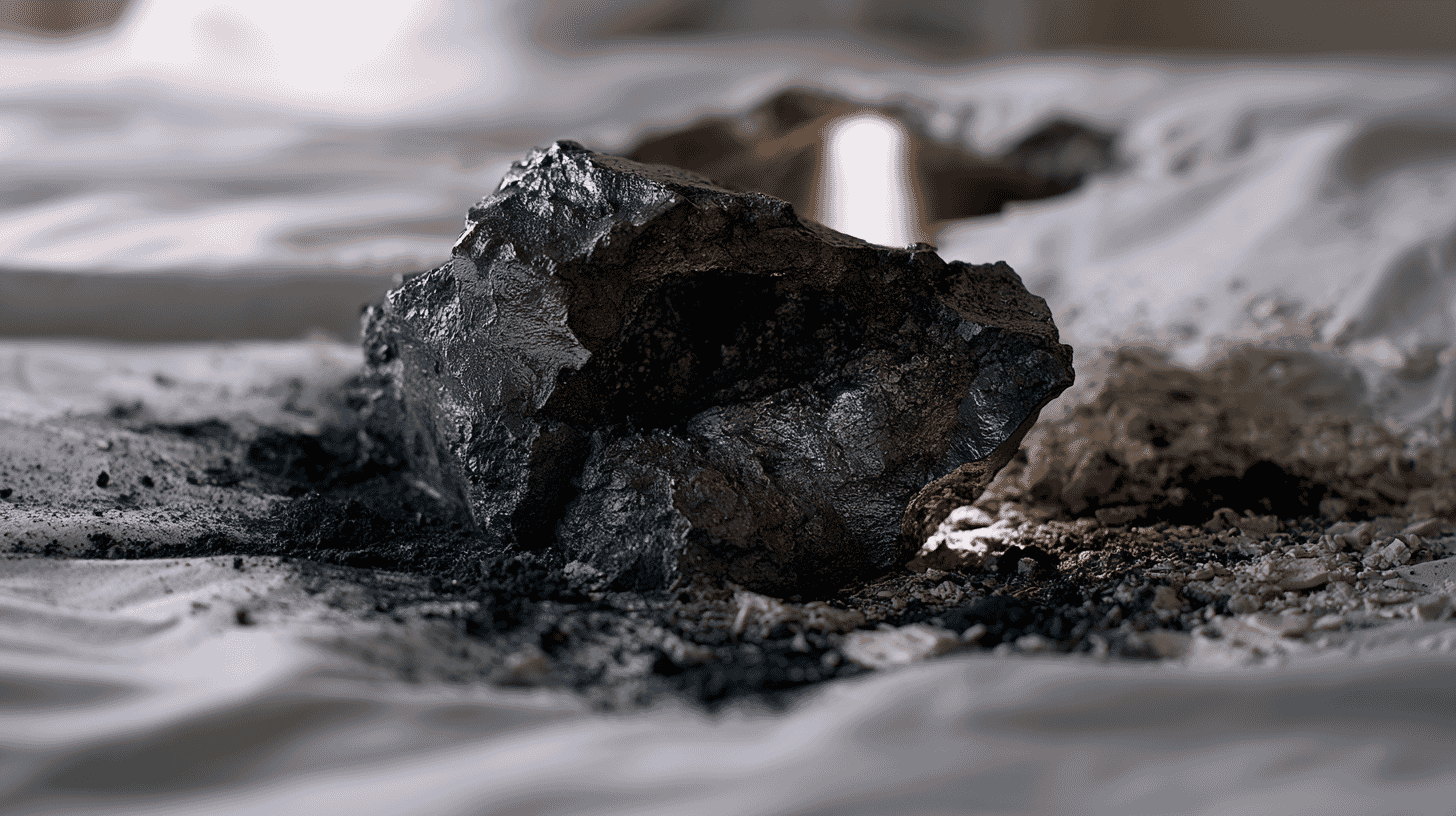
☄️ A rock the size of a heavy piece of luggage broke apart over New York City one summer afternoon, and a piece of it landed on a bed in New Jersey. The homeowner reached for disposable gloves and aluminum foil instead of a broom, and two years later a team that includes researchers from the Institute of Science Tokyo and JAMSTEC has read salty water off an asteroid that dried out in the early Solar System.
A daytime fireball, and a hole in the ceiling
On July 16, 2024, at 15:17 UTC, a fireball crossed the sky in broad daylight, passing just south of the Statue of Liberty and shaking the region with a sonic boom. Sixty people across five states, from Rhode Island down to Pennsylvania, reported it to the American Meteor Society. Sixteen of them felt the shock wave.
The object hit the atmosphere at 32,000 miles per hour, or 14.4 kilometers per second. It was fragile and came apart fast, going dark 22 miles up, around 35 kilometers. Doppler weather radar at Newark Airport then picked up something odder: a long cloud of falling pebbles drifting from Staten Island into New Jersey.
Mike Hankey of the American Meteor Society said cameras in Connecticut and Pennsylvania, plus a doorbell camera in Wayne, New Jersey, caught enough of the meteor to reconstruct its path. The reconstructed line pointed back into the inner asteroid belt.
The town of Hillsborough sat at the far end of that debris cloud, where the largest rocks came down. Exactly one was found, and only because it hit a house. It went through the roof, through the ceiling of the master bedroom, shattered, and came to rest on the floor.
The owner was home. He heard the crash, found the hole, and described a strong sulfur-like odor along with black fragments and dust across his bed and carpet.
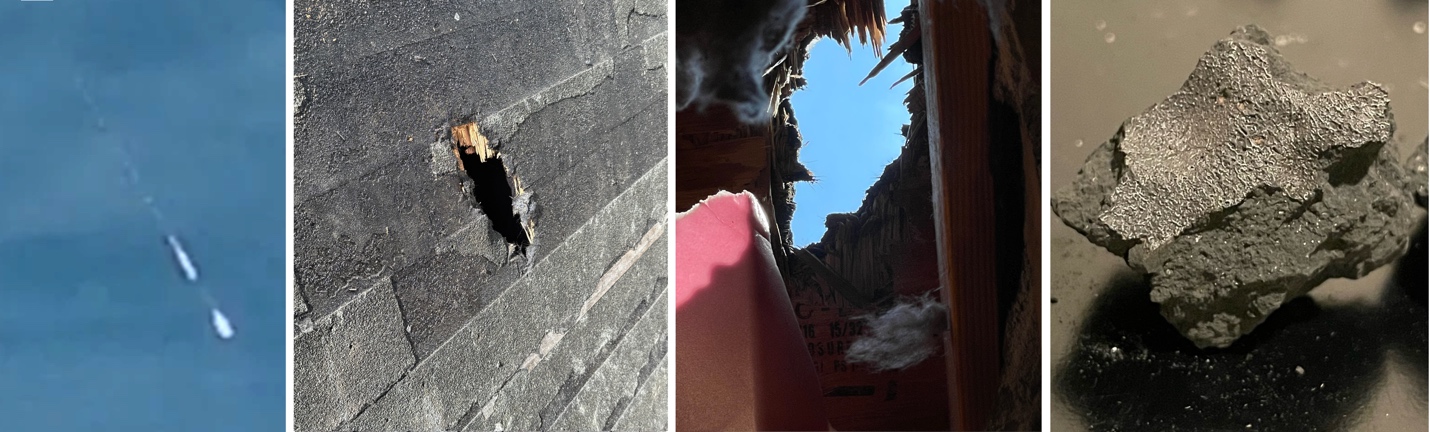
Source: SETI Institute / Jenniskens et al. (2026), Science Advances, CC BY 4.0
Gloves, foil, and glass jars
The owner did not sweep it up. He put on disposable gloves, handled the fragments with aluminum foil, sealed them in glass jars, and photographed the scene as he went.
Salt is why that mattered. Any salt a meteorite carries from its parent asteroid will pull moisture out of Earth's air and dissolve within days of landing in a field. Salts recovered from most meteorites turn out to be terrestrial contamination instead. It is one of the reasons agencies fly to asteroids and bring samples home in sealed capsules.
Named the Hillsborough meteorite, the rock weighed more than two pounds, about 0.91 kilograms. It is a CM carbonaceous chondrite, where the M refers to Mighei, a meteorite that fell in Ukraine in 1889. Mike Zolensky of NASA's Johnson Space Center found parts of it far more altered by water than a typical CM2 and classified the specimen as CM1/2, sitting between the two petrographic types.
That makes it the 22nd observed CM fall on record, and only the second witnessed CM1/2 fall. The first, Kolang, fell in North Sumatra, Indonesia in 2020, and Jenniskens has said that one came to rest in mud. No CM1 fall has ever been witnessed at all. Peter Jenniskens, the lead author, who works at the SETI Institute and at NASA's Ames Research Center, credits the homeowner's speed for making these the most pristine CM1/2 fragments science has.
Salt that dried out near the surface of an asteroid
Zolensky and his colleague JangMi Han found small salt-rich CM1 clasts scattered through the rock. Their reading is that the clasts formed close to the outside of the parent asteroid, in a spot where standing water boiled off and left its salt behind.
Salt crystals have survived in a few meteorites before, most famously the brine-bearing halite in the Monahans and Zag ordinary chondrites, whose organic content was analyzed in 2018 by a group that included Queenie Chan, Mike Zolensky and Yoko Kebukawa, all three of them on this paper too. What had not been shown before, as the team's July 2026 paper in Science Advances frames it, was brine formation in CM-type chondrites. Jenniskens described the study as forensic work that turned up preserved pieces of a small primitive asteroid where it met concentrated salty fluids.
Salty water keeps phosphate in solution rather than locking it into insoluble minerals, and it pushes organic molecules and freshly forming minerals into close contact where they can react. If you want the conditions that assembled the chemistry life later runs on, a shrinking pocket of salty water is a promising place to start.
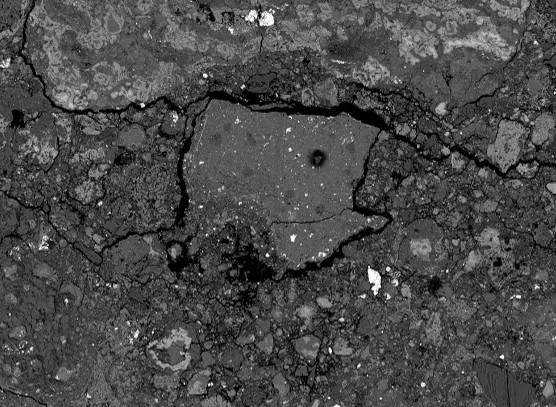
Source: SETI Institute / Jenniskens et al. (2026), Science Advances, CC BY 4.0
What the Japanese team read in the carbon and nitrogen
The Japanese contribution runs through the organic side of the analysis. Yoko Kebukawa, an associate professor at the Institute of Science Tokyo, worked with Nanako Ogawa, Yoshinori Takano and Naohiko Ohkouchi at JAMSTEC's Biogeochemistry Research Center, a group that has spent years on Ryugu and Bennu material.
Ogawa, together with cosmochemist Queenie Chan of Royal Holloway, University of London, reported that Hillsborough is 1.8 percent carbon and 0.07 percent nitrogen by weight, with carbon and nitrogen isotope ratios typical of CM meteorites. Those isotope signatures are the basis for thinking primitive carbonaceous chondrites delivered organic matter to the early Earth.
Inside that carbon was a wide spread of soluble organic compounds, including amino acids and carboxylic acids. Danny Glavin's team at NASA's Goddard Space Flight Center concluded the amino acid mixture formed inside the parent body, most likely with help from brine chemistry. Accounting for terrestrial contaminants, one fragment held roughly half the extraterrestrial amino acid content of the CM2 meteorite Murchison, while another held close to four times as much.
Some of the compounds detected in the samples came from the fiberglass-insulated roof the rock punched through on its way in, and had to be subtracted before anything could be said about the asteroid.
Philippe Schmitt-Kopplin of the Technical University of Munich, who handled the organic mass spectrometry, notes that a high fraction of the compounds were produced by organic chemistry interacting with minerals, but that it remains unclear whether the magnesium-bearing organic compounds came from brine chemistry or are leftovers from earlier impact shocks. That question is open.
Ryugu and Bennu are waiting
The other prominent family of primitive carbonaceous chondrite is the CI type, named for Ivuna, which fell in Tanzania in 1938. Both asteroids humanity has sampled directly are of that broad kind. JAXA's Hayabusa2 brought material back from Ryugu, and in November 2024 a Japanese team with Kyoto University's Toru Matsumoto as lead author reported tiny salt crystals in those grains, including sodium carbonate, halite and sulfates. NASA's OSIRIS-REx brought back Bennu, and in January 2025 a team co-led by Tim McCoy and Sara Russell published a full evaporite sequence in it: sodium-bearing phosphates plus sodium-rich carbonates, sulfates, chlorides and fluorides, left behind by a brine that dried out early in the parent body's history.
CM material belongs to a different chemical family. Hillsborough pushes salty water into a second branch of the family tree, which widens the set of early Solar System settings in which this chemistry could have been running. As of August 2026 the team is still identifying exactly which salt minerals are present, with comparison against Ryugu and Bennu the explicit next step.
Two space agencies spent years and large budgets flying to asteroids to collect material of this kind. Then a comparable sample arrived free of charge through a roof in New Jersey, and stayed usable because one person happened to have gloves, foil and jars nearby.
Part of the meteorite is headed for the collections of New York's American Museum of Natural History. Curator Denton Ebel called it a precious asteroid sample delivered to their doorstep.
If a rock came through your ceiling tomorrow, would you know who to call, and would you know not to pick it up bare-handed? And who would that rock belong to where you live?






Global Discussion
4 comments