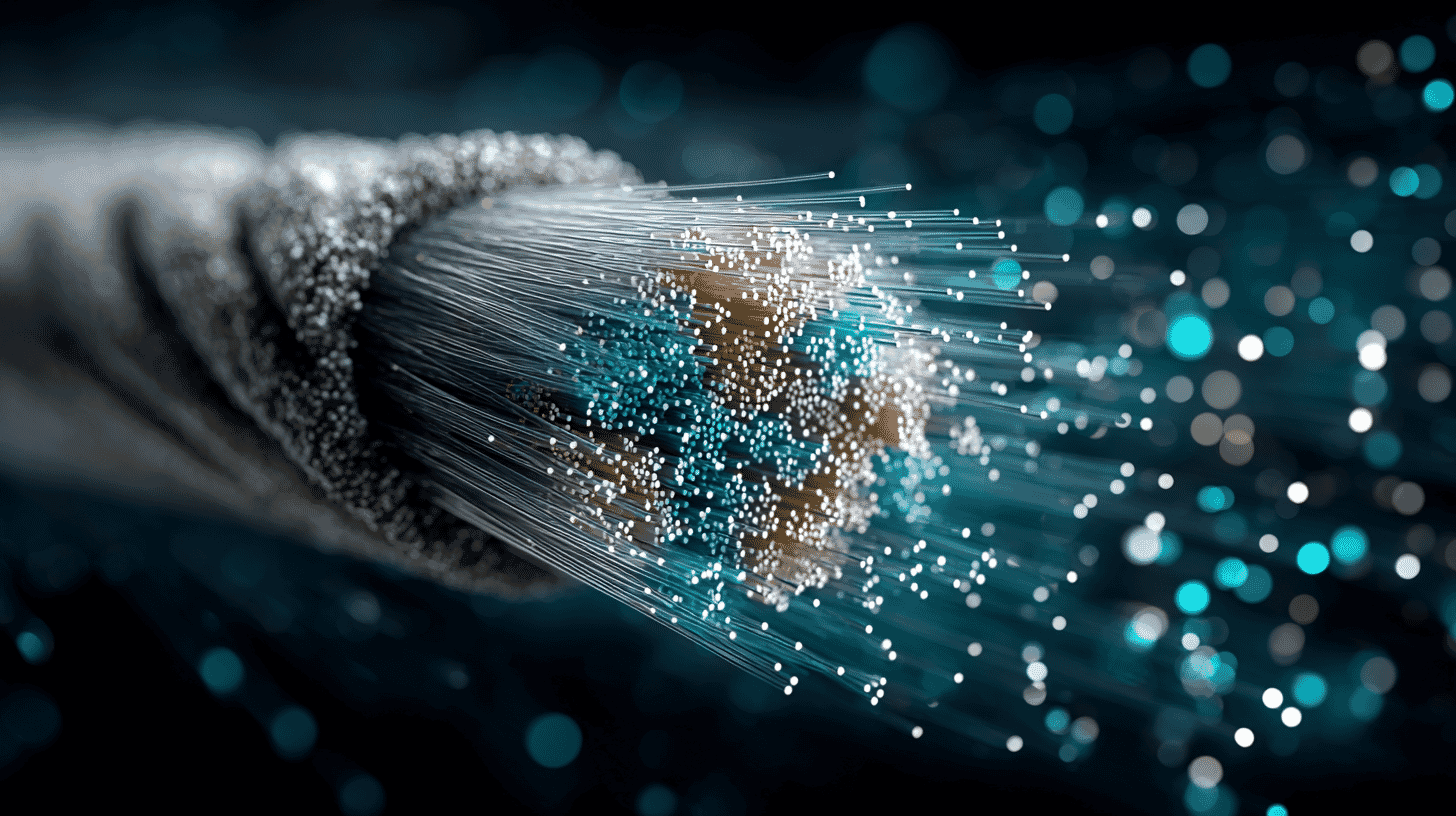
The internet speed you enjoy every day runs on optical fiber: glass strands thinner than a human hair that carry data as pulses of light. A Japanese company has now packed 13,824 of them into a single cable and started mass production. In the age of AI, where data centers are starving for bandwidth, Japan's manufacturing is stepping up.
Furukawa Electric's Lightera Begins Mass Production of 13,824-Core Cable
On March 12, 2026, Lightera, the optical solutions arm of Japan's Furukawa Electric Group, announced the start of mass production of a 13,824-core ultra-high-density fiber optic cable, among the highest fiber counts in the world. Lightera is a global organization comprising Lightera Japan, Lightera, LLC. in the US, and Lightera LatAm S.A. in Brazil, headquartered in Norcross, Georgia; the brand launched in April 2025.
To put this in perspective: a "core" here means one individual optical fiber strand inside the cable. So 13,824 cores means 13,824 separate light-carrying pathways bundled into one cable. This is double the fiber count of their previous generation, and transmission capacity has doubled accordingly.
All 13,824 fibers fit inside a cable with an outer diameter of 40mm or less (about 1.6 inches), roughly the width of a golf ball. The density comes from Furukawa Electric's proprietary "rollable ribbon" technology, which intermittently bonds 16 thin fibers, each 200 micrometers (0.2mm) in diameter, into flexible ribbon strips that fold and pack efficiently.
Why So Many Fibers? The AI Data Center Bandwidth Crisis
The explosive growth of generative AI services like ChatGPT and cloud computing has sent data traffic inside data centers skyrocketing. AI-focused data centers require roughly 10 times more optical fiber than traditional cloud facilities, and at the rack level, GPU-based systems need up to 36 times more fiber connections than conventional CPU racks.
But data center space is finite. Underground conduits have limited diameter and capacity. The engineering challenge has become: how do you cram more data-carrying capacity into the same physical space?
The numbers tell the story. Bandwidth purchased for data center connectivity surged roughly 330% between 2020 and 2024. Metro dark fiber (unused fiber infrastructure in urban areas) purchases jumped 268% in a single year.
How Rollable Ribbon Technology Works
At the heart of Furukawa Electric's cable is "rollable ribbon" (also called intermittently bonded ribbon) technology. Traditional fiber ribbons bond all fibers into a rigid, flat strip. Rollable ribbon bonds them only at intervals, creating a structure that flexes, folds, and compresses.
Think of the difference between a stiff sheet of plywood and a flexible bamboo mat, or, as one Furukawa executive put it, a net bag of oranges. Both hold the same material together, but one bends and stacks far more efficiently. That flexibility is what lets you pack dramatically more fibers into the same cable diameter.
The cable also supports VSFF (Very Small Form Factor) connectors, a next-generation connector standard designed for high-density networking. These smaller connectors allow more connections in less rack space. And because the cable is rated for both indoor and outdoor use, it can connect separate data center buildings, essential for building large GPU clusters that span multiple facilities.
New Dedicated Factory in Mie Prefecture
To support mass production, Furukawa Electric opened a second factory within its Mie facility in Kameyama City, Mie Prefecture, dedicated exclusively to ultra-high-density fiber cable manufacturing. The factory has been fully operational since February 2026.
With this expansion, production capacity for ultra-high-density cables, including the 13,824-core model, has more than doubled against fiscal year 2023.
The Competition: Fujikura and Corning
The ultra-high-density fiber cable market is intensely competitive, with key players taking different technological approaches.
Fujikura, Furukawa Electric's Japanese rival, got to a 13,824-core cable first, launching its "SWR/WTC" product in July 2025. Fujikura pairs its own "Spider Web Ribbon" (SWR) technology with a "Wrapping Tube Cable" (WTC) design, and the product has already been deployed in overseas hyperscale data centers.
Furukawa's mass production start puts it level on fiber count. Its differentiation rests on the rollable ribbon technology, VSFF connector support, and the dedicated Mie plant behind the volume.
Corning, the world's largest optical fiber manufacturer, is going a different way. At OFC 2026 in Los Angeles (March 17-19), it unveiled a four-core multicore fiber: multiple independent light paths inside one strand, keeping the standard 125-micron cladding diameter while delivering up to four times the capacity per fiber, and cutting installation time by as much as 60%. Corning also formed a multi-source agreement with three other industry players to define design, performance, and interoperability requirements for four-core multicore fiber (SDM4 MCF).
Stack more fibers, or put more inside each one. The approaches are opposites. Corning also signed a multiyear agreement with Meta worth up to $6 billion on January 27, 2026, significantly expanding its optical cable plant in Hickory, North Carolina, with Meta as anchor customer. Its market presence is formidable.
A Global Fiber Shortage is Already Here
AI-driven fiber demand keeps running ahead of supply. One major fiber manufacturer has reportedly sold out its entire 2026 inventory in advance, and ribbon fiber lead times have stretched past 60 weeks.
In China, standard fiber prices spiked from roughly 20 yuan to over 35 yuan per fiber-kilometer between late 2025 and early 2026, with some regional prices exceeding 44 yuan. The data center construction rush is the direct cause.
Global data center fiber demand surged 75.9% year-over-year in 2025, and the segment is projected to account for 30% of total global fiber demand by 2027, up from 5% in 2024.
The bottleneck in the AI era is shifting away from raw compute and toward the width and speed of the light paths between GPUs. Furukawa and Fujikura arriving at the same 13,824-core mark says something about where the contest actually is.
What's the data center landscape like in your country? Is fiber infrastructure keeping up with AI demand? Are there domestic companies competing in this space, or does your country rely on imports? We'd love to hear your perspective!
References
- https://www.furukawaelectric.com/release/2026/comm_20260312.html
- https://eetimes.itmedia.co.jp/ee/articles/2603/18/news042.html
- https://optronics-media.com/news/technology/20260313/108069/
- https://www.nikkei.com/article/DGXZQOUC125H60S6A310C2000000/
- https://www.fujikura.co.jp/news/pressrelease/2025071813824swrwtc.html
- https://www.corning.com/worldwide/en/about-us/news-events/news-releases/2026/03/corning-to-launch-ai-innovations-in-fiber-cable-and-connectivity-at-ofc-2026.html
- https://www.fierce-network.com/broadband/major-fiber-vendors-strategize-huge-demand-ai-2026
- https://www.cnbc.com/2026/01/27/apple-supplier-corning-wins-6-billion-from-meta-for-ai-optical-fiber.html





Global Discussion
14 comments