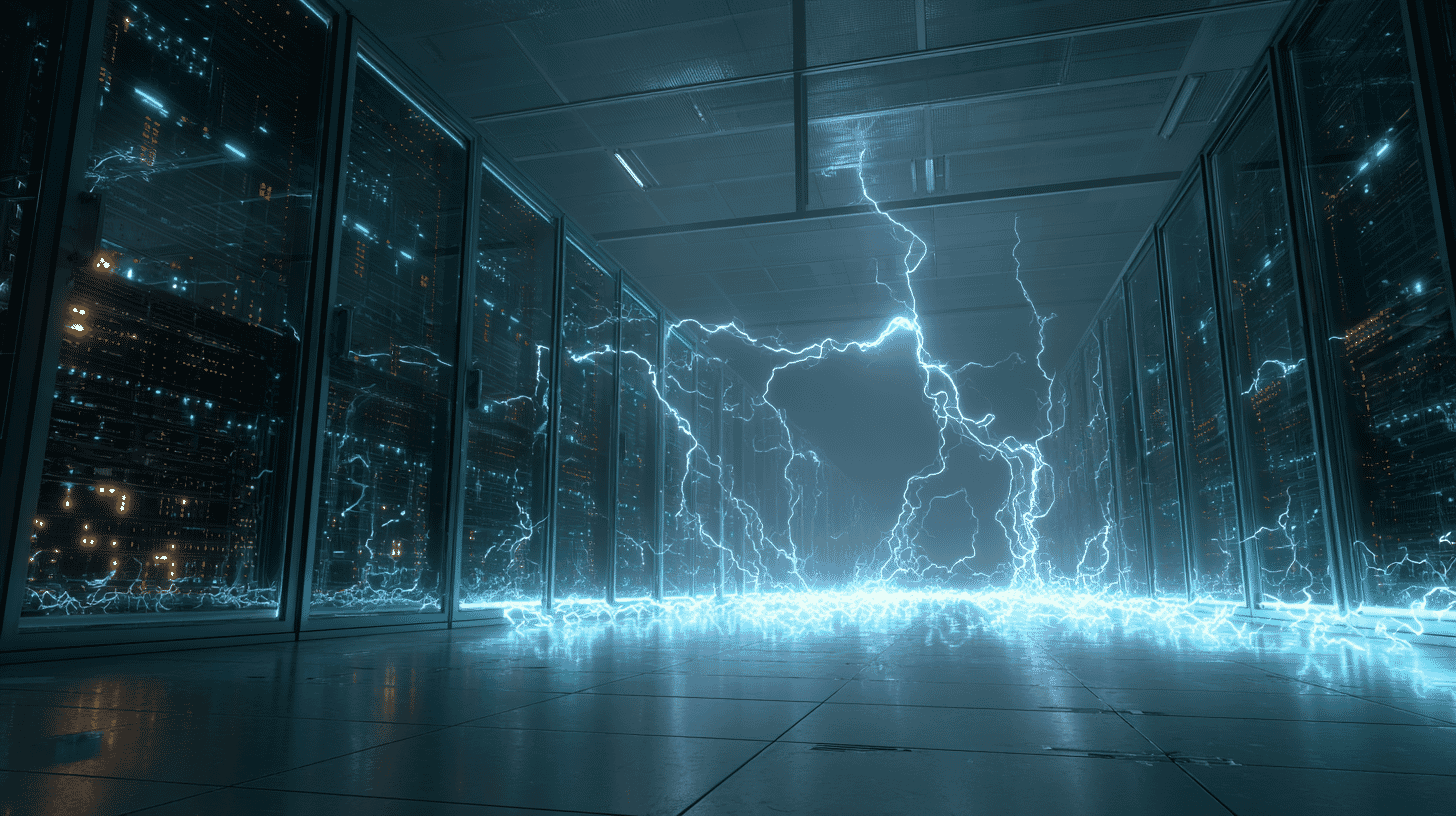
⚡ A single AI data center can consume as much power as a nuclear plant. Now imagine that power swinging by over 50% in milliseconds. That's the crisis facing the global power grid, and Japan's power semiconductor makers see a once-in-a-generation business opportunity. Welcome to the golden age of power electronics.
The "Power Fluctuation" Crisis Nobody Saw Coming
The explosive rise of generative AI, from ChatGPT to Gemini and beyond, has triggered a data center construction boom worldwide. According to the International Energy Agency (IEA), global data center electricity consumption is projected to roughly double from about 415 TWh in 2024 to around 945 TWh by 2030. Gartner forecasts similar growth, from 448 TWh in 2025 to 980 TWh by 2030.
But the real shock isn't just how much power AI devours, it's how wildly that power consumption fluctuates.
Traditional data centers run servers at relatively steady loads. AI data centers are a different beast entirely. During large-scale training, tens of thousands of GPUs cycle between compute-heavy phases (drawing maximum power) and communication-heavy phases (when power consumption drops sharply). These transitions happen in milliseconds, creating power swings of tens to hundreds of megawatts.
When Meta trained its LLaMA 3 model using 24,000 H100 GPUs (about 30 MW of computing capacity), the power fluctuations were so severe that engineers scrambled to build a workaround. They created a command with the memorable name "pytorch_no_powerplant_blowup=1", literally, "don't blow up the power plant", which generated dummy computational tasks to smooth out the power draw.
Modern AI accelerators have been observed to exhibit power variations exceeding 50% of their thermal design power (TDP) within milliseconds. At gigawatt scale, equivalent to a nuclear power plant, this translates to hundreds of megawatts of instantaneous fluctuation. Given that even a 10% swing in power supply can fry motors, trip breakers, and crash electronics, this is not merely a "power shortage" problem. It threatens the very stability of electrical grids.
What Is Power Electronics? The Invisible Backbone of Modern Life
Enter power electronics, known in Japan as pawa erekutoronikusu, or pawa-ere for short. This field encompasses the technology of converting and controlling electrical power: changing voltage, current, and frequency to suit different needs.
Think of it this way: when you plug your phone charger into a wall outlet, it converts 120V AC (in the US) or 100V AC (in Japan) into 5V DC. That's power electronics at work. The same fundamental technology drives electric vehicle motors, converts solar panel output into household power, and runs railway systems.
At the heart of power electronics lie power semiconductors, specialized chips designed to handle large amounts of electrical energy efficiently. Unlike logic chips (CPUs, GPUs) that process data, or memory chips that store it, power semiconductors manage the flow and conversion of electricity itself.
In an AI data center, high-voltage AC power from the grid must be stepped down through multiple conversion stages until it reaches the few volts that GPU chips actually need. Power semiconductors operate at every stage of this chain. Even a 1% improvement in conversion efficiency, when applied across a gigawatt-scale facility, saves millions of dollars per year in electricity costs.
Japan's Massive Business Opportunity
The global power semiconductor market currently stands at roughly $27 billion. Yole Group expects it to grow at a 7.1% compound annual rate from 2025 to 2031, reaching about $41.3 billion. Some Japanese trade press carries bullish forecasts of more than $65 billion within a few years; the figures swing widely depending on who is counting. What everyone agrees on is the direction, with AI data centers and carbon neutrality both pushing demand up.
Japan remains a key player in this field, with several major companies positioned to capitalize:
Mitsubishi Electric holds the #2 global share in power modules, integrated power semiconductor packages, on 2024 figures from Omdia. By its own count it ranked first in 2023 for power modules used in voltage-sourced-converter HVDC transmission. In the data center space it says it holds the top global share in EML optical devices, the high-speed communication lasers that connect NVIDIA GPU-based AI systems. Orders for data center optical devices surged 49% year-on-year in Q3 FY2025, and a new building for 8-inch SiC wafers is going up at Shisui in Kumamoto. The picture is not uniformly bright, though: in May 2025 the company said it was curbing and stretching out capacity investment in power semiconductors to match market conditions, shifting part of that spending into optical device production.
Fuji Electric is a power electronics specialist at its core. On IGBT revenue it ranks third worldwide, behind Infineon and Mitsubishi Electric. In 2024, the company acquired US-based Transphorm to secure GaN (gallium nitride) technology, and in July 2025 began mass production of 650V GaN FETs targeting AI servers and uninterruptible power supplies (UPS). Its SiC production capacity is set to increase 50-fold by FY2027 compared to FY2023.
Toshiba and Rohm have formed a partnership for joint SiC power semiconductor production valued at about ¥388.3 billion ($2.6 billion), while Fuji Electric's manufacturing tie-up with Denso runs to roughly ¥211.6 billion. The Japanese government requires investment commitments of at least ¥200 billion ($1.3 billion) to qualify for subsidies, which is what set off the current wave of pairings among the country's many smaller players.
Renesas Electronics is championing an 800V DC data center architecture using GaN power semiconductors. Moving from the conventional 48V system to 800V dramatically reduces power distribution losses. The company ships over 1.5 billion power management ICs annually.
The Global Competitive Landscape: Germany Leads
Japan faces a significant challenge, however. Germany's Infineon Technologies leads the global power semiconductor market with 22.8% share, followed by US-based onsemi at 11.2%. Even Japan's top player, Mitsubishi Electric, holds just 5.5%. The fundamental issue is structural: Japan has many power semiconductor makers, but each is too small individually to compete with global giants.
Infineon has staked out a bold position in the AI data center market, integrating Si (silicon), SiC, and GaN, three different semiconductor materials, into single power supply units. Its product lineup ranges from 3 kW to 12 kW PSUs. AI server-related revenue is projected to reach approximately €600 million ($650 million) in FY2025, with expectations of hitting €1 billion ($1.1 billion) within two years.
The answer to that structure arrived in 2026, when consolidation finally moved. In early March, reports emerged that Mitsubishi Electric and Toshiba had opened talks, around the same time Denso made an acquisition proposal to Rohm. On March 27, Rohm, Toshiba and Mitsubishi Electric signed a basic agreement to begin discussions on integrating their power semiconductor businesses and, potentially, the companies themselves, with the private equity firm Japan Industrial Partners and its affiliate TBJ Holdings brokering. A completed deal would rank second in global share on a simple sum of the parts. Denso later withdrew its bid for Rohm. Rohm president Katsumi Azuma said in May that the talks would take longer than expected, so the landing is still not in sight. Turning power semiconductors from individual company businesses into a national strategic industry remains a work in progress.
Update, July 2026: Yole Group's ranking of 2025 power semiconductor revenue, published on July 10, puts Infineon first, onsemi second, STMicroelectronics third, Mitsubishi Electric fourth, Fuji Electric fifth, Toshiba sixth, Rohm eighth and Renesas fourteenth. The combined revenue of all five Japanese firms still falls short of Infineon's. Five Chinese makers also placed in the top 20.
US and European Data Center Power Challenges
The US faces the most acute version of this crisis. In September 2025, OpenAI and NVIDIA announced a partnership to build at least 10 GW of AI data centers with millions of GPUs. That's equivalent to about 10 nuclear power plants. At Tokyo electricity rates, full operation would cost roughly $1.3 million per hour.
PG&E, a major US utility, has identified approximately 10 GW of new data center load expected over the next decade, prompting multibillion-dollar transmission infrastructure investments. Tesla's Megapack battery energy storage systems (BESS) are increasingly deployed as power fluctuation buffers, xAI's Memphis-based "Colossus" facility uses Tesla BESS to manage the sharp power swings from AI training workloads.
The century-old AC versus DC debate has also resurfaced. For GPU-dense, megawatt-per-rack architectures, high-voltage DC (HVDC) distribution reduces conversion losses and improves efficiency. Industry consensus is converging on a hybrid approach: AC at the facility level, DC for the densest AI/GPU zones.
In Europe, data center power consumption is expected to grow from 2.7% to 5% of regional electricity usage by 2030. European regulators impose stricter conditions on data center siting based on data sovereignty and environmental concerns, with Nordic countries (Finland, Sweden, Norway) leveraging cold climates and renewable energy to attract facilities.
Japan's Unique Challenge: The "Watt-Bit Collaboration"
Japan's data center power consumption is projected to triple from 19 TWh in 2024 to 57–66 TWh by 2034. But Japan faces a structural challenge distinct from the US: data centers are heavily concentrated in the Tokyo metropolitan area, particularly in Inzai and Shiroi (Chiba Prefecture), where power connection applications already far exceed grid capacity. The Tokyo Electric Power area has received supply applications totaling 9.5 GW (roughly 9 nuclear plants' worth) through 2037.
Japan's answer is what it calls "Watt-Bit Collaboration" (Watto-Bitto Renkei), part of the GX 2040 Vision approved by the Cabinet in February 2025. The concept integrates energy infrastructure (Watts) with information and communications infrastructure (Bits). The idea is to distribute data centers to regions rich in renewable energy and shift AI computational workloads geographically based on power availability, processing in solar-rich Kyushu during the day and wind-powered Hokkaido at night. The University of Tokyo and Fujitsu began testing this "workload shift" technology in January 2026.
The government plans to invest ¥210 billion (about $1.4 billion) over five years starting in FY2026, subsidizing up to 50% of investments in data centers and semiconductor plants that use 100% decarbonized power. SoftBank Group's planned mega AI data center in Tomakomai, Hokkaido (scheduled to open in FY2026) will serve as a model, leveraging cold-climate cooling and locally produced renewable energy.
Three Approaches to Taming Power Fluctuations
The industry is pursuing three main strategies to address the AI data center power fluctuation challenge:
Software-based smoothing: As Meta demonstrated, injecting dummy workloads can flatten power spikes. However, this wastes energy, simulations show over 10% extra consumption in some cases.
GPU firmware-level controls: Setting power ramp rate limits and minimum power floors prevents sudden swings. Current hardware can maintain floors at about 90% of TDP, but residual oscillations still pass through.
Hardware solutions, batteries and advanced power electronics: Battery energy storage systems (BESS) and supercapacitors absorb rapid power fluctuations, while next-generation power semiconductors (SiC and GaN) enable faster, more efficient power conversion at every stage. Solid-state transformers (SSTs) are also emerging as a game-changer, Taiwan's Delta Electronics projects overall efficiency of about 92% by combining SSTs with HVDC architectures, dramatically reducing multi-stage conversion losses.
The optimal approach likely combines all three strategies, with power electronics playing an increasingly central role as data centers scale from hundreds of megawatts to multiple gigawatts.
As long as AI continues its relentless advance, demand for power electronics will only grow. Japan has decades of accumulated expertise here, but what it is running into now is not a technology gap, it is a scale gap. Whether the Rohm-Toshiba-Mitsubishi talks actually land will shape Japanese industrial competitiveness in the AI era.
How is your country addressing the power challenges of AI data centers? What's the state of the power semiconductor industry where you live?
References
- https://xtech.nikkei.com/atcl/nxt/column/18/03498/021200001/
- https://www.iea.org/reports/energy-and-ai/
- https://www.gartner.co.jp/ja/newsroom/press-releases/pr-20251119-dc
- https://arxiv.org/html/2509.07218v2
- https://arxiv.org/html/2502.01647v2
- https://journal.uptimeinstitute.com/electrical-considerations-with-large-ai-compute/
- https://www.trendforce.com/insights/data-center-power
- https://eetimes.itmedia.co.jp/ee/articles/2607/10/news072.html
- https://www.sangyo-times.jp/article.aspx?ID=13632
- https://toyokeizai.net/articles/-/931243






Global Discussion
15 comments