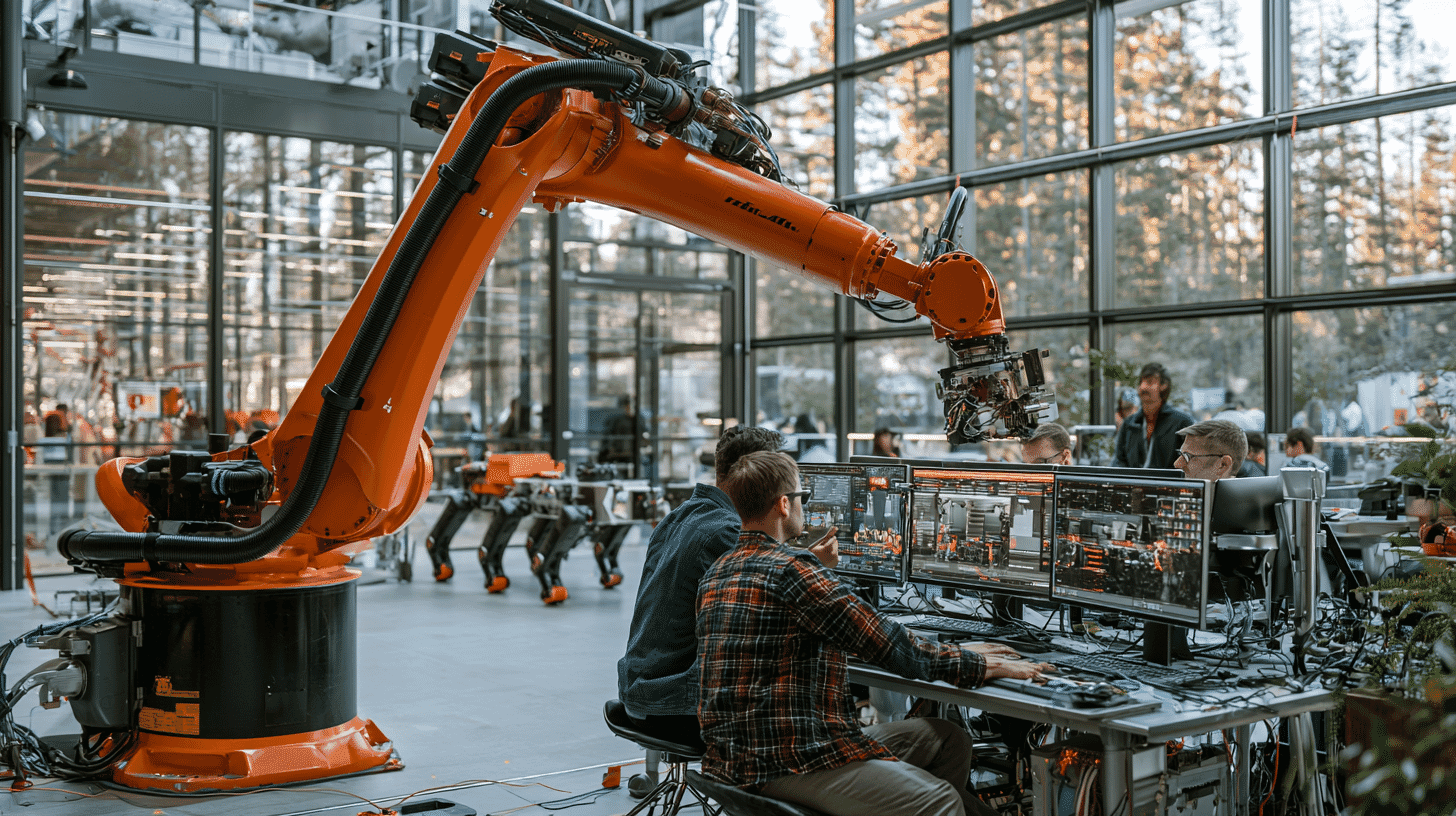
🤖 A company that builds jet engines, bullet trains and motorcycles just opened an office in Silicon Valley, to teach robots how to act in the real world. Kawasaki Heavy Industries has launched a "physical AI" hub in San Jose, joining forces with NVIDIA, Microsoft, Analog Devices and Fujitsu. Why is a 130-year-old industrial giant betting on AI that lives outside the screen, and what does the move say about the race between the United States and China?
A 130-year-old industrial giant lands in Silicon Valley
On May 21, 2026, Kawasaki Heavy Industries held an opening ceremony for a facility with a deliberately ambitious name: the Kawasaki Physical AI Center San Jose. It occupies space inside the building of Kawasaki Robotics in San Jose, California, squarely in the heart of Silicon Valley.
Kawasaki is not a name most people associate with cutting-edge AI. Founded in 1896, it is one of Japan's oldest and broadest industrial conglomerates, building aircraft, ships, hydrogen energy systems, rail cars and the motorcycles that carry its badge around the world. Now it wants to add something far less tangible to that catalog: artificial intelligence that can sense a situation and physically respond to it.
At the new center, Kawasaki will collaborate with four heavyweight names in computing: NVIDIA, Microsoft, Analog Devices and Fujitsu. NVIDIA CEO Jensen Huang sent a video message for the opening, as did Jacques Marescaux, a French surgeon widely regarded as a pioneer of robotic surgery. Kawasaki says it plans to recruit AI engineers locally and grow the team to dozens of people within a few years.
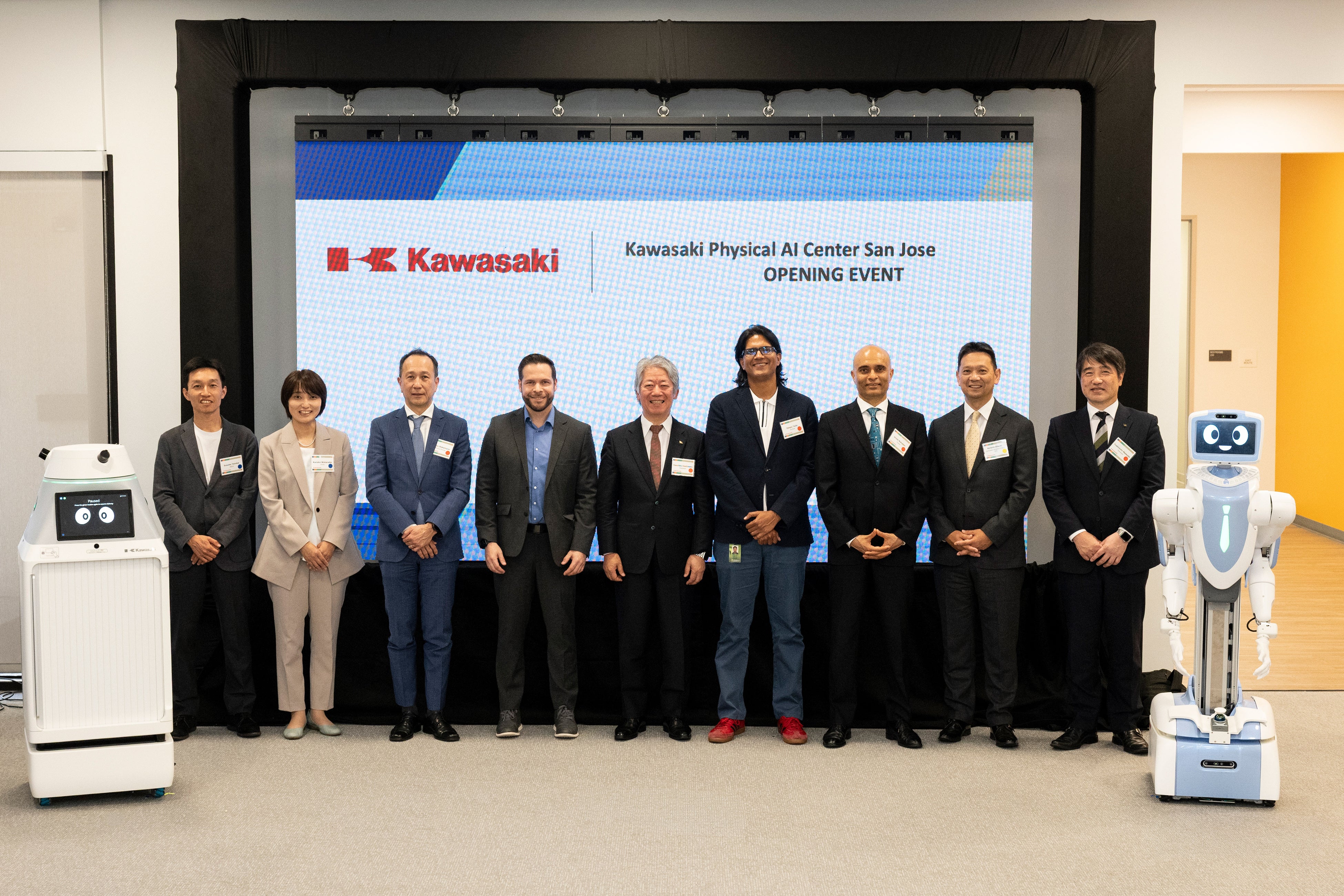
Source: Kawasaki Heavy Industries press release
What "physical AI" is, and why real-world data is the real prize
The AI most people know, chatbots and image generators, works entirely inside the digital world. It produces text and pictures. Physical AI is different: it perceives the real world through sensors and cameras, decides what to do, and then acts through a machine. A delivery robot reading a crowded hospital corridor, a surgical arm reproducing a doctor's fine movements, a vehicle picking its way over rough ground: that is physical AI at work.
NVIDIA's Jensen Huang has called this the next great wave of computing, arguing that "every industrial company will become a robotics company." But there is a catch that favors firms like Kawasaki. To get good at the physical world, an AI needs enormous amounts of data from the physical world: how machines move, how parts fit, how things go wrong on a real factory floor.
That is Kawasaki's pitch. Across aerospace, shipbuilding, plant engineering and motorcycles, it has spent decades accumulating exactly that kind of messy, real-world operational data. Software giants have the algorithms and the chips; what they often lack is grounded industrial experience. Kawasaki is betting that this gap is its opening.
Healthcare first, and a robot horse you can ride
Kawasaki has been clear about where it wants to start. Company president Yasuhiko Hashimoto said the center will focus first on healthcare and nursing care, fields squeezed worldwide by aging populations and labor shortages. The goal is what Kawasaki calls a "hospital one-stop solution": robotics and AI supporting the whole journey from arrival and diagnosis through treatment, surgery and post-operative care.
Hashimoto framed the philosophy carefully. The aim, he said, is not to replace people but to support human judgment and action, safely and efficiently. It is a notable choice of words in an industry where "robots taking jobs" is a constant worry.
The hardware behind the ambition already exists. Kawasaki's lineup includes hinotori, the first robotic-assisted surgery system developed in Japan, built by Medicaroid, a joint venture between Kawasaki and medical-equipment firm Sysmex. Approved in Japan in 2020, hinotori is a homegrown rival to the long-dominant da Vinci system made by America's Intuitive Surgical. There is also Nyokkey, an autonomous service robot, and FORRO, an indoor delivery robot designed for places like hospitals.
The most eye-catching machine in the family is CORLEO, a four-legged, hydrogen-powered robot that a person actually rides, steering it by shifting body weight. Unveiled at the 2025 Osaka Expo, where it racked up roughly 1.2 billion social media impressions, CORLEO looks like something out of a video game. Kawasaki sees it as a serious answer to mobility in rough or remote terrain, and the areas the center targets after healthcare, industrial fields such as semiconductors and automotive plus new mobility, are where machines like it fit in.
Four partners, four pieces of the puzzle
Each of Kawasaki's four partners brings a different strength, and the division of labor is fairly explicit.
NVIDIA supplies the AI and simulation backbone, including the tools used to train robots in photorealistic virtual environments before they ever touch the real world. Analog Devices contributes sensing, audio and manipulation technology aimed at robots that can handle a wide range of tasks. Microsoft provides the cloud and AI platform meant to make real-world deployments reliable and scalable. Fujitsu, drawing on its enterprise-IT roots, works on linking business systems, robot systems and AI together, particularly for healthcare.
The San Jose hub is also tied into Kawasaki's wider network. It will work alongside the company's R&D center in Strasbourg, France, the Kawasaki Innovation Centre Europe SAS, which began operating in March 2026. The intent is a loop: gather local needs in each region, then turn them into practical, deployable systems.
Not chasing humanoids: Japan's quieter bet in the US-China race
Step back, and Kawasaki's move sits inside a much larger contest. Physical AI has become a front line in the technology rivalry between the United States and China.
China has surged ahead in the most visible category, humanoid robots. At CES 2026 in Las Vegas, Chinese firms made up the majority of humanoid-robotics exhibitors. China has staged humanoid robot games, half-marathons and even a robot combat league, and by some counts the country had more than 150 humanoid robot startups in 2025. Commentators in US outlets have openly warned that China could come to dominate the physical AI future.
The United States, meanwhile, holds a commanding position in the layer underneath: the AI chips and software, where NVIDIA sets the pace.
Japan's position is different again. It is a quiet powerhouse of industrial robotics, home to firms like FANUC, Yaskawa and Kawasaki, but it has not produced a flashy humanoid champion. Kawasaki's strategy reflects that reality. Rather than competing in the humanoid showcase race that China dominates, it is leaning into practical, task-specific machines such as surgical robots, delivery robots and rideable mobility platforms, pairing its industrial know-how with American AI muscle.
Opening a hub in San Jose, rather than expanding only at home, is a pragmatic admission: that is where the advanced AI chips, the engineering talent and the partner ecosystem are concentrated. For a Japanese conglomerate, planting a flag in Silicon Valley is both an opportunity and a quiet acknowledgment of where the center of gravity in AI now sits.
Whether this model, Japanese industrial depth plus US computing power, can hold its own against China's manufacturing scale is the open question. But Kawasaki has decided that the answer will not be found by waiting in Japan.
In Japan, robots are increasingly being designed to assist rather than replace: in hospitals, in factories, on rough terrain. Would you want a robot involved in your own hospital visit, or is that a line you would rather not cross? And in the race to build AI that acts in the real world, who do you think will end up leading: the United States, China, or someone else?
References
- https://prtimes.jp/main/html/rd/p/000000033.000050413.html
- https://www.khi.co.jp/pressrelease/news_260522-1.pdf
- https://finance.yahoo.com/sectors/technology/articles/kawasaki-heavy-nvidia-plan-silicon-160730316.html
- https://global.kawasaki.com/en/corp/newsroom/news/detail/?f=20251211_7502
- https://www.medicaroid.com/en/product/hinotori/
- https://time.com/7382151/china-dominates-the-physical-ai-race/








Global Discussion
4 comments