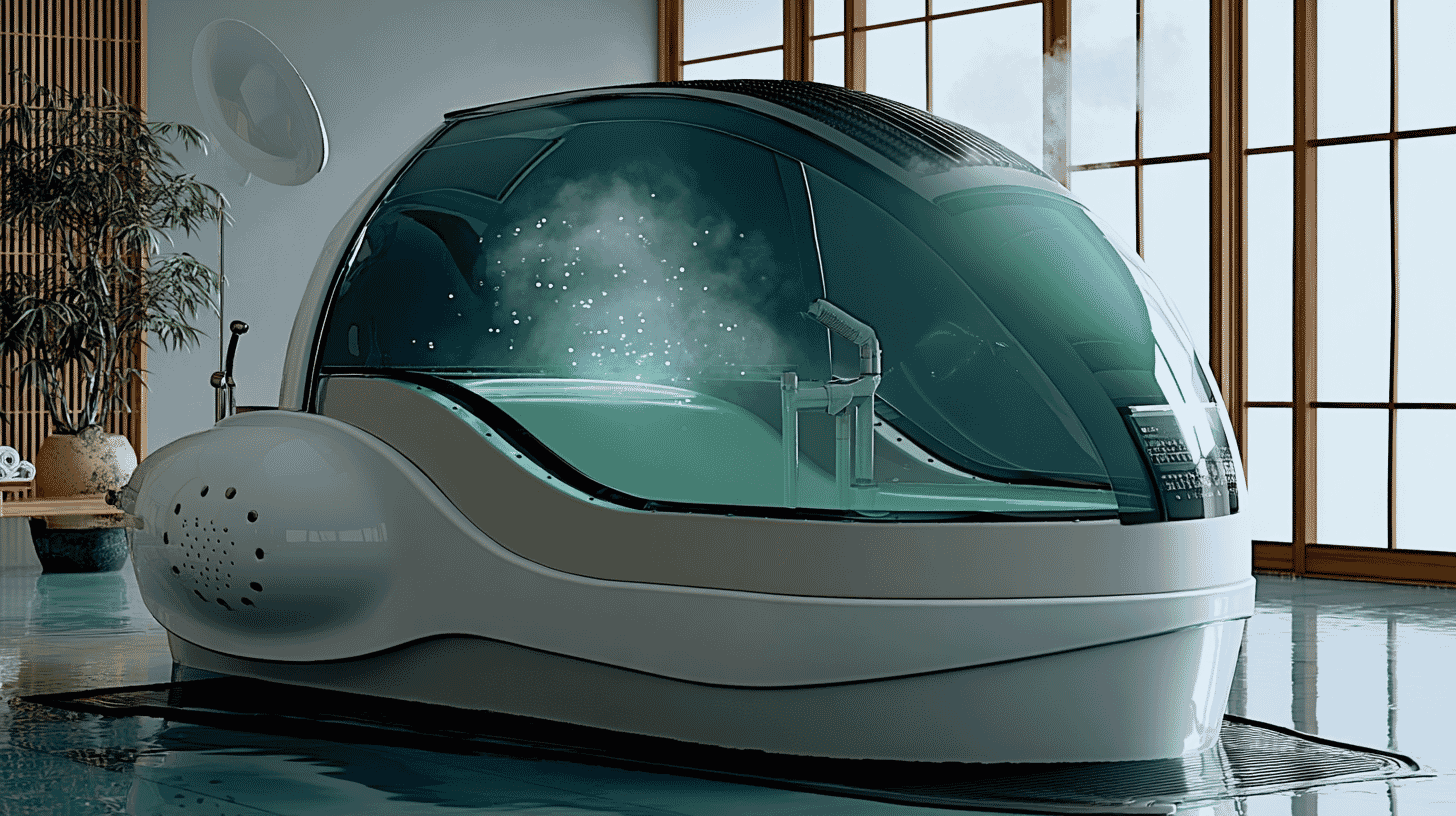
🛁 You sit down. Fifteen minutes later you step out washed and dried, having touched nothing. The "human washing machine" that stunned a 10-year-old boy at the 1970 Osaka Expo took 55 years to become a product you can actually order. It costs 60 million yen, roughly $370,000. You buy it at an electronics store. No, really.
From Expo Legend to Electronics Store Floor
On February 26, 2026, a capsule-shaped machine that looks like an escape pod from a low-budget starship turned up on the floor of Yamada Denki's LABI Ikebukuro flagship in Tokyo. This is the Mirai Human Washing Machine, the fully automated bathing pod that drew queues at the 2025 Osaka-Kansai Expo, and it is now a thing you can buy in a shop. Per the retailer, it's the first time the machine has been sold through a consumer electronics chain.
It was built by Science, based in Osaka's Yodogawa ward and best known for Mirable, a showerhead that cleans with microscopic bubbles.
The price is 60 million yen, installation and the first year of maintenance included, orderable at Yamada Denki stores nationwide. Jun Sasazawa, an adviser to Yamada Holdings, put it plainly: without question the most expensive product Yamada Denki sells.
Sit Down, and 15 Minutes Later You're Dry
The pod runs about 2.3 meters long. You settle into the seat, the hatch closes, and 350 liters of hot water flood in at once. From there the machine handles everything.
The cleaning comes from Science's fine bubble technology. Bubbles under one micrometer across (0.001 mm) latch onto sebum and grime and float it off the skin. No scrubbing, no shampoo. Bubbles plus a fine-mist shower from above and in front do the whole body. Then a compressor blows warm air until you're dry enough to skip the towel. Total: about 15 minutes.
Meanwhile a sensor in the backrest is reading your heart's electrical activity. AI analyzes what that says about your autonomic nervous system and picks visuals and music to match your mental state, projecting them inside the capsule. Company spokeswoman Sachiko Maekura has told foreign press that the machine doesn't just wash the body, it washes the soul.
A Dream from 1970, Chased for 55 Years
The concept is older than most people assume.
At the 1970 Osaka Expo, Sanyo Electric (now part of Panasonic Holdings) exhibited the Ultrasonic Bath, which used ultrasound to generate bubbles and wash a person. Technical limits and cost killed it. It never shipped.
A fourth-grader in the crowd never got over it. That was Yasuaki Aoyama, now Science's chairman, who reportedly visited the Expo twenty times. He founded Science in 2007, spent years developing its fine bubble technology, and when Osaka won the 2025 Expo he decided he would put a modern human washing machine in it.
The good part is who showed up. Science asked Manatsu Ueda, the former Sanyo designer behind the Ultrasonic Bath, to help. And Eiji Yamatani, the former Sanyo engineer who'd worked on the 1970 technology, had spent decades quietly bothered that he'd never managed to produce the fine bubbles he wanted. He happened to see a Mirable commercial, and called Science himself.
Fifty Units, Hand-Built, and the Lamborghini Label
Science plans to make 40 to 50, all by hand. Foreign outlets took one look at the numbers and dubbed it the Lamborghini of showers.
At the Expo, the pod sat in the Osaka Healthcare Pavilion, and demand outran supply badly. Overseas reports put applications above 40,000; the number of people who actually got in was 1,277. For context, the Expo drew more than 27 million visitors. Among those 1,277, post-bath surveys came back at 98.3 percent satisfaction.
Science hadn't planned to sell the thing at all. What changed its mind was a U.S. resort operator making inquiries. An Osaka hotel has since bought the first unit and opened it up beyond its own guests, with another five to eight reserved. The buyers are hotels and bathing facilities, not individuals.
The One That Actually Matters Costs $9,000
The 60-million-yen figure gets all the oxygen, but the other product announced that day may be the real story.
Yamada Holdings and Science co-developed the Mirai Human Washing Machine Social Implementation Model: 1.45 million yen before tax, about $9,000, sold exclusively through Yamada Denki. It's aimed at care facilities and ordinary homes, priced to sit within reach of a bathroom remodel or an accessibility renovation.
There's no AI light show. Instead, twelve nozzles fire what Science calls a tornado mist, cleaning the whole body without contact. A wheelchair pulls up alongside, and someone with limited mobility transfers in with minimal movement.
Sasazawa's interest is personal. His own uncle, he says, reached an age where an ordinary bath became impossible, and an ordinary Japanese tub has a wall about 40 centimeters high to climb over. That step is a wall for the person bathing and for whoever is helping them.
The last engineering problem turned out to be winter. A standard water heater fills the tub too slowly, and you get cold waiting. The fix is gloriously unsophisticated: keep 160 liters preheated and dump it in all at once. Two or three minutes and the water's up to your chest.
"The 60-million-yen high-end model is a symbol," Sasazawa said. "What we actually want to deliver is for people who struggle with bathing every day. This model is the answer."
Why Japan Wants a Human Washing Machine
About 29 percent of Japan's population is 65 or older, and care work is chronically short-staffed. Bath assistance is among the hardest parts of the job: fall risk, physical strain, and a real toll on both people involved. Technology that washes without scrubbing lands directly on that problem.
It helps to understand that bathing in Japan was never just hygiene. The country has roughly 3,000 hot spring areas, and the word toji, meaning a recuperative stay at an onsen, treats soaking as adjacent to medicine. Reheating tubs, jet baths, mist saunas: Japanese bathrooms evolved the way they did because of that assumption.
A boy's obsession from 1970 became a 60-million-yen capsule. But if this technology changes anything, it will be the 1.45-million-yen version that does it. Over five days between March 16 and 30, Yamada's Ikebukuro store ran a free trial, two people a day, chosen by lottery. What they got to sit in was the cheap one.
Would a machine like this sell where you live? Or is the whole premise, pouring this much engineering into getting clean, one that only makes sense in Japan?
References
- https://kaden.watch.impress.co.jp/docs/news/2088804.html
- https://type.jp/et/feature/30557/
- https://www.nikkei.com/article/DGXZQOUC2614F0W6A220C2000000/
- https://prtimes.jp/main/html/rd/p/000000066.000098081.html
- https://i-feel-science.com/expo2025/future-of-human-washing-machine/
- https://newatlas.com/consumer-tech/human-washing-machine-science/
- https://interestingengineering.com/innovation/human-washing-machine-goes-on-sale




Global Discussion
15 comments