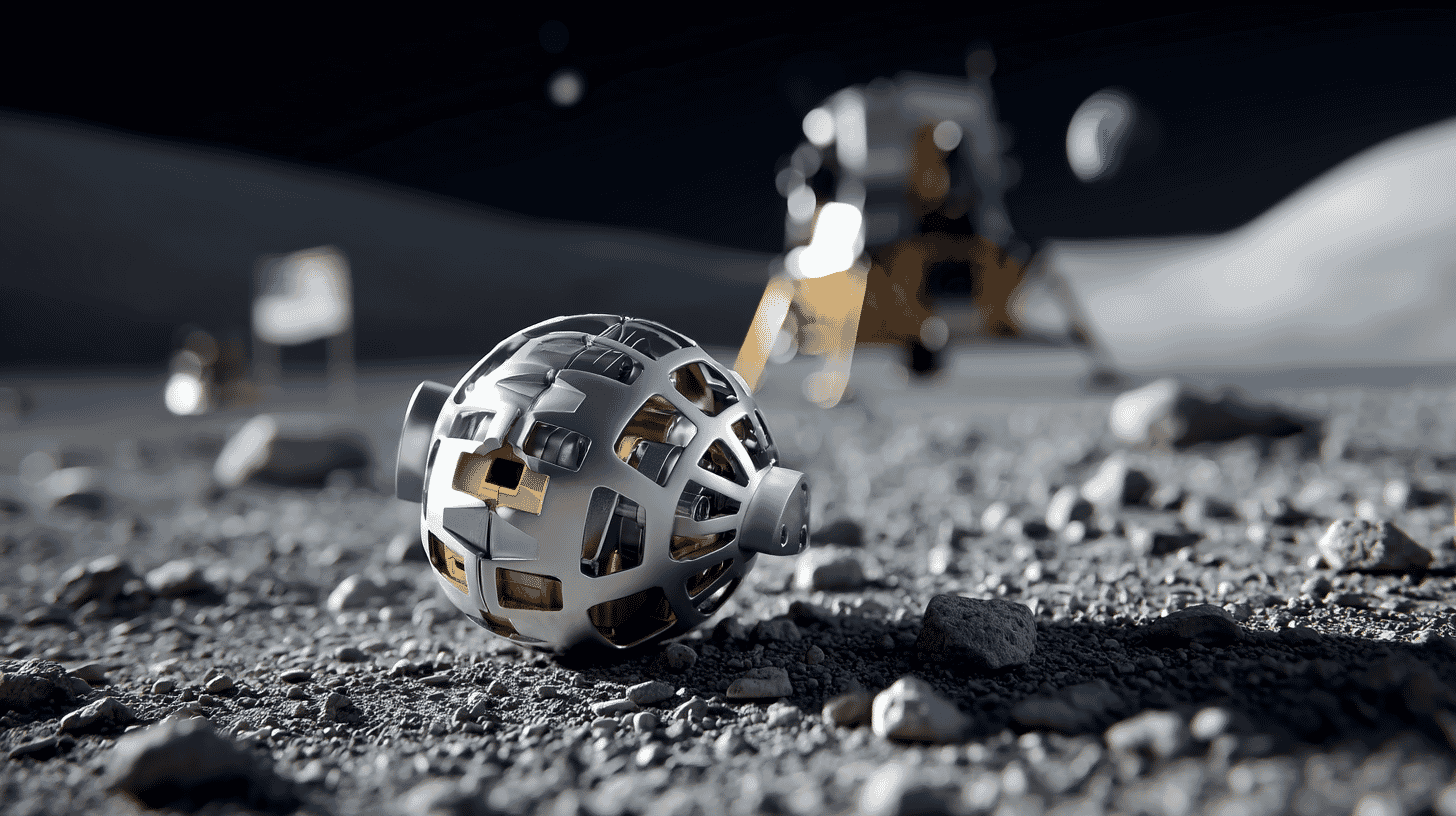
🌙 JAXA called it "an important step toward space exploration by small robots." It turns out the step was literal. A 228-gram ball, lighter than a can of soda and built with help from a toy maker, rolled across the lunar surface on its own. The little robot is named SORA-Q, and its results ran in Science Robotics on June 10, 2026, on the cover.
SORA-Q, officially LEV-2, reached the Moon in January 2024 after riding down with the SLIM lander. We already knew it had taken pictures up there. What we didn't have was proof that it had actually moved. A new image and a fresh round of analysis from JAXA finally settle that question.
Did it really move?
The photo everyone shared back in 2024 showed the SLIM lander sitting on a nearby slope, taken by SORA-Q's front camera. It was a great picture, but a single photo can't prove movement. You can shoot a lander while standing perfectly still.
So the team went back to a second image, from the rear camera, that they hadn't shown before. Part of it was lost when the radio link cut out mid-transmission, leaving only the left side. But both photos happen to include the same rock. Using that rock as a fixed marker, the researchers measured how the view had shifted between the two shots. The numbers only add up if the robot rolled about 0.13 meters and spun roughly 180 degrees in between.

©JAXA / Takara Tomy / Sony Group / Doshisha University
Thirteen centimeters is about the length of your hand. But the distance isn't the point. What matters is that this little robot did everything by itself, with no one on Earth at the controls. It woke up, unfolded, straightened itself, drove away from the lander, chose which of its own photos were worth keeping, and sent them home. All of that was automatic, because the radio link was far too patchy to steer a robot by joystick from 380,000 kilometers away.
The records back it up. SORA-Q ran for at least 108 minutes and processed images onboard 240 times. It even noticed at one point that it had tipped into a bad position and corrected its own posture. For a machine this tiny, that kind of self-reliance is the impressive part, not the few centimeters it covered.
How a ball turns into a rover
For a small Moon robot, the real enemy isn't the cold or the vacuum. It's the dirt. Lunar soil is fine and powdery, and tiny wheels tend to dig in and get stuck. At 228 grams, there's almost no weight to muscle out of a rut.
SORA-Q gets around this by changing shape. It travels packed as a sphere about 78 millimeters wide, then cracks open into a two-wheeled crawler once it lands. The wheels turn off-center, so instead of spinning helplessly in soft dust they sort of paddle the robot along. The new analysis confirms this odd little trick worked on real lunar soil, not just in a test sandbox back home.

©JAXA / Takara Tomy / Sony Group / Doshisha University
This is where SORA-Q's background pays off. It was built by JAXA, Sony Group, Doshisha University and Takara Tomy, one of Japan's biggest toy makers, known for Tomica cars and Transformers. Decades of making cheap toys that fold and transform without breaking went straight into a spacecraft. You can even buy a working 1:1 replica, the SORA-Q Flagship Model, for 27,500 yen (about $170), and drive it around your living room with a phone app. On December 20, 2025, the story of how it was built aired on NHK's revived documentary series Project X.
Small enough to reach where big robots can't
So why does a 13-centimeter crawl earn a journal cover? Because it proves a different way of exploring the Moon actually works.
For decades, a Moon rover meant something big and expensive. That has an obvious downside: when one machine costs a fortune, you can't afford to lose it, so you keep it away from anything risky. A palm-sized robot flips that logic. It's cheap enough to send in numbers, and cheap enough to put in harm's way.
Picture a handful of them fanning out across a wide area at once, or a few sent ahead of a pricey rover to scout a cave mouth or a steep crater wall before the big machine commits. The Moon's hardest places to reach, like lava tubes, sharp slopes and the permanently dark pits where ice may be hiding, are exactly where you'd rather risk a tiny scout. JAXA says it's looking at the Moon first, then Mars, then tougher targets beyond.
To be clear, a machine that ran 108 minutes on two cameras is a proof of concept, not a science lab. But new ideas start with a proof of concept, and Japan now has hard proof that the world's smallest lunar rover really drove.
For a long time, going to the Moon meant going big. SORA-Q is a small, stubborn argument for going small instead. Which way would your country bet?
References
- JAXA press release: https://www.jaxa.jp/press/2026/06/20260618-1_j.html
- Science Robotics (DOI): https://doi.org/10.1126/scirobotics.aec8039
- TECH+ (Mynavi): https://news.mynavi.jp/techplus/article/20260618-4598038/








Global Discussion
4 comments