
🪳 Picture yourself trapped under rubble after a flood. Something is coming toward you through a gap far too small for any human rescuer. Help has arrived. And it's a cockroach. In a scuba suit. Steered by remote control.
Thank you. No, wait. Please don't.
A team in Singapore and Japan just built precisely that, and it works better than you might want it to.
The bug that learned to dive
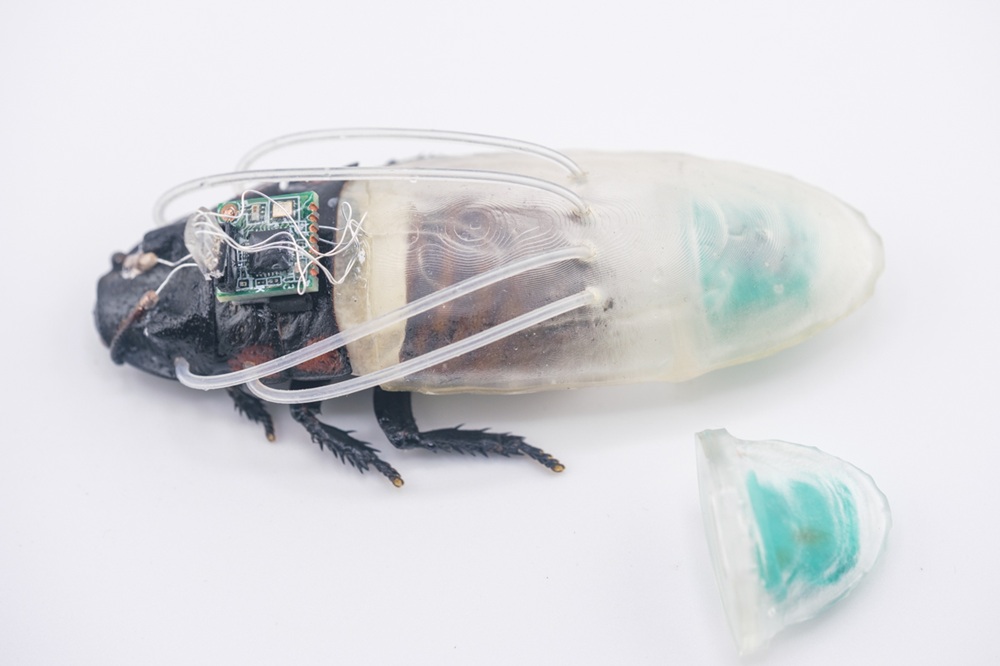
Researchers at Nanyang Technological University (NTU) in Singapore and Waseda University in Tokyo have fitted a live Madagascar hissing cockroach with a small, flexible "diving suit" that lets it breathe and keep moving underwater for up to three hours. Strip the suit off and a submerged cockroach stops moving in roughly two minutes. With it on, the insect walks, turns and responds to remote commands the entire time. The study was published on June 29 in Nature Communications.
That single change turns a strictly land-bound cyborg insect into an amphibious one, able to cross a flooded tunnel, a puddle, or a half-submerged gap in collapsed debris. To prove it, the team sent the suited roach through 3D-printed tunnels flooded with water, some sections deliberately filled with carbon dioxide to mimic the oxygen-starved pockets of a real disaster zone. It made it through all of them.
Source: NTU Singapore / Waseda University
How do you hand a cockroach scuba gear?
Cockroaches don't breathe through a mouth. Air enters through tiny holes on the thorax called spiracles, which feed an internal web of tubes. Underwater, those holes are useless: there's simply no air to draw in.
The suit gets around this with chemistry rather than a heavy pressurized tank. The whole oxygen generator measures about 10 by 10 millimeters, roughly a stick of chewing gum, and is 3D-printed from a clear resin. Inside sits a small cellulose sponge coated with manganese dioxide. Add a few drops of diluted hydrogen peroxide, seal the opening, and the manganese dioxide slowly breaks that peroxide down into water and oxygen. No battery, no electronics for this part at all. A membrane lets the gas escape but blocks water from seeping in, and four soft silicone tubes pipe the oxygen straight to the spiracles on the roach's thorax. It is, essentially, a scuba regulator shrunk to insect scale.
The performance is almost comically good. A suited cockroach clocked about 87.5 millimeters per second on land and 78.4 mm/s underwater, barely slower wet than dry. (Turning is where it suffers, dragging the bulky suit against the water.) For the hardest test, a gap just two centimeters high and underwater, the team went a step further and implanted the control electronics inside the insect's body so nothing stuck out to catch. The roach slipped straight through.
So why not just build a robot?
Because of a stubborn tradeoff. The insect's own muscles do the moving, so a cyborg needs a tiny fraction of the power a comparable robot would. A robot small enough to squeeze into rubble usually can't carry a battery big enough to run for long. That gap is exactly why researchers keep returning to living insects.
And this is no longer just theory. The NTU lab is led by Professor Hirotaka Sato, a Japanese researcher who pioneered the cyborg insect more than a decade ago, and his cockroaches have already gone into a real disaster. After the magnitude-7.7 earthquake that hit Myanmar on March 28, 2025, cyborg insects were deployed as part of Singapore's Operation Lionheart search effort. Fitted with sensors, they can register the signs of a buried survivor: movement, body heat, and the carbon dioxide of someone breathing. The diving suit is meant to strip away one of the last barriers holding them back: water.
Sato's longtime partner on the mechanical side is Professor Shinjiro Umezu at Waseda, where the two first met as students. Umezu described the real engineering headache: kitting out a bug with gear it could still walk around in normally, while cramming in an oxygen supply that would actually last once it went under.
Still science fiction, and it's eyeing space
Time for a reality check. Lab tunnels are not collapsed buildings. Real disaster sites come with mud, sharp edges, toxic water, shifting debris and unpredictable currents, none of which a neat 3D-printed tube reproduces. The team is candid that field-ready rescue roaches remain some distance off; the next jobs are durability, better waterproofing and onboard navigation.
And then Sato says the quiet part out loud. His ultimate ambition, he told New Scientist, is space: this same idea reimagined as a survival suit for insects exploring somewhere like the surface of Mars. Which opens a fresh problem: space agencies work hard to avoid carrying Earth life to other worlds, and a cockroach is, well, a great deal of Earth life.
None of the insects were harmed, the researchers note, and the tubes detach afterward. Even so, the feeling this technology leaves behind is hard to shake: a real, potentially life-saving breakthrough delivered by the single least reassuring messenger imaginable. If a suited cyborg cockroach were the thing that found you in the dark, would relief win out, or would part of you wish it had stayed away?
Japan and Singapore are betting you'd take the rescue. Where you live, could you make your peace with a cockroach as the hero?
References
- NTU Singapore press release: https://www.ntu.edu.sg/news/detail/3d-printed-suit-for-cyborg-insects-extends-operations-underwater
- Waseda University research news: https://www.waseda.jp/inst/research/news/84905
- ITmedia NEWS: https://www.itmedia.co.jp/news/articles/2607/01/news028.html
- Fan, Z., Kai, K., Song, K. et al. Nat Commun 17, 5398 (2026): https://doi.org/10.1038/s41467-026-74235-1









Global Discussion
0 comments