
⚡ Japan just awarded its first-ever government contract to a power plant that will burn nothing but hydrogen. Not a coal plant with a splash of hydrogen mixed in. Not a gas turbine fired with a 30% hydrogen blend. A 106.6-megawatt facility, in Aomori Prefecture, designed from the ground up to run on 100% hydrogen, and to keep running for 40 years. The winner is a company most readers outside Japan have never heard of: Hoku Energy, a UK-rooted developer barely two years old.
A first-of-its-kind award in Japan's national framework
On May 20, 2026, Hoku Energy K.K., the Japanese subsidiary of UK-based Hoku Infrastructure Limited, announced that its "Daiichi Power Plant" had been selected under Japan's 3rd Long-Term Decarbonized Power Source Auction (LTDA), the program the country uses to subsidize new clean-power capacity.
The headline is unusual. There are bigger hydrogen-related projects in Japan. There are blended hydrogen-and-gas turbines being tested at industrial scale. There are ammonia co-firing plans at coal stations that dwarf this one in tonnage.
What makes Daiichi different is the word mono-firing. The 106.6MW plant in Aomori, scheduled to start commercial operations in the early-to-middle part of the 2030s, is meant to run on hydrogen, and nothing else, from day one. It is the first new-build project of that kind to clear Japan's national support framework. The same round selected one other hydrogen mono-firing project: CEF H2's Miike plant in Omuta, Fukuoka Prefecture, at 146.4MW. That one is a conversion, retrofitting an existing coal unit through a co-firing phase, which leaves Hoku's as the only new build.

Source: Hoku Energy press release via PR TIMES
What the LTDA actually is
If you have not been following Japanese electricity policy, the LTDA is worth a sentence of context. Launched in 2023 by the Organization for Cross-regional Coordination of Transmission Operators (OCCTO), it pays winning developers a fixed capacity payment for 20 years as a rule, or 40 years for a handful of categories such as nuclear and large hydro. The first bidding round was held in January 2024. The idea is to give investors the long-term certainty they need to put billions into projects (hydrogen, nuclear safety upgrades, new-build pumped-storage hydropower) whose returns from selling electricity alone would never close the financial case.
Hoku's award comes with a 40-year contract from the start of operations. That kind of horizon usually goes to nuclear or large hydro. Giving it to a hydrogen plant is itself a policy signal.
Previous LTDA rounds have been heavily oversubscribed: the second round drew bids of about 12.3 gigawatts against a 5GW target, roughly 2.5 times the volume sought. Yet inside that flood, batteries and pumped hydro dominated the awards. The Hoku selection in the third round is one of the few hydrogen-side new-builds in a queue that has so far leaned heavily toward storage and toward retrofitting existing coal plants with ammonia co-firing.
Why hydrogen, and why now
The Daiichi project sits at the intersection of two pressures that have been building in Japan for years.
The first is decarbonization. Japan's GX (Green Transformation) strategy, codified in 2023, promises ¥150 trillion (about US$944 billion at ¥159/USD) of public and private investment over a decade to push the economy toward carbon neutrality by 2050. Power generation is at the heart of that target. Fossil fuels still cover roughly 70% of the electricity mix, and the government has bet that hydrogen and ammonia will replace coal and gas where direct electrification is impractical.
The second is the surge in electricity demand from data centers and advanced manufacturing. Japan is in the middle of a semiconductor-fab and AI-data-center buildout, with TSMC's Kumamoto plants, Rapidus in Hokkaido, and a wave of hyperscale data centers around Tokyo and Osaka all pulling new load onto the grid. Solar and wind alone cannot supply that load 24/7. Something has to fill in when the sun goes down. Hoku is positioning Daiichi as exactly that: a dispatchable, carbon-free baseload to serve, in its own marketing, "Watts" for the "Bits" economy.
Whether the math actually works depends on a question the press release does not answer: where the hydrogen comes from. More on that below.
How this compares internationally
The "first 100% hydrogen power plant" framing is true within Japan's national framework, but it is worth understanding what is happening elsewhere, because the picture is messier than the headline suggests.
United States. The most-watched US project is IPP Renewed in Utah, an 840MW combined-cycle plant that will use Mitsubishi Power's J-class gas turbines. It is far larger than Daiichi. But it will start operations in 2025 burning a blend of 30% hydrogen and 70% natural gas, with a target to reach 100% hydrogen by 2045, twenty years later than Daiichi's intended fuel mix from day one. Plug Power, the publicly-listed US hydrogen company many investors associate with "American hydrogen power," is actually a fuel-cell and electrolyzer business. Its stationary GenSure systems do generate power from hydrogen, but at backup and microgrid scale, 500 kW to a few MW per unit, not at utility scale. They are different machines for different jobs.
Europe. Linde and Air Liquide are the two industrial-gas giants people name when they think "European hydrogen." Both are deeply invested in producing and distributing hydrogen (Linde operates the largest PEM electrolyzer at Leuna, Germany, with a 5MW alkaline expansion approved in 2025), but neither is in the business of running 100% hydrogen power plants. Linde has been explicit that it expects green hydrogen to remain uncompetitive on cost for another five to seven years, and 90% of its US investment has shifted to blue hydrogen with carbon capture for industrial customers.
South Korea. This is the closest peer. Doosan Enerbility signed memoranda with Korea Western Power (KOWEPO) and Korea South-East Power (KOEN) in 2025 to develop Korean-built 90MW and 400MW 100% hydrogen-fueled gas turbines, with commercialization targeted for 2028. Korea's path is to develop the turbines domestically first, then site them. Japan's path, in the Hoku case, is the opposite: site and capacity payment first, with the turbine technology presumably sourced from MHI or an international supplier.
The honest summary: 100% hydrogen mono-firing at utility scale is nowhere operating commercially yet, on any continent. Several countries are racing to be first. Japan has now committed public money to one specific project under a 40-year contract. That is a different kind of commitment from a turbine test or an MOU.
The Aomori angle
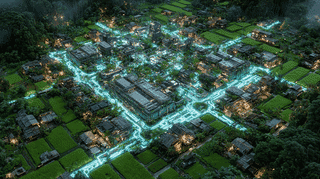
Why Aomori? The press release is short on detail, but the prefecture is not a random choice. Aomori already hosts the Mutsu-Ogawara industrial complex, a deep-water port that has handled LNG and could in principle handle imported liquid hydrogen or ammonia. The prefecture is also the home of Rokkasho, Japan's nuclear-fuel-cycle hub, meaning it has the heavy industrial infrastructure, grid connections, and political familiarity with large energy projects that newer sites lack.
Update after publication: on May 26 and 27, 2026, the Aomori daily To-o Nippo and broadcaster ABA reported that the leading candidate site is the Mutsu-Ogawara development district in Rokkasho, with construction expected to begin around 2030. Rokkasho mayor Takaharu Hashimoto said the village would watch developments closely and work with the prefecture, with residents' safety as the precondition.
For local communities, the project is a double-edged proposition. Aomori has wrestled for decades with hosting nuclear facilities other prefectures did not want. A hydrogen plant is not a reactor, but the local conversation about who bears the cost of national energy choices will be familiar.
The hydrogen-supply question Hoku has not yet answered
Here is where the Daiichi project moves from "exciting" to "to be determined."
A 106.6MW hydrogen plant running at high utilization needs serious volumes of hydrogen fuel, somewhere on the order of tens of thousands of tonnes per year. That hydrogen has to come from somewhere, and "somewhere" in Japan today does not exist at that scale. The Hokkaido green-hydrogen project led by Eneos, Idemitsu, and Hokkaido Electric is targeting only 10,000 tonnes per year by 2030, and that is meant to be the country's largest. Mitsubishi Power's Takasago Hydrogen Park, the leading R&D site, has a single 1,100 Nm³/hr electrolyzer: adequate for testing, not for supplying a 106.6MW plant.
The realistic answer is that Daiichi will run on imported hydrogen. Japan has signed supply-chain MOUs with Australia, the Middle East, and partners in Southeast Asia. Hoku's parent group has separately signed MOUs with Taiwan Fertilizer for a green-ammonia value chain, and with US-based Amogy on ammonia-to-power technology for data centers. The pieces of an import chain are starting to appear. The question is whether they will be commercially ready, at the cost target Japan has set (¥20/Nm³, or about US$0.13), by the time Daiichi is supposed to fire its first turbine.
What critics are saying
The Renewable Energy Institute, a Tokyo-based think tank that has been critical of Japan's hydrogen-and-ammonia push, argues that subsidizing hydrogen power generation under LTDA risks locking in high-cost fossil-fuel-derived hydrogen, what is sometimes called "grey" or "blue" hydrogen, for decades, while taking budget away from direct deployment of renewable generation that could decarbonize faster and cheaper. They are not alone in that critique internationally; the same argument has been made against blue-hydrogen heavy strategies in Europe and the US.
Supporters counter that Japan, unlike Europe, has limited domestic renewable resource and a grid that needs dispatchable carbon-free baseload to balance variable solar and offshore wind. Hydrogen plants like Daiichi, in this view, are not an alternative to renewables: they are the partner that keeps renewables from collapsing the grid on a windless winter night.
Both sides have a point. The bet Japan has just placed, via Hoku, is that this argument will look right in 2035.
What's next
There is a long road between an LTDA award and a running power plant. Hoku must now:
- Lock down a long-term hydrogen supply contract at workable cost
- Select turbine technology (MHI's H-25 class is the most obvious candidate at this scale, though others are possible)
- Complete environmental assessments and community engagement in Aomori
- Secure project financing, presumably leveraging the 40-year capacity payment as a credit anchor
- Build the plant on a schedule that delivers by the early-to-mid 2030s
Any one of those steps could slip. The LTDA program has even included a special provision for the 3rd round: if hydrogen or ammonia support frameworks fail to materialize at the expected level, winners can exit the market without the usual penalty. That clause is in there because the government knows the fuel-supply piece is still uncertain. A fourth round is scheduled for January 2027, with the eligible fuel narrowed to low-carbon hydrogen and ammonia and new pre-screening on things like expected Japanese equity participation.
What is settled, though, is the framework. Japan has now formally bet on hydrogen as something other than a future research project. There is a name on the contract, a megawatt figure, a prefecture, and a forty-year promise. Whether the bet pays off is going to be one of the most-watched stories in Asian energy policy for the rest of the decade.
What is your country doing on hydrogen power? Running toward it, sitting it out, or somewhere in between?
References
- https://prtimes.jp/main/html/rd/p/000000002.000183669.html
- https://hokuenergy.com/news/hoku-energys-daiichi-plant-selected-as-japans-first-new-build-100-hydrogen-power-project/
- https://www.occto.or.jp/various/capacity-market/jitsujukyukanren/2025_boshuyoukou_long.html
- https://www.meti.go.jp/shingikai/enecho/denryoku_gas/jisedai_kiban/system_review/pdf/103_03_03.pdf
- https://www.renewable-ei.org/activities/column/20250716.php
- https://www.powermag.com/mhi-mitsubishi-power-report-breakthroughs-for-hydrogen-combustion-ammonia-burners/
- https://gascompressionmagazine.com/2025/05/29/100-hydrogen-fueled-turbines-by-2028/
- https://enkiai.com/fuel-cells/lindes-hydrogen-dominance-2025-a-deep-dive-analysis
- https://www.hydrogeninsight.com/production/japanese-energy-companies-launch-the-countrys-largest-green-hydrogen-project/2-1-1602552






Global Discussion
5 comments