A Japanese chemical maker has moved into the Nordic green hydrogen market. Asahi Kasei's alkaline water electrolysis system has been picked for Finland's first commercial hydrogen refueling station, and installation is under way. How does a Japanese company take on an electrolyzer market where European players hold the top spots?
Asahi Kasei Begins Installing Its Hydrogen System in Finland
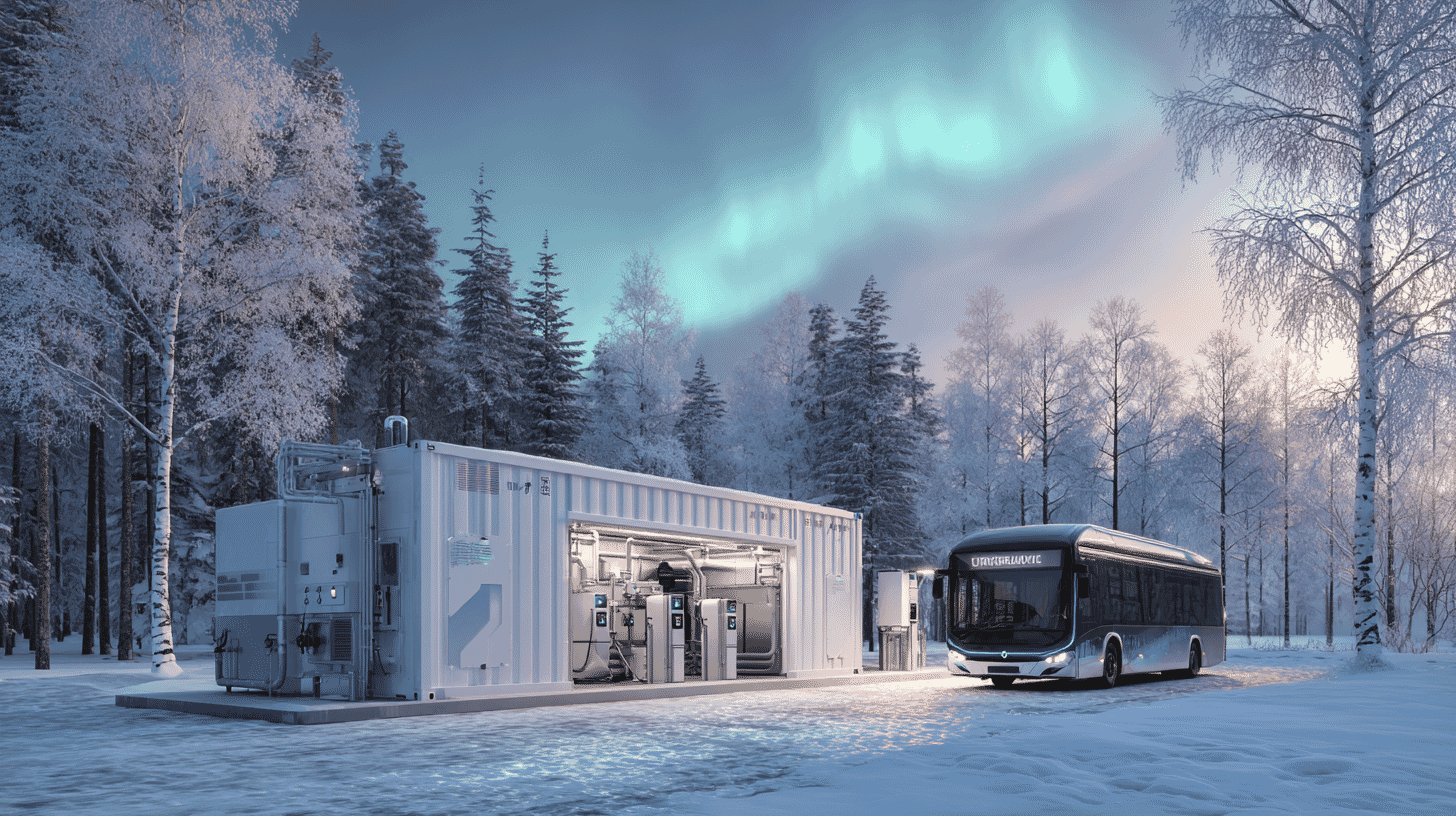
In March 2026, Asahi Kasei, one of Japan's largest chemical and materials companies, began installing its containerized alkaline water electrolyzer system, the "Aqualyzer C3," in Jyväskylä, a city in central Finland. The system splits water into hydrogen and oxygen using electricity. When powered by renewable energy, it produces "green hydrogen", hydrogen made without any carbon emissions.
The installation site is Finland's first commercial hydrogen refueling station, operated by a subsidiary of the Central Finland Mobility Foundation (Cefmof). This foundation was established by the City of Jyväskylä, TOYOTA GAZOO Racing World Rally Team, and the Toyota Mobility Foundation to promote decarbonization through hydrogen in central Finland.
Hydrogen production is expected to start around July 2026, with steady-state operations by year-end. At full capacity, the system will produce roughly 400 kg of hydrogen per day, enough to refuel about three fuel cell vehicles per hour.
What Is the Aqualyzer C3?
The Aqualyzer C3 is a containerized, plug-and-play electrolyzer system developed by Asahi Kasei. All the equipment needed for water electrolysis is packed inside standard shipping containers, making it relatively quick to install and easy to scale. The unit going into Jyväskylä is a 1 MW-class system, sized for smaller, distributed installations, with staged expansion in mind.
Asahi Kasei's electrolysis technology has deep roots. Since 1975, the company has been a global leader in chlor-alkali electrolysis, the process of splitting saltwater into caustic soda (sodium hydroxide) and chlorine using ion-exchange membranes. Over five decades, it has delivered 167 plants across 28 countries. The company adapted this membrane expertise to develop water electrolysis systems for hydrogen production.
In 2020, Asahi Kasei installed a massive 10 MW-class Aqualyzer at the Fukushima Hydrogen Energy Research Field (FH2R) in Namie, Fukushima, one of the world's largest alkaline water electrolysis demonstration facilities. The Aqualyzer C3, launched in 2024 in collaboration with Italian electrode manufacturer De Nora, is the smaller, more portable sibling designed for hydrogen stations and smaller-scale operations.
Why Finland? The Nordic Hydrogen Opportunity
Finland, as an EU member state, is committed to ambitious climate goals under the European Green Deal, targeting carbon neutrality by 2035. Yet as of 2024, Finland had zero operational hydrogen refueling stations, a gap that this project aims to fill.
There is a further reason Finland makes sense. According to a JETRO survey, renewables (56.3%) and nuclear (39.1%) together supply 95% of Finnish electricity, so the carbon intensity of the grid is very low. That exempts projects there from the EU's "additionality" requirement for certified green hydrogen, a lower bar than in most member states, and grid connections and permits move quickly.
Jyväskylä has set its own target of achieving carbon neutrality by 2030. In 2025 it became the first city in Finland to put fuel cell buses into public transit. The buses are built by Portugal's Caetano Bus, in which Mitsui & Co. holds a stake and to which Toyota supplies the fuel cells. The point of the exercise is to accumulate operating data on hydrogen infrastructure and fuel cell vehicles through a hard Nordic winter.
The Toyota connection is notable. TOYOTA GAZOO Racing competes in the World Rally Championship (WRC) in Finland each year, and that motorsport relationship has evolved into a broader decarbonization partnership. For Asahi Kasei, this is the first commercial order since launching its electrolyzer business, making it a critical beachhead for European market expansion.
A Market Dominated by European Giants
The global electrolyzer market is one of the fastest-growing sectors in clean energy. Valued at roughly $860 million in 2024, it is projected to surge past $8 billion by 2032, growing at over 30% annually.
The market is currently dominated by European and American companies. Norway's Nel ASA leads with approximately 17% market share, followed by Germany's Thyssenkrupp Nucera and Siemens Energy, Belgium's John Cockerill, and America's Plug Power. Together, the top six companies control more than 60% of the global market. Alkaline electrolyzers, the type Asahi Kasei produces, account for about 49% of installed capacity, making them the most widely deployed technology.
Against this backdrop, Asahi Kasei enters as a latecomer. But it brings unique strengths: five decades of membrane electrolysis expertise, a proven track record at the Fukushima demonstration site, and the ability to offer both small-scale containerized systems and large-scale industrial solutions. The company aims to reach ¥100 billion (approximately $650 million) in electrolyzer sales by around 2030, with projects spanning Asia and Europe, including a 60 MW demonstration with Malaysia's Petronas group planned for 2027–2030.
Japan's Hydrogen Strategy: Exporting the "How," Not Just the Fuel
Japan was the first country in the world to adopt a national hydrogen strategy back in 2017, and many nations followed suit. The revised 2023 strategy outlines ¥15 trillion (about $100 billion) in combined public and private investment, covering everything from production to transport, storage, and end use.
However, Japan faces a structural paradox: it is a hydrogen technology leader but has limited domestic renewable energy potential for large-scale green hydrogen production. This means Japan will likely need to import much of its hydrogen supply.
But there is a flip side to this challenge. While Japan may not become a major hydrogen producer, it can be a major exporter of hydrogen equipment and technology. Asahi Kasei's electrolyzers, Toyota's fuel cell vehicles, and Panasonic's residential fuel cell systems (known as "Ene-Farm" in Japan) represent different links in a hydrogen value chain where Japanese companies hold world-class capabilities.
The Finland project embodies this "export the tools, not just the fuel" strategy. By placing its equipment in a high-profile Nordic project, Asahi Kasei gains real-world operational data in European conditions, data that will be invaluable for securing future orders.
Challenges Ahead
The road won't be easy. Asahi Kasei's electrolyzer business is still in its early commercial phase, with far fewer installations than established European rivals. Nel ASA and Siemens Energy are working on projects measured in hundreds of megawatts, with plans to scale manufacturing to gigawatt levels. Chinese manufacturers have also surged ahead, with annual production capacity exceeding 2.5 GW and aggressive cost competitiveness.
Green hydrogen itself remains more expensive than fossil fuel-derived hydrogen, and market growth depends heavily on government subsidies, the U.S. Inflation Reduction Act, the EU Hydrogen Strategy, and China's Five-Year Plan all shape demand. Policy shifts could accelerate or stall the market overnight.
Still, the start of installation in Finland is an unambiguous milestone. If Asahi Kasei can demonstrate reliable, efficient operation in Nordic conditions, it could open doors across Europe's rapidly expanding hydrogen infrastructure. After five decades of perfecting electrolysis membranes in the chlor-alkali industry, Japan's chemical sector is betting that the same fundamental chemistry can power the next energy revolution.
In Japan, hydrogen has long been called "the fuel of the future", and now Japanese-made systems are actually starting to operate overseas. Is hydrogen energy being used in your country? Have you ever seen a hydrogen refueling station? We'd love to hear your perspective.
References
- https://prtimes.jp/main/html/rd/p/000000240.000079452.html
- https://www.asahi-kasei.com/news/2025/e250730.html
- https://cefmof.org/finlands-newest-and-only-h2-refueling-station-to-be-built-in-jyvaskyla/
- https://ak-green-solution.com/
- https://toyotamobilityfoundation.org/en/press-room/pressrelease09272024/




Global Discussion
15 comments