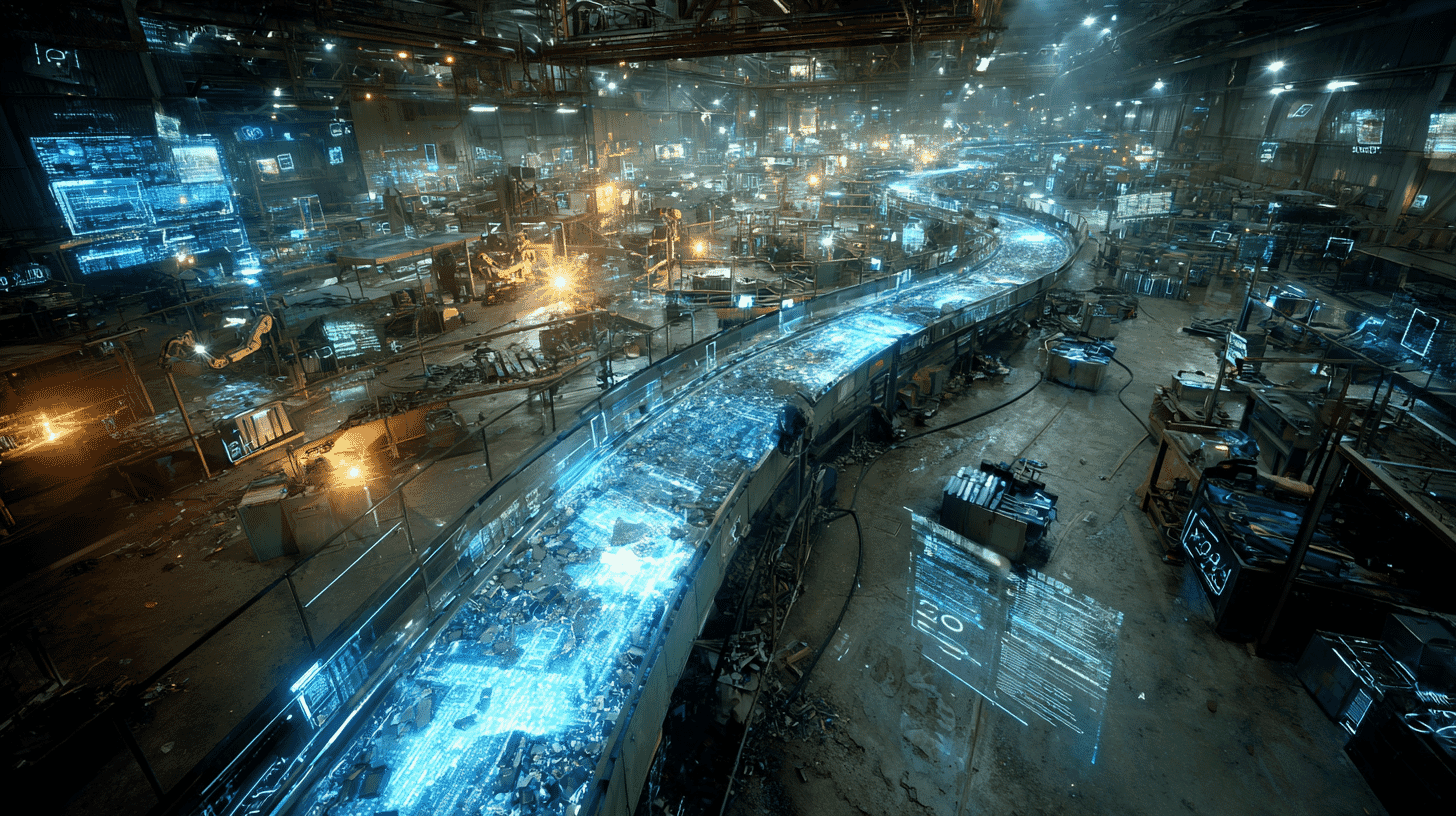
That old smartphone in your drawer might be worth more than you think. Japan's homes and businesses are sitting on an estimated 6,800 tons of gold, 60,000 tons of silver, and vast quantities of rare metals, equivalent to 16–22% of global reserves. Now a three-way race between Japanese, American, and Chinese companies is turning this "urban mine" into a real business.
Itochu Launches Joint Venture with America's Largest E-Recycler
On March 24, 2026, Japanese trading giant Itochu Corporation announced a capital and business alliance with Electronic Recyclers International (ERI), the largest electronic device recycler in the United States. Itochu's wholly-owned subsidiary Belong, which handles used smartphone sales, and ERI will each hold a 50% stake in a new Japanese entity called "ERI Japan," set to launch in April 2026. Itochu also plans to invest in ERI's US operations.
Founded in 2002, ERI operates eight facilities across the US and has recycled over one million tons of IT equipment. Its competitive edge lies in AI-powered image recognition and robotic sorting, plus a proprietary platform called "Optech" that provides full traceability of every step in the recycling process.
Belong CEO Koichiro Nishimura will head ERI Japan. The company plans to leverage Belong's existing smartphone collection network and Itochu Group's metal trading channels, expanding collection targets to include large enterprise IT equipment like servers.
Why Urban Mining, Why Now?
Japan's urban mine is staggeringly rich. According to the National Institute for Materials Science, the country holds approximately 6,800 tons of gold (about 16% of global reserves) and 60,000 tons of silver (roughly 22%). Indium reserves represent about 61% of the world total, and tantalum about 10%, all locked inside discarded electronics.
Yet only about 20% of domestic IT devices are currently collected for recycling. A single smartphone contains roughly $0.70 worth of rare metals, making manual disassembly economically unviable. This cost barrier has kept Japan's urban mine largely untapped for decades.
Three converging forces are now changing the equation. Gold prices have surged since 2025, rare metals have become geopolitically critical, and advances in AI and robotics are finally making automated recovery commercially feasible.
China's Lithium Giants Eye Japan's E-Waste
Itochu isn't the only player circling Japan's urban mine. Chinese companies are also showing growing interest.
Ganfeng Lithium, China's largest lithium compound manufacturer, operates a vertically integrated business spanning upstream mining, battery production, and recycling. The company has plans to build facilities capable of processing 100,000 tons of spent lithium batteries annually, making it an aggressive player in the global resource circulation space.
Japan is expected to see a sharp increase in end-of-life EV batteries in the coming years, containing valuable cobalt, nickel, and lithium. For Chinese recyclers, this represents an attractive "ore deposit." According to Nikkei Tech Foresight reporting, Chinese firms' interest in Japan's urban mines is intensifying, raising concerns about resource outflow from the country.
Domestic Players Join the Rush
The Itochu-ERI venture is part of a larger trend sweeping Japan's recycling industry.
Dr. Tatsuya Oki of the National Institute of Advanced Industrial Science and Technology (AIST) spent over 30 years developing the world's first fully automated rare metal recovery unit, combining AI detection with air-based physical separation. Testing began in September 2025 at a facility in Osaka, with commercial operations targeted for 2028.
Major non-ferrous metals company DOWA Holdings recovers over 20 types of metals from circuit boards at its Kosaka mine in Akita Prefecture. Tanaka Kikinzoku Kogyo is expanding processing capacity on the back of soaring gold prices. Asaka Riken is pursuing "LiB to LiB" full-circle recycling of spent lithium-ion batteries using proprietary solvent extraction technology.
Japan's November 2025 enactment of the Advanced Recycling Business Act has further boosted demand for recyclers with both high-tech capabilities and robust data security. The IT device processing market is projected to grow significantly through 2029, a genuine gold rush is underway.
Policy Tailwind: Tokyo Foundation's "$87 Billion Treasure" Proposal
The business momentum is being matched by policy action.
On March 31, 2026, the Tokyo Foundation for Policy Research presented a policy proposal titled "The $87 Billion Treasure Trove: Recommendations for Active Utilization" to Economy Minister Ryosei Akazawa. The proposal highlights that Japan loses trillions of yen annually through mineral imports and calls for a "Basic Act on Domestic Resource Utilization" to prioritize urban mine exploitation.
The proposal also recommends creating a "Japanese mega-recycler", modeled after the large-scale waste processing companies that drive Europe's circular economy. The Itochu-ERI joint venture appears to be a real-world preview of exactly this concept.
Minister Akazawa responded positively, stating he would "work to incorporate the proposal into the growth strategy and basic policy framework." This marks a significant shift: the recycling promotion goals set after the 2010 rare earth crisis went largely unmet for 15 years. The Tokyo Foundation proposal frankly acknowledges that failure and pushes for structural reforms through legislation, industry development, and international cooperation.
The Core Issue: Domestic Circulation vs. Resource Outflow
ERI Japan's Nishimura has stated clearly that all recovered resources will be kept within Japan. This is a critical point from an economic security perspective.
Currently, some of Japan's discarded electronics flow overseas as secondhand goods or scrap, taking their embedded rare metals with them. Chinese companies' interest in Japan's urban mines is partly driven by a desire to channel these resource flows into their own supply chains.
The Japanese government is expanding the scope of the Small Appliance Recycling Act and working toward mandating rare metal recovery from EV batteries. The Ministry of Economy, Trade and Industry has secured approximately $200 million in funding over three years starting 2024 for domestic recycling infrastructure.
But regulation and funding alone aren't enough. The commercial sector needs to build actual collection networks and profitable business models. The entry of a major trading house like Itochu fills precisely this gap.
Japan's Choices Will Reshape the Global Resource Map
Urban mining is not just a Japanese issue. The International Energy Agency projects that lithium demand will increase roughly 13-fold by 2040, while cobalt demand will more than sextuple. Natural mines alone cannot meet this surge, how effectively nations recycle will determine who controls tomorrow's supply chains.
If Japan can establish a commercially viable urban mining model, it becomes a template for the world. If it fails to build collection and circulation systems despite sitting on rich reserves, its rare metals will continue flowing into foreign hands.
The simultaneous launch of the Itochu-ERI venture, AIST's automated recovery technology approaching commercialization, and the Tokyo Foundation's policy proposal is no coincidence. Japan's race to transform from a "resource-poor nation" into a "resource-circulating nation" has officially begun.
How does your country handle discarded electronics? Are there urban mining initiatives where you live? Share your perspective, we'd love to hear how this issue looks from your part of the world.
References
- https://www.businessinsider.jp/article/2603-itochu-recycle-business/
- https://www.tkfd.or.jp/research/detail.php?id=4824
- https://prtimes.jp/main/html/rd/p/000000065.000056667.html
- https://www.meti.go.jp/speeches/kaiken/2025/20260109001.html
- https://kantenna.com/topic/urban-mining-rare-metal-automated-recycling-japan-2025








Global Discussion
14 comments