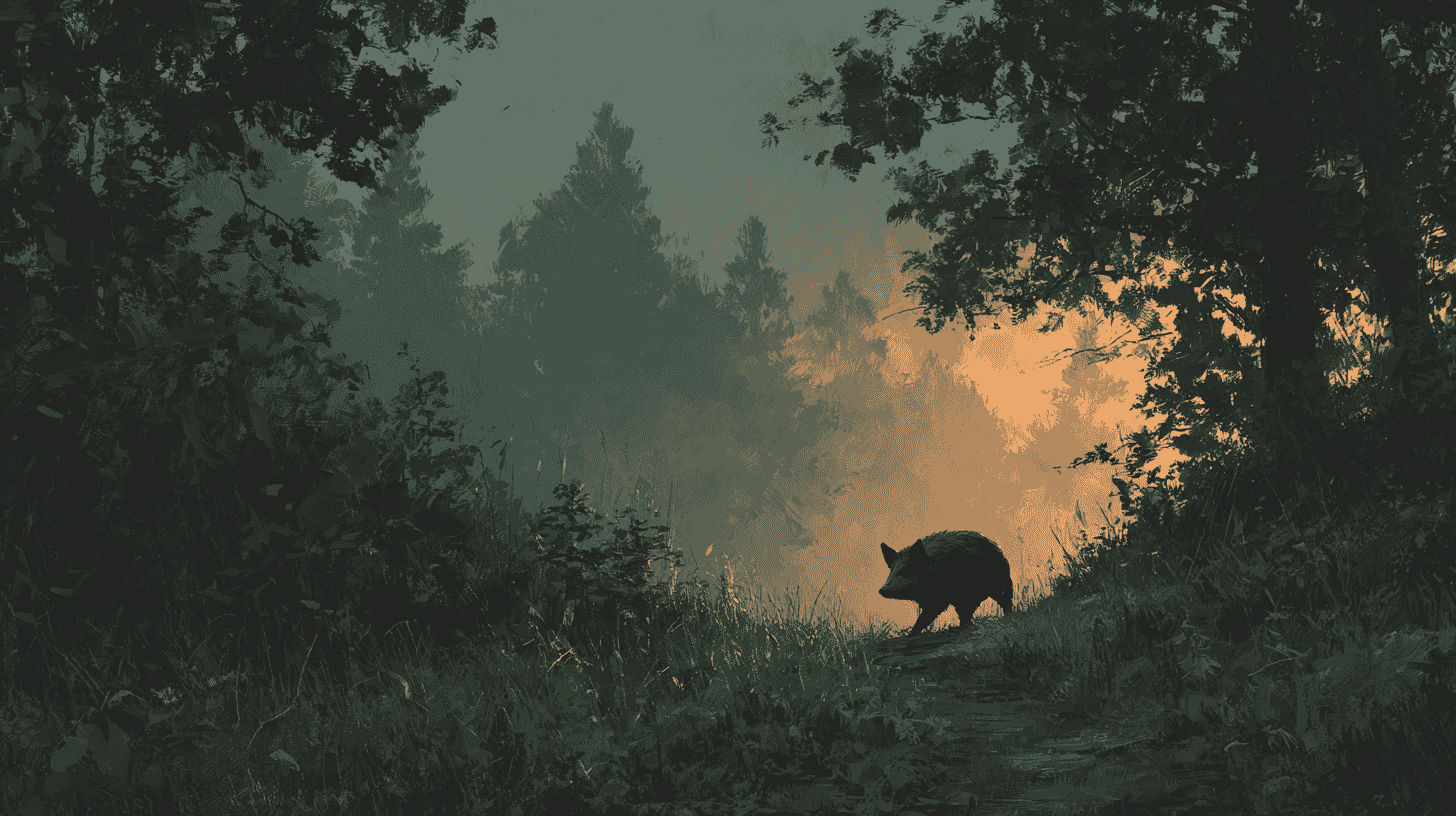
🐗 The wild boar crashing through a Japanese hillside looks like the definition of "wild." But hidden in its family tree is something you'd never guess: a farm animal that ran away from home more than 2,000 years ago. A study out of Nagoya University reads that twist off a pile of ancient jawbones, and it turns out to be a story playing out again right now, half a world away.
A farm animal on the loose
Start with the biology, because it's the fun part. A pig is just a wild boar that humans domesticated. They're the same species, Sus scrofa, close enough to interbreed and produce fertile offspring. Left to its own devices, a pig doesn't stay a "pig" in any pure sense for long.
In Japan, the timeline goes like this. During the Jomon period, people hunted native wild boars. Then, in the Yayoi period, farmers brought domestic pigs over from the Chinese mainland and began raising them. At Yayoi sites like Asahi in Aichi Prefecture and Shimogōrikuwanae in Ōita, archaeologists have already shown that pig-keeping and boar-hunting went on side by side.
The archipelago did not move as one, though. Niimi's own earlier work has established pig-keeping on Okinawa's main island from 7,200 years ago and in the Yaeyama Islands from roughly 4,000 years ago, far earlier than the Yayoi period on Honshu and Kyushu.
What Associate Professor Michiko Niimi of the Nagoya University Museum, working with Ritsuo Uchida, formerly of Shimane's archaeological research center, wanted to know was whether the same thing happened out west, in the San'in region. Their evidence: boar and pig jawbones dug up at the Nishikawazu site in Matsue, Shimane, dating to the Yayoi period. The paper, "Wild Boars and Pigs Excavated from the Nishikawazu Site," ran in volume 43 of the journal of the Shimane Archaeological Society and was presented at the society's general meeting on June 20, 2026.
Reading a jawbone like a detective
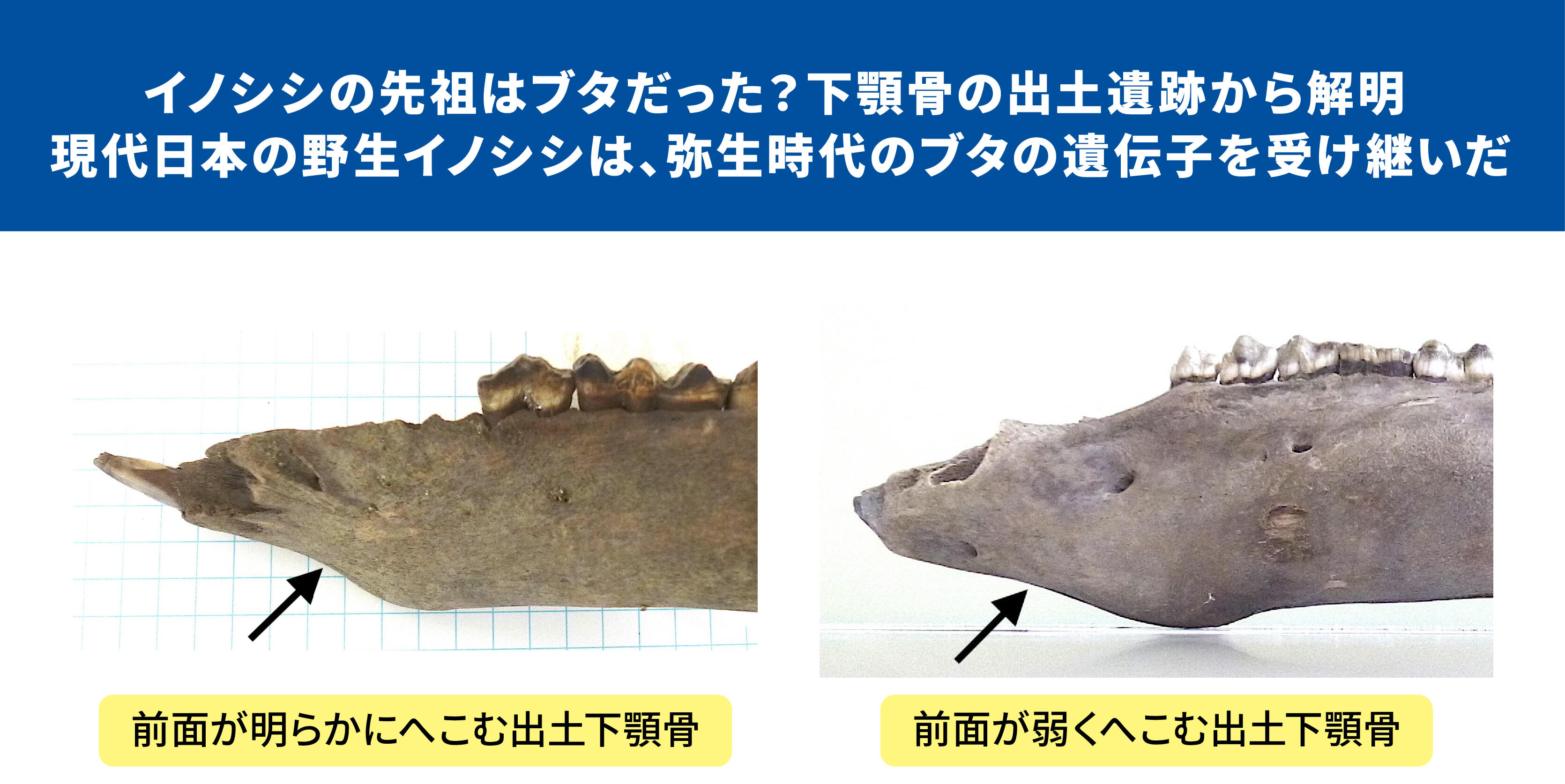
The clever part is this: you don't need a DNA lab to tell a domestic pig from a wild boar. When boars are bred into pigs, their skulls and jaws get shorter front-to-back, and that reshaping leaves marks. The front of the lower jaw caves inward, and the angle at which it rises gets steeper.
Of the 93 jawbones from Nishikawazu, 26 were preserved well enough to check the front face. Of those, 18 showed the tell-tale concave front, and another 4 had the steeper rising angle. That's 22 out of 26, more than eight in ten, carrying the signature of domestication. So most of these animals were domestic pigs, or their descendants.
Source: Nagoya University press release
The bones tell a second story through age. On a farm, animals get slaughtered young, once they've put on enough meat, so a bone pile from a farm skews toward juveniles. The researchers could age 45 of the jawbones by looking at how the molars had come in. The split: 12 piglets under about six months (27%), 19 young animals up to roughly three years (42%), and 14 fully grown adults (31%). That youthful skew matches other known pig-farming sites. But at Nishikawazu the young-animal share was a bit lower than at those sites, which suggests the people here were raising pigs and still hunting a fair number of wild boars on the side. That balance may be a local quirk of the San'in region.
Then came the chemistry. On three of the pig-shaped jawbones, the team measured carbon and nitrogen stable isotopes, which record what an animal ate. One sample showed a high nitrogen value; the other two came back low. A high value points to an animal eating human food scraps, meaning it was being fed and kept. Low values point to a diet foraged in the wild. In other words, some animals that looked like pigs by their bones had been living wild.
The pigs that melted back into the woods
That last detail is the hinge of the whole story. If an animal has the body of a domestic pig but the diet of a wild one, the simplest explanation is that the pigs at Nishikawazu weren't penned very tightly. Some escaped, went feral, and bred with the native wild boars already living in those hills.
Do that for a few centuries and the math takes over. Genes from those mainland pigs spread through the local boar population until you could no longer cleanly separate "escaped livestock" from "native wildlife." By the Yayoi period, the researchers argue, genes of Chinese-mainland pig origin had already seeped widely into Japan's wild boar populations. And since today's Japanese wild boars descend from those animals, they likely still carry a whisper of Yayoi-era pig in them.
A caution worth keeping: this study didn't sequence any DNA. The conclusion rests on bone shape, age structure, and diet chemistry, read together against what we already know about how domestication works. "Modern boars carry ancient pig genes" is an inference drawn from that evidence, not a genome someone read off directly. It's also one site in one region, not a verdict on the whole country.
A story that travels
This ancient San'in tale should feel oddly familiar anywhere, because the exact same thing is unfolding right now across much of the world.
In the United States, genetic work by the Department of Agriculture has found that roughly 97% of invasive wild pigs are hybrids of escaped domestic pigs and wild boar. They are now reported in at least 35 states. In Brazil, boars that crossed in from Uruguay in the 1990s went invasive fast and have been hunted as pests ever since. In Australia, feral pigs are a full-blown ecological crisis. In every case the recipe is identical to the one at Nishikawazu: a farmed pig gets loose, goes wild, and quietly rewrites what "wild" even means.
Japan has a live example of its own. After the 2011 Fukushima Daiichi accident emptied the surrounding towns, domestic pigs left behind escaped into abandoned farmland and forest and interbred with the native wild boars. A genetic study published in the Journal of Forest Research in 2026 treats the zone as a rare natural experiment, with no repeated introductions and almost no human activity. What happened at Yayoi-era Nishikawazu ran again, two thousand years later, in Fukushima.
The Nagoya team frames their find as an early instance of a pattern that recurs wherever domestic pigs arrive in a land that only had wild boars, from ancient Japan to a Texas ranch. A single Yayoi village, it turns out, was already describing something still very much in progress.
So next time you picture a "wild" animal, it's worth asking how wild it really is. In your part of the world, is there a "wild" species whose roots trace back to something that once lived on a farm?





Global Discussion
3 comments