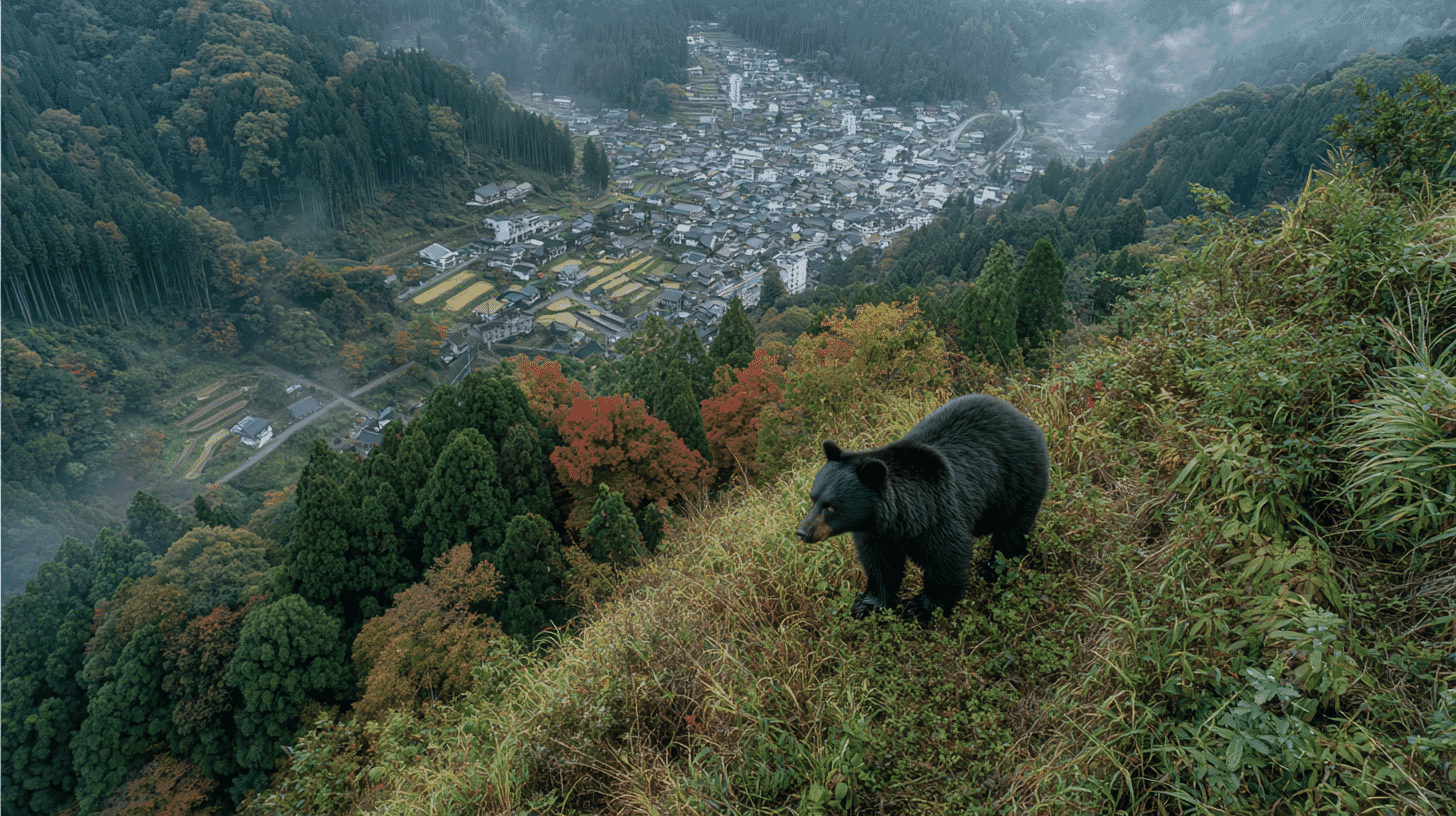
In fiscal year 2025, bear attacks in Japan reached a record 238 victims with 13 fatalities, the worst numbers since tracking began. In response, the Ministry of Environment has overhauled its bear management guidelines, marking a historic shift from "protection" to "population control." What is the new zoning system, and how does it compare with bear management worldwide?
Record-Breaking Casualties Force a Policy Rethink
Japan's bear crisis hit an unprecedented scale in fiscal year 2025 (April 2025–February 2026). Across the country, 238 people were injured or killed in bear encounters, including 13 fatalities. Both figures shatter the previous record set in FY2023 (219 victims, 6 deaths), with the death toll more than doubling.
The Tohoku region in northeastern Japan bore the brunt: Akita Prefecture alone reported 67 victims, followed by Iwate (40) and Fukushima (24). The six Tohoku prefectures accounted for over 60% of all casualties. October was the deadliest month with 89 victims, as bears became hyperactive before winter hibernation.
Sighting reports for FY2025 also hit an all-time high of 50,776 nationwide (preliminary figure), roughly 2.5 times the previous year's total of 20,513. Experts point to a severe acorn shortage (from beech and oak trees), the collapse of rural buffer zones due to depopulation, and a steady expansion of bear populations and ranges.
The Heart of the Reform: From "Protection" to "Management"
On April 3, 2026, the Ministry of Environment published its revised "Guidelines for Formulating Specified Wildlife Protection and Management Plans (Bear Edition)", the first major overhaul in approximately four years, incorporating around 450 public comments.
The most significant change is philosophical. Previous guidelines prioritized "maintaining or increasing" bear populations, a conservation-oriented approach. The new guidelines shift to "maintaining or reducing" populations, a management-oriented approach. While the long-term survival of regional bear populations remains a baseline requirement, the policy now explicitly aims to bring overgrown populations down to appropriate levels using science-based methods.
The New Zoning Framework
The centerpiece of the revised guidelines is a strengthened zoning system. Building on the previous four-zone model (core habitat, buffer zone, prevention area, exclusion area), the revision adds a critical new category: the "Enhanced Management Area."
Exclusion Area (expanded): Covers urban areas and farmland. Bears entering this zone are classified as "problem individuals" and are, in principle, subject to lethal removal. The revision significantly expands this zone's boundaries.
Enhanced Management Area (new): Established around the perimeter of exclusion areas. Intensive measures, active trapping, brush clearing, electric fencing, aim to prevent bears from settling or pushing into human zones. This area essentially recreates the buffer function that satoyama (traditional semi-rural landscapes) once provided naturally, before rural depopulation caused their collapse.
Buffer Zone: Positioned between bear habitat and human areas for monitoring and controlled responses.
Core Habitat: Deep mountain areas where bears primarily live, managed for conservation with ongoing monitoring.
Each prefecture will incorporate this framework into its own management plan, with periodic reviews based on changes in land use and bear behavior.
Government Roadmap: Targets for 2030
In November 2025, the government released a "Bear Damage Countermeasure Package" with a roadmap extending to 2030. Key targets include achieving 100% emergency response readiness in all municipalities with permanent bear populations, clarifying estimated population sizes and annual harvest targets for every bear population unit, and ensuring all relevant municipalities have adopted zoning management plans.
For the Tohoku, Kanto, and Chubu regions, provisional harvest targets are set at roughly 20% of estimated populations, the natural growth rate of 14.5% plus an additional 5%, aimed at actively reducing numbers. Hokkaido has a separate 10-year target of 12,540 Hokkaido brown bears (Ezo brown bears) from 2025 to 2034.
The September 2025 revision of the Wildlife Protection and Management Act also introduced an "emergency firearms" system, allowing municipal leaders to authorize shooting when bears appear in urban areas. A new government program to fund "Government Hunters", municipal employees with hunting licenses, is also underway, with a target of 2,500 personnel (roughly triple the current number).
WWF Japan's Perspective: The "Landscape Approach"
WWF Japan acknowledges the necessity of emergency culling but argues that reducing bear numbers alone will not solve the problem.
The organization advocates a "Landscape Approach", rather than managing farmland, residential areas, forests, and rivers separately, they should be planned as an integrated whole. This means designing the long-term spatial arrangement of where humans live and where bears roam, coordinated with urban planning and land use strategy.
Specifically, WWF Japan calls for comprehensive land use planning in depopulating mountainous areas, addressing what happens to abandoned farmland and degraded forests, and connecting bear management to broader biodiversity goals.
They also highlight that deer overpopulation is degrading forest vegetation that bears depend on for food, and that climate change may be disrupting the fruiting cycles of beech trees, the primary food source for bears in autumn. The bear problem, WWF argues, is an ecosystem-wide challenge, not a single-species issue.
How Does Japan Compare with Global Bear Management?
North America: The United States is home to an estimated 300,000+ black bears and around 55,000 grizzlies. States operate independent management plans combining regulated hunting seasons, problem-animal removal, and strict food storage regulations. Yellowstone National Park has established a behavioral approach focused on human responsibility, bear spray is strongly recommended, and bear-proof food containers (bear canisters) are mandatory in backcountry camping.
Europe: Many European countries are actively reintroducing large predators that were previously exterminated. France's Pyrenees and Italy's Alps have ongoing brown bear reintroduction programs, though conflicts with livestock farmers are intense. Romania hosts Europe's largest brown bear population (over 6,000 estimated), with urban encounters becoming a growing concern. Scandinavia (Sweden, Finland) permits regulated hunting for population control, paired with scientific monitoring programs.
Japan's unique challenge: Japan's situation differs in critical ways. Roughly two-thirds of the country is forested, placing bear habitat extremely close to human settlements. Rural depopulation has destroyed the satoyama buffer zones that historically kept bears away from towns. And the hunting workforce is aging rapidly, the average age of licensed hunters in Japan exceeds 60. Unlike North America, where vast national parks can physically separate bears from people, Japan must find ways to coexist within a much tighter geographic footprint. The zoning approach is essentially Japan's answer to this uniquely compressed landscape.
Why Are Bears Coming to Town?
Multiple factors drive bears into human areas:
Acorn failures. When beech and oak trees produce poor crops, a cycle that climate change may be worsening, bears expand their range in search of food.
Rural collapse. As elderly residents leave mountain villages, abandoned farms and untended fruit trees (persimmons, chestnuts) become powerful bear attractants. The satoyama areas that once buffered mountain and lowland zones have lost their human presence.
Population expansion. Bear numbers and ranges have increased across most of Japan (except Shikoku), pushing animals into unfamiliar territory.
Habituation. A growing generation of bears shows little fear of humans, making traditional "chasing away" tactics less effective.
Challenges Ahead
The guideline revision is a meaningful step, but implementation challenges are significant.
Effective zoning requires each municipality to develop detailed plans suited to local conditions, backed by continuous monitoring. For financially strained rural governments, hiring wildlife specialists and conducting scientific surveys is a tall order.
The hunter shortage is equally pressing. The government aims to triple the number of municipal Government Hunters to 2,500, but building that workforce takes years.
And as WWF Japan notes, the guidelines do not fully address the degradation of bear habitat itself, neglected plantation forests, oak die-off from pathogens, and mountain ecosystems disrupted by large-scale solar and wind energy projects.
Japan is now rethinking its entire relationship with bears, moving beyond the "kill or protect" binary toward science-based zoning and coexistence planning. How does your country manage bears or other large wildlife? What policies or cultural attitudes shape human-wildlife relations where you live? We'd love to hear your perspective.








Global Discussion
14 comments